




The Bond Market Offered No Safe Harbor Last Week. Why a Diversified ETF Strategy Still Beats Trying to Time the Market.
Key Points
2022 taught us that owning bonds as a risk hedge against stocks is no longer enough.
Elevated inflation, rising debt levels, and monetary policy are all reasons why investors need to diversify beyond just stocks and bonds.
Investors should consider adding gold, Bitcoin, and real estate to their portfolios to handle a wider variety of economic conditions.
- 10 stocks we like better than iShares Trust - iShares Core U.s. Aggregate Bond ETF ›
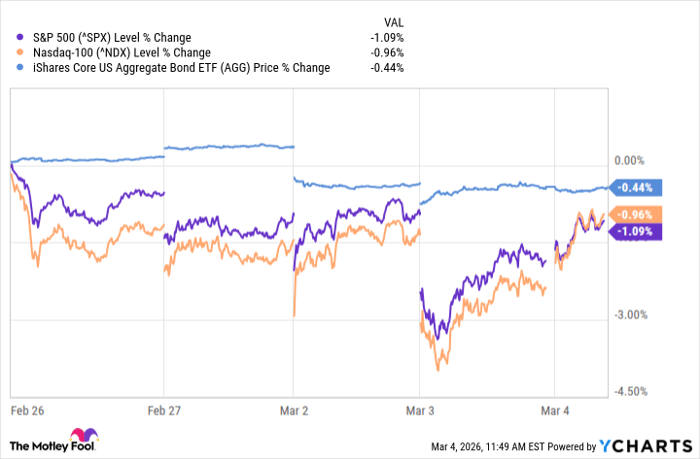
Last week, the conflict in Iran helped spike equity market volatility and send U.S. stock prices lower. Sentiment had already been weakening in the lead-up, but the strikes themselves sent the S&P 500 (SNPINDEX: ^GSPC) and Nasdaq-100 indexes sharply lower. They've recovered somewhat since then, but investors are still working to try to figure out the ultimate impact of this to the markets and the economy.
In situations like this, investors often turn to bonds for a measure of safety and stability. In most cases, bonds are expected to offset stock market risk and cushion downside. But look at what has happened over the past several trading days.
Will AI create the world's first trillionaire? Our team just released a report on the one little-known company, called an "Indispensable Monopoly" providing the critical technology Nvidia and Intel both need. Continue »
^SPX data by YCharts
Even though stock prices fell, the iShares Core U.S. Aggregate Bond ETF (NYSEMKT: AGG), a fund that contains Treasuries, investment-grade corporate bonds, and mortgage-backed securities, fell too. When investors needed portfolio protection, bonds didn't provide it.
Lessons from the 2022 bear market
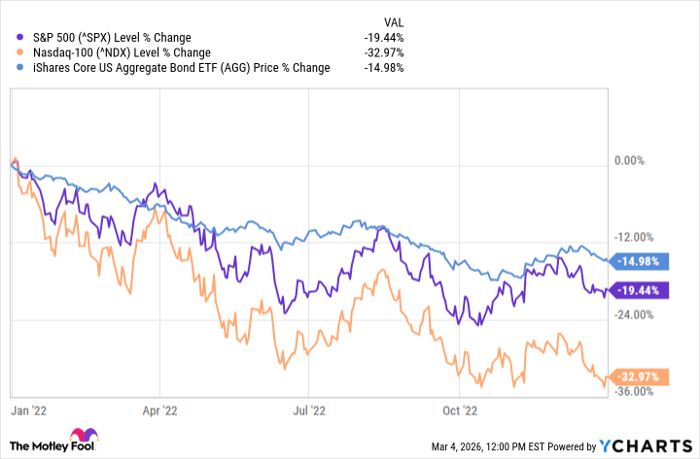
Bonds don't always work as a risk-off asset. Lately, in fact, they've done a pretty poor job. 2022 was one of the worst years ever for both stocks and bonds at the same time.
^SPX data by YCharts
Expecting bonds to deliver gains whenever stocks fall ignores the important fact that every situation is unique. In 2022, bonds were losers because the Fed needed to raise rates aggressively to get inflation under control.
Bonds are unlikely to work in every situation, which is why owning a diversified portfolio of asset classes that behave differently in different situations is the better plan.

Image source: Getty Images.
Understanding how asset classes correlate with each other
In most cases, the major asset classes, such as stocks, bonds, gold, and real estate, have a positive correlation with each other. That means, in general, they move up and down together. The big differentiator is the degree to which they move together.
Most categories of stocks -- large caps, small caps, international stocks, emerging markets, etc. -- tend to have pretty high correlations. While there are differences between them, they're fundamentally still stocks. That means they're far more similar than different.
Real estate is a bit different. Real estate investment trusts (REITs) generally trade like stocks, but they're often less correlated. Instead of investing in companies, they invest in various types of properties, making them a little more unique.
The biggest diversification benefits come from non-stock asset classes.
Bonds have a low but positive correlation with stocks. For as much as we might think they move in opposite directions, they often move in similar directions, too. That low correlation factor, however, means they're still ideal partners for creating a diversified portfolio. Even with a long-term positive correlation, they can still help smooth out volatility and downside risk when paired together.
Gold is perhaps the best diversifier of the bunch. Historically, its correlation to stocks is close to zero. That means it may go up or down regardless of what's happening with stocks. It's the one asset class that pretty much does its own thing.
Ideas for a diversified portfolio
I believe that stocks and bonds make for an ideal core for a diversified portfolio, but they should not be considered the only two asset classes for a portfolio. There are too many unique factors, such as inflation, monetary policy, and government debt, to take into account to not at least consider other asset classes.
The first asset class to add to a stock/bond core is probably gold. And that's not just because of recent performance. Gold has perhaps the best ability to reduce overall portfolio risk through diversification. It also tends to perform better when inflation is elevated or there are concerns about the strength of the dollar. The latter has been the biggest driver in the recent rally.
Bitcoin is probably the next asset class to consider adding. Its investment case as a legitimate dollar alternative hasn't really come true and it behaves more like a growth stock than anything. But it's more gold-like in its diversification potential and that means it's still suited toward helping in different economic environments.
Overall, you can't boil the markets down to a simple question of "should I be in or should I get out?" We've learned several times recently that the markets can react to conditions in a variety of ways. Owning several different asset classes and diversifying your portfolio is the best way to position it to handle a variety of scenarios.
Should you buy stock in iShares Trust - iShares Core U.s. Aggregate Bond ETF right now?
Before you buy stock in iShares Trust - iShares Core U.s. Aggregate Bond ETF, consider this:
The Motley Fool Stock Advisor analyst team just identified what they believe are the 10 best stocks for investors to buy now… and iShares Trust - iShares Core U.s. Aggregate Bond ETF wasn’t one of them. The 10 stocks that made the cut could produce monster returns in the coming years.
Consider when Netflix made this list on December 17, 2004... if you invested $1,000 at the time of our recommendation, you’d have $534,008!* Or when Nvidia made this list on April 15, 2005... if you invested $1,000 at the time of our recommendation, you’d have $1,090,073!*
Now, it’s worth noting Stock Advisor’s total average return is 949% — a market-crushing outperformance compared to 190% for the S&P 500. Don't miss the latest top 10 list, available with Stock Advisor, and join an investing community built by individual investors for individual investors.
See the 10 stocks »
*Stock Advisor returns as of March 9, 2026.
David Dierking has no position in any of the stocks mentioned. The Motley Fool has positions in and recommends Bitcoin. The Motley Fool has a disclosure policy.
Recommended Articles


