




This Overlooked Vanguard ETF Could Quietly Outperform the S&P 500 Over the Next 5 Years
Key Points
The U.S. equity market has been dominated by mega-cap growth and tech for the past several years.
As concerns grow about tech valuations and the direction of the U.S. economy, another group is looking like it might take the lead.
This Vanguard ETF combines attractive valuations and the tailwind from easing tariff policies.
- 10 stocks we like better than Vanguard Index Funds - Vanguard Extended Market ETF ›
The last three years (and most of the last decade, really) have been dominated by U.S. large caps. Much of that growth has come from a narrow group of mega-cap tech stocks. The artificial intelligence (AI) revolution and the massive investments being made into its development have resulted in big revenue and earnings growth, making this one of the market's most successful groups.
But there's been a big shift in 2026. The market has begun focusing on sectors that will be harmed by the emergence of AI and questioning whether the hundreds of billions of dollars being spent will yield an adequate return on investment. That has caused a major rotation away from tech and into previously unloved areas of the market, including value, dividend, and defensive stocks.
Will AI create the world's first trillionaire? Our team just released a report on the one little-known company, called an "Indispensable Monopoly" providing the critical technology Nvidia and Intel both need. Continue »
We're also seeing big outperformance from small company stocks, too. While these companies are generally viewed as more speculative and riskier, there has been so much value built up in them that they've also become a natural landing spot in the current market rotation.

Image source: Getty Images.
With the global tariff environment now looking more favorable for smaller companies since the recent Supreme Court decision and the fact that they're trading at such a discount to large caps, the timing could be right for a long-overdue extended stretch of outperformance. That's why I believe the Vanguard Extended Market ETF (NYSEMKT: VXF) is poised to beat the S&P 500 over the next several years.
The small-cap catch-up story
The Vanguard Extended Market ETF consists of the entire U.S. investable equity market minus the S&P 500. In essence, think of it as the Vanguard Total Stock Market ETF but removing the Vanguard S&P 500 ETF.
It owns more than 3,300 individual stocks and has an expense ratio of just 0.05%, making it one of the cheapest options for capturing the non-S&P 500 market.
One of the fund's biggest advantages is that it isn't just a small-cap ETF. It's a mid- to small-cap ETF. Small-caps may have bigger long-term growth potential, but mid caps fill that space of being more well established, yet potentially still growing faster than the large caps.
Plus, if you go back more than 30 years, it's the S&P 400 Mid Cap index that's beaten both the S&P 500 and the S&P 600 Small Cap index.
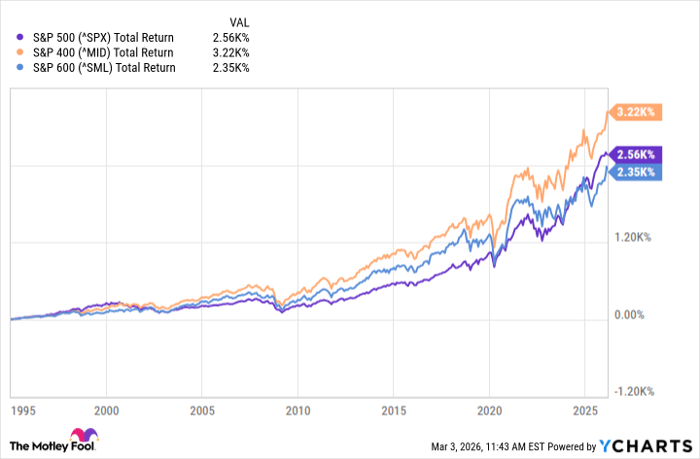
^SPX data by YCharts
The Vanguard Extended Market ETF captures those two indexes and more. Owning this fund is essentially expecting that further value will be unlocked from this group -- it has a price/earnings (P/E) ratio of just 20 -- and that earnings growth will begin spreading out beyond just the tech sector. Tech is still expected to deliver the biggest earnings growth in 2026, but 2027 is likely to see earnings growth widen out to other sectors.
After years of underperformance, it's looking more like small caps might finally be setting up to have a moment. And it might be a better investment over the next several years than the S&P 500.
Should you buy stock in Vanguard Index Funds - Vanguard Extended Market ETF right now?
Before you buy stock in Vanguard Index Funds - Vanguard Extended Market ETF, consider this:
The Motley Fool Stock Advisor analyst team just identified what they believe are the 10 best stocks for investors to buy now… and Vanguard Index Funds - Vanguard Extended Market ETF wasn’t one of them. The 10 stocks that made the cut could produce monster returns in the coming years.
Consider when Netflix made this list on December 17, 2004... if you invested $1,000 at the time of our recommendation, you’d have $534,008!* Or when Nvidia made this list on April 15, 2005... if you invested $1,000 at the time of our recommendation, you’d have $1,090,073!*
Now, it’s worth noting Stock Advisor’s total average return is 949% — a market-crushing outperformance compared to 190% for the S&P 500. Don't miss the latest top 10 list, available with Stock Advisor, and join an investing community built by individual investors for individual investors.
See the 10 stocks »
*Stock Advisor returns as of March 9, 2026.
David Dierking has positions in Vanguard Total Stock Market ETF. The Motley Fool has positions in and recommends Vanguard S&P 500 ETF and Vanguard Total Stock Market ETF. The Motley Fool has a disclosure policy.
Recommended Articles


