




Can Rivian Disrupt the Market and Reward Investors in 2026?
Key Points
The R2's success is critical for Rivian to continue its vision to sell millions of vehicles.
Rivian removed $7,200 in automotive cost of goods sold per vehicle in the fourth quarter.
A smooth launch and continued cost reductions should enable the R2 to improve gross profitability.
- 10 stocks we like better than Rivian Automotive ›
While Rivian Automotive (NASDAQ: RIVN) and other full electric vehicle (EV) automakers initially received much hype, that has long since faded -- especially after a rough 2025 that included automotive tariffs and policy changes. That's left Rivian's stock stuck in the mud, with just a 5% gain in share price over the past three years. However, with the highly anticipated R2 getting ready to hit the roads, can Rivian disrupt the market and reward investors? Here are two big factors to consider.
The stakes are high
The hype behind Rivian's R2 is palpable, especially after investors and consumers waited through 2025 with no other Rivian vehicle launches. One hurdle facing Rivian's R2 is convincing mainstream buyers -- a target price of around $50,000 should get its foot in the door -- to choose a newer automotive brand over established companies that have built brands and consumer loyalty over the decades.
Will AI create the world's first trillionaire? Our team just released a report on the one little-known company, called an "Indispensable Monopoly" providing the critical technology Nvidia and Intel both need. Continue »

Image source: Rivian.
There is potential for the R2 to disrupt the market and convince mainstream consumers, particularly early adopters, to try it, as Rivian has established itself as a competitive full-electric vehicle maker. It gives consumers who have stuck with Tesla a new option after the automaker slacked off on keeping its vehicle portfolio fresh and faced political troubles with its polarizing CEO, Elon Musk.
On the flip side, if the R2 underperforms expectations, it could have massive implications for investors. "There is immense pressure on the R2 launch," said Jessica Caldwell, head of insights at Edmunds, according to Automotive News. "If it fails to connect with buyers, Rivian won't just miss revenue targets -- it could stall the momentum of the entire brand, leaving its future in question."
Scale to profitability
Rivian's broad goal is to produce and sell millions of vehicles annually, and while that is a possibility in the distant future, watching the impact the R2 has on gross profits will be critical for investors. Rivian has already posted consistently improving gross margins, thanks to cost-cutting and operational improvements. In fact, Rivian delivered over $7,200 improvement in automotive cost of goods sold per vehicle during the fourth quarter of 2025, compared to the prior year.
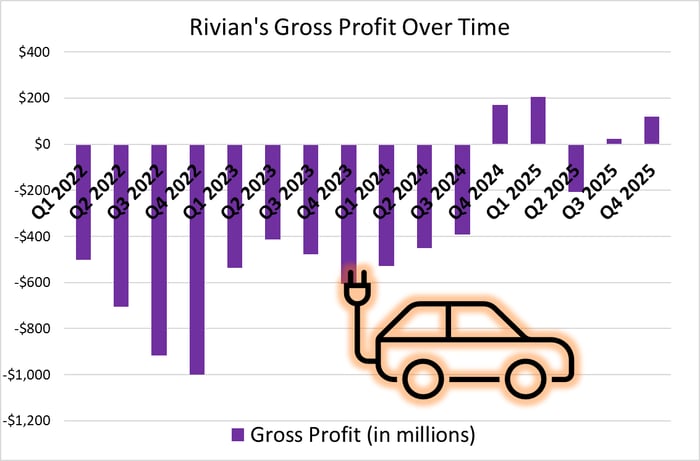
Graphic source: Author. Data source: Rivian SEC filings.
Further, Rivian recorded a significant milestone when it announced it had achieved its first full year of gross profit at $144 million. That's a worthy milestone and a step toward profitability, which still looks bleak in the near term with Rivian posting a $3.6 billion net loss on $5.4 billion in revenue in 2025.
This year is setting up to be an inflection point for Rivian investors if the R2 can win over mainstream consumers with a competitively priced vehicle in a lucrative market with few options around $50,000. Investors would be wise to expect speed bumps in the new vehicle launch, but should remain optimistic about the R2's potential to disrupt the market and shift Rivian's business into a higher gear.
Should you buy stock in Rivian Automotive right now?
Before you buy stock in Rivian Automotive, consider this:
The Motley Fool Stock Advisor analyst team just identified what they believe are the 10 best stocks for investors to buy now… and Rivian Automotive wasn’t one of them. The 10 stocks that made the cut could produce monster returns in the coming years.
Consider when Netflix made this list on December 17, 2004... if you invested $1,000 at the time of our recommendation, you’d have $534,008!* Or when Nvidia made this list on April 15, 2005... if you invested $1,000 at the time of our recommendation, you’d have $1,090,073!*
Now, it’s worth noting Stock Advisor’s total average return is 949% — a market-crushing outperformance compared to 190% for the S&P 500. Don't miss the latest top 10 list, available with Stock Advisor, and join an investing community built by individual investors for individual investors.
See the 10 stocks »
*Stock Advisor returns as of March 9, 2026.
Daniel Miller has no position in any of the stocks mentioned. The Motley Fool has positions in and recommends Tesla. The Motley Fool has a disclosure policy.
Recommended Articles


