




History Suggests an Epic Stock Market Crash Could Happen in 2026. Here's Why I Disagree.
Key Points
The S&P 500 Shiller CAPE ratio is at its highest level since the dot-com bubble burst in 2000.
Some investors fear that soaring valuations driven by artificial intelligence (AI) stocks are unsustainable.
While there is some overlap between AI and the internet era, smart investors understand that these two periods are quite different.
- 10 stocks we like better than S&P 500 Index ›
The new year is only 2 months old, yet investors have experienced more drama than they probably were anticipating. As of this writing on Feb. 25, the S&P 500 (SNPINDEX: ^GSPC) and Nasdaq Composite are about breakeven on the year. This performance hasn't come without some overpronounced surges that were swiftly followed up with intense sell-offs.
Major factors influencing the stock market in 2026 include the direction of monetary policy from the Federal Reserve, interpretations of macroeconomic indicators such as inflation, geopolitical tensions across the globe, and, of course, rising fears over an artificial intelligence (AI) bubble.
Will AI create the world's first trillionaire? Our team just released a report on the one little-known company, called an "Indispensable Monopoly" providing the critical technology Nvidia and Intel both need. Continue »
The main theme? Uncertainty is driving the stock market right now.
Let's take a look at one particular metric that could signal where stocks are headed in 2026. While history suggests further selling could be on the horizon, I have a contrarian view that buying the dip right now may prove to be a wise choice.
Image source: Getty Images.
This stock market signal hasn't happened since the year 2000
There are loads of ways to assess valuation. Many look at ratios such as price-to-earnings (P/E) or price-to-sales (P/S) and compare these multiples to historical levels, or benchmark against a set of peers in the same industry.
While this analysis can be useful, it also has some flaws. Namely, P/E and P/S ratios tend to be static -- only accounting for the last year or isolating a company's market value at a particular point in time.
Given how much the prospects of AI have transformed the stock market in recent years, I think a better metric to look at is the cyclically adjusted price-to-earnings (CAPE) ratio. The CAPE ratio accounts for earnings growth over a 10-year horizon. This is important as it accounts for the impacts of inflation as well as other non-recurring items on a company's profitability profile relative to its share price.
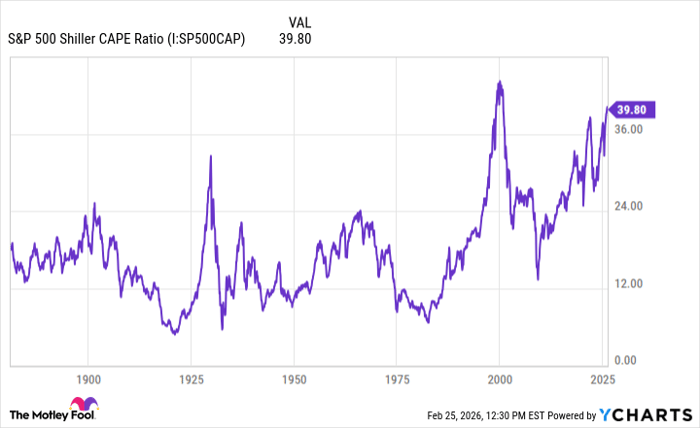
S&P 500 Shiller CAPE Ratio data by YCharts.
Currently, the CAPE ratio is hovering just below 40 -- its second-highest level in history. The first time the CAPE ratio traded near this level was during the late 1920s, right before the market crashed and gave way to the Great Depression. In more recent history, it peaked at 44 in the year 2000 -- just prior to the bursting of the dot-com bubble.
So, history would suggest that the stock market could be headed for an epic sell-off this year.
Why is AI different from the dot-com bubble?
The main overlap between AI and the internet is that both live in the technology realm. Over the last few years, a number of tech stocks have ballooned into trillion-dollar behemoths thanks to the positive impacts AI is having on revenue and profitability.
Given soaring share prices, some investors are wary that AI is becoming a ready-to-pop bubble, much like the dot-com boom did. While I see the correlation, I think this is an apples-to-oranges comparison.
Many companies in the late 1990s essentially fooled investors into a narrative that the internet would be a game changer for their business. Valuations were soaring on the heels of engagement indicators like page views and clicks.
AI has been fundamentally different. Just take a look at the earnings profiles for major AI hyperscalers below:
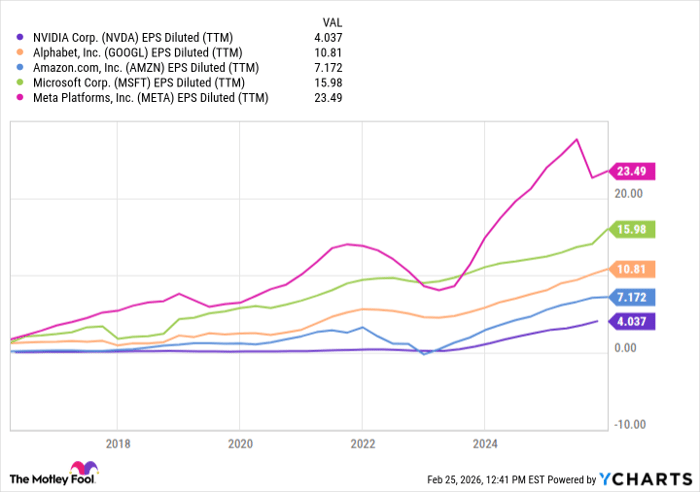
NVDA EPS Diluted (TTM) data by YCharts.
Over the last few years, the slope in earnings growth among big tech has gone from steady to notably steeper. Considering these companies are some of the biggest spenders in the tech sector, these accelerating profitability profiles underscore how accretive AI has already become for their businesses.
Against this backdrop, I think the stock market's AI-driven rally is not only justified, but should be sustainable in 2026 and beyond.
Will the stock market crash in 2026?
Given the differences between the current AI trend and the dot-com era, I am confident that the stock market is not as at risk of a pronounced correction or crash. That said, further selling is likely on the horizon for now.
As stated above, there is no shortage of uncertainty and fear dragging the market lower at the moment. Perhaps the biggest question mark is the outcome of the midterm elections in November. I'd encourage investors to adopt a macromindset instead of trying to predict the accuracy of political polls.
Here's the big picture: Over the last 50 years, the S&P 500 has generated inflation-adjusted returns of nearly 7% annually. That may not seem like much -- and it includes down years -- but compounded over several decades, these returns can turn even modest contributions into game-changing wealth.
To me, the smartest way to invest right now is to own blue chip stocks with diversified business models, and trim or liquidate exposure to speculative positions.
By building a diversified portfolio featuring companies that generate durable, resilient cash flow and complementing this exposure with cash, investors should remain insulated from pronounced selling while also having the flexibility to buy the dips when they occur.
Should you buy stock in S&P 500 Index right now?
Before you buy stock in S&P 500 Index, consider this:
The Motley Fool Stock Advisor analyst team just identified what they believe are the 10 best stocks for investors to buy now… and S&P 500 Index wasn’t one of them. The 10 stocks that made the cut could produce monster returns in the coming years.
Consider when Netflix made this list on December 17, 2004... if you invested $1,000 at the time of our recommendation, you’d have $534,008!* Or when Nvidia made this list on April 15, 2005... if you invested $1,000 at the time of our recommendation, you’d have $1,090,073!*
Now, it’s worth noting Stock Advisor’s total average return is 949% — a market-crushing outperformance compared to 190% for the S&P 500. Don't miss the latest top 10 list, available with Stock Advisor, and join an investing community built by individual investors for individual investors.
See the 10 stocks »
*Stock Advisor returns as of March 9, 2026.
Adam Spatacco has positions in Alphabet, Amazon, Meta Platforms, Microsoft, and Nvidia. The Motley Fool has positions in and recommends Alphabet, Amazon, Meta Platforms, Microsoft, and Nvidia. The Motley Fool has a disclosure policy.
Recommended Articles


