




Dow Jones Industrial Average churns as momentum withers
- The Dow Jones remains stuck near 42,500 on Tuesday.
- Equities blinked after another sharp downturn in CB consumer expectations.
- Investors remain leery of slowing economic data and a potential uptick in inflation.
The Dow Jones Industrial Average (DJIA) stuck in place on Tuesday, adrift near the 42,500 level after a another sharp decline in CB Consumer Confidence survey results broke a near-term bullish recovery in stock prices. Sentiment surveys continue to get weighed down by policy and tariff uncertainty, keeping risk appetite tepid as investors await signs or stability in both economic conditions and US trade policy.
According to the US Conference Board (CB), one-year consumer inflation expectations have risen yet again, rising to 6.2% in March versus February’s 5.8%. According to the CB, consumers remain overwhelmingly concerned about the still-high price of staple household goods like eggs, and overarching concerns about potential inflation fallout from the Trump administration’s tariffs. The CB’s consumer confidence survey of future economic expectations also dropped to a new 12-year low on March, falling to 65.2 and tumbling well below the 80.0 mark that typically forecasts a possible recession.
Adding insult to injury, the Moody’s ratings agency released a noted early Tuesday warning that the US’s fiscal strength has “deteriorated”, specifically highlighting the increasing unaffordability of US debt servicing. Going further, Moody’s noted that US fiscal strength is heading for a multi-year decline, a statement that is likely to anger Donald Trump and his administration, who are actively pursuing a large debt limit increase from Congress.
Stocks news
Despite a raft of cautionary data and notes on Tuesday, investor sentiment remains relatively stable heading into the middle of the trading week. The Dow Jones remains stubbornly stuck to the 42,500 region, and the Standard & Poor’s 500 (S&P) index was also flat, treading water near 5,760. The Nasdaq Composite index rose around one-quarter of one percent to 18,230 as tech stocks recover their footing, but not enough to drag the rest of the equity market higher.
Read more stock news: Apple stock rises as Nvidia sheds weight
Dow Jones price forecast
The Dow Jones Industrial Average has run out of gas in the near term, with intraday bids stuck to the 42,500 level. Price action still leans in favor of buyers after the DJIA recovered back to the top side of the 200-day Exponential Moving Average (EMA) near the 42,000 major price handle, but bidders may be poised to take a breather.
Technical oscillators show bulls still have some room to run, but its a steep climb to recover record highs north of 45,000. On the low end, a backslide could mean an extended decline back below the latest swing low into 40,660.
Dow Jones 5-minute chart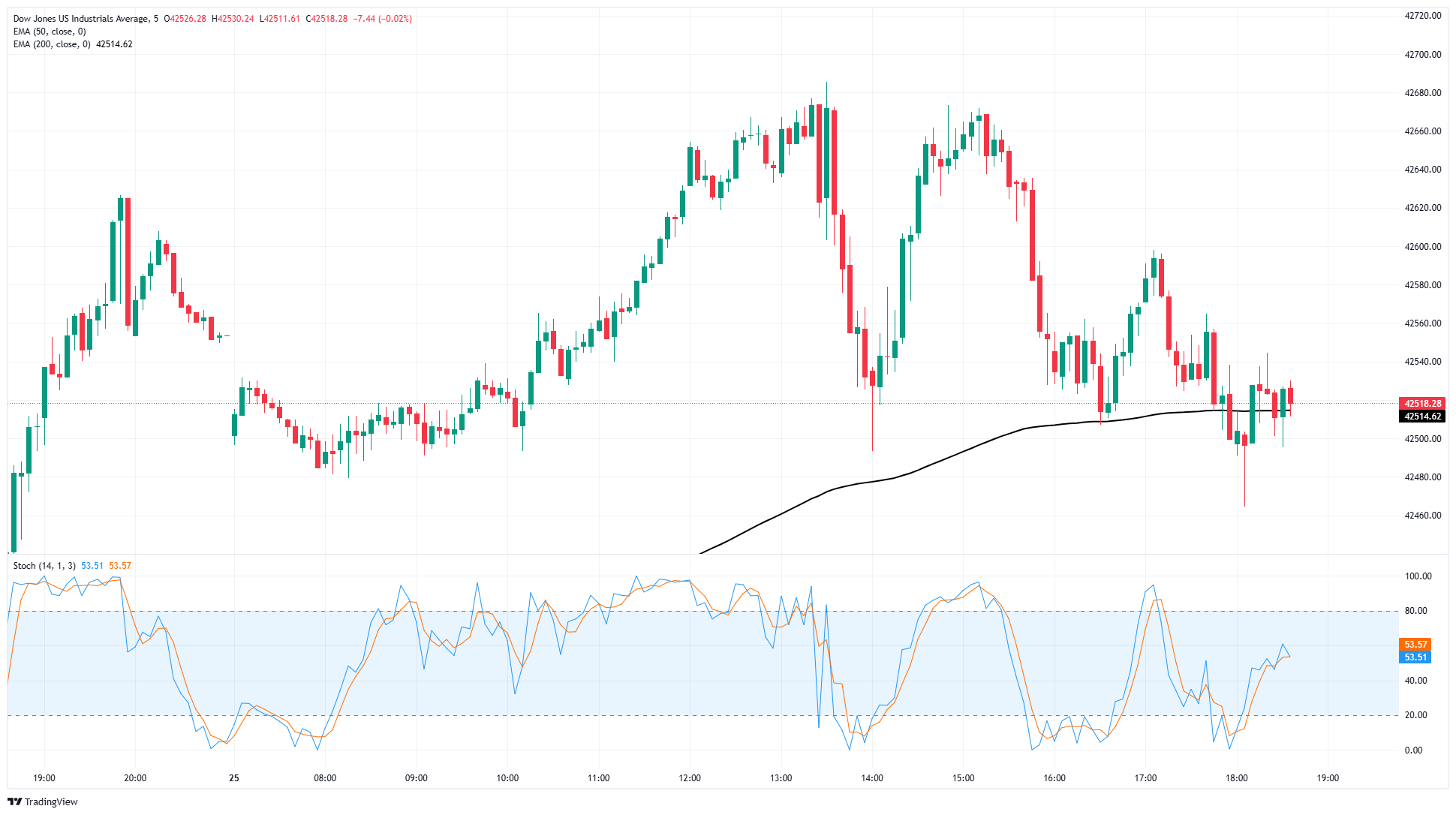
Dow Jones daily chart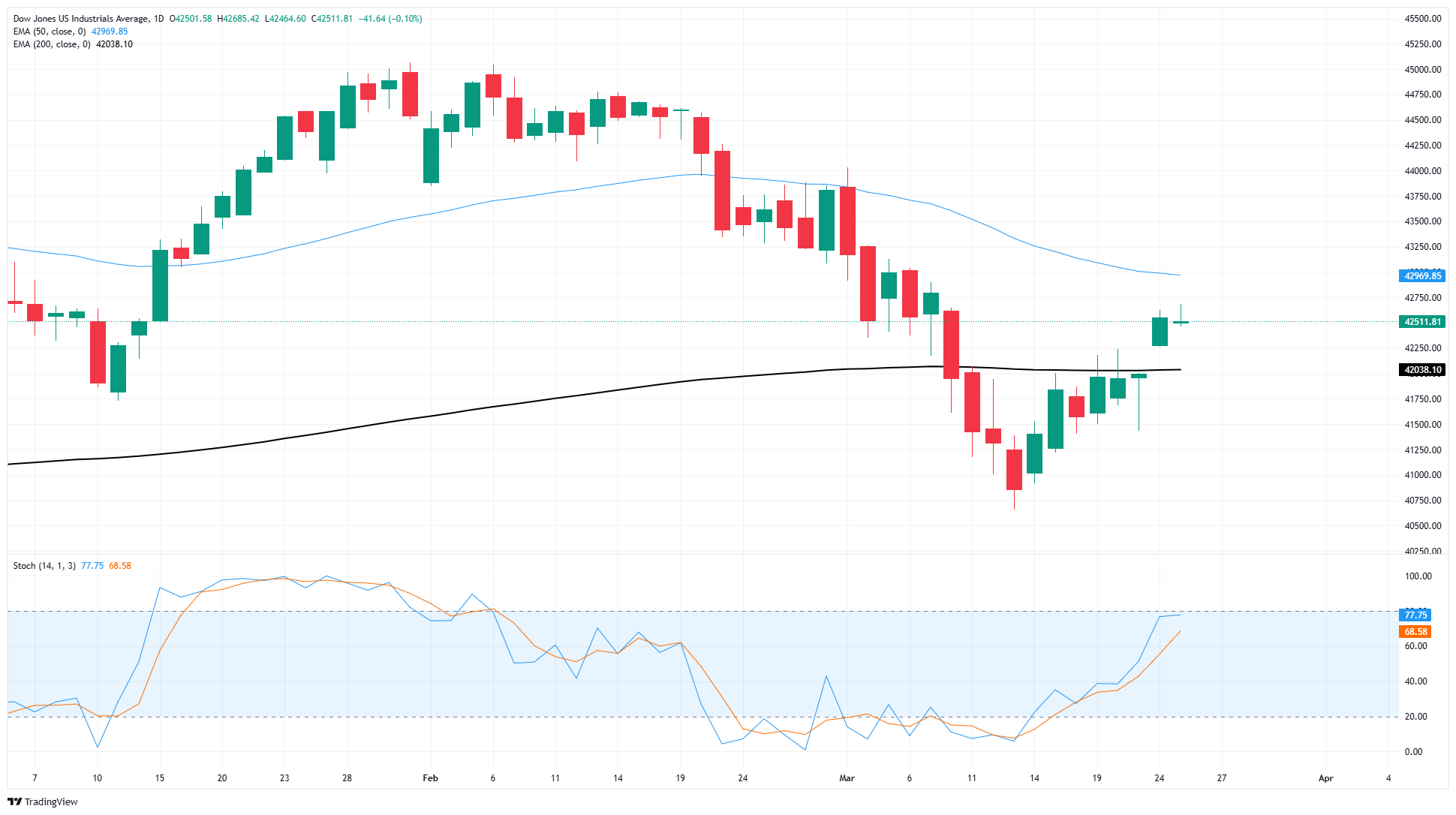
Dow Jones FAQs
The Dow Jones Industrial Average, one of the oldest stock market indices in the world, is compiled of the 30 most traded stocks in the US. The index is price-weighted rather than weighted by capitalization. It is calculated by summing the prices of the constituent stocks and dividing them by a factor, currently 0.152. The index was founded by Charles Dow, who also founded the Wall Street Journal. In later years it has been criticized for not being broadly representative enough because it only tracks 30 conglomerates, unlike broader indices such as the S&P 500.
Many different factors drive the Dow Jones Industrial Average (DJIA). The aggregate performance of the component companies revealed in quarterly company earnings reports is the main one. US and global macroeconomic data also contributes as it impacts on investor sentiment. The level of interest rates, set by the Federal Reserve (Fed), also influences the DJIA as it affects the cost of credit, on which many corporations are heavily reliant. Therefore, inflation can be a major driver as well as other metrics which impact the Fed decisions.
Dow Theory is a method for identifying the primary trend of the stock market developed by Charles Dow. A key step is to compare the direction of the Dow Jones Industrial Average (DJIA) and the Dow Jones Transportation Average (DJTA) and only follow trends where both are moving in the same direction. Volume is a confirmatory criteria. The theory uses elements of peak and trough analysis. Dow’s theory posits three trend phases: accumulation, when smart money starts buying or selling; public participation, when the wider public joins in; and distribution, when the smart money exits.
There are a number of ways to trade the DJIA. One is to use ETFs which allow investors to trade the DJIA as a single security, rather than having to buy shares in all 30 constituent companies. A leading example is the SPDR Dow Jones Industrial Average ETF (DIA). DJIA futures contracts enable traders to speculate on the future value of the index and Options provide the right, but not the obligation, to buy or sell the index at a predetermined price in the future. Mutual funds enable investors to buy a share of a diversified portfolio of DJIA stocks thus providing exposure to the overall index.
Recommended Articles


