




Brent Crude Returns Above $90 in Three-Day Rally as $95 Becomes Key Rebound Resistance
TradingKey - Driven by consecutive attacks on Middle Eastern energy facilities and oil tankers, international oil prices rose for a third straight session and are poised to post their first weekly gain since November. In recent trading, Brent crude (UKOIL) climbed to $91.90. As the U.S. Thanksgiving holiday kept trading volume light and left investors cautious about chasing gains, oil prices oscillated intraday between geopolitical risks and oversupply expectations.
Saudi Arabia's Ministry of Energy confirmed that the Jizan refinery was struck by a 'hostile aerial projectile,' killing one worker, injuring several others, and igniting a fire at the facility. Although the fire was subsequently extinguished, some refining operations were temporarily halted, and authorities are still assessing the extent of damage to the equipment. Meanwhile, the Saudi-led coalition stated that the attack was launched by Yemen's Houthi militia.
Meanwhile, reports of multiple tankers being attacked or striking mines near the Strait of Hormuz have also prompted the market to reprice shipping disruption risks. The waterway connects major Persian Gulf oil producers to global markets and serves as a vital chokepoint for international crude and liquefied natural gas trade. If vessel transit faces further disruptions, export capacity could be compromised even if output from oil-producing nations remains steady.
Data from the United Kingdom Maritime Trade Operations (UKMTO) showed that during the week ended November 18, a total of 263 vessels transited the strait, down approximately 15% from the prior week; among them, the number of tankers dropped from 52 to 37.
Consequently, while the Strait of Hormuz has not suffered a full shutdown, shipping risks, insurance premiums, and freight costs have already risen. As long as attacks continue, traders are likely to price a higher geopolitical risk premium into oil, which is a key driver behind Brent crude's consecutive rebound following its prior sharp decline.
Beyond the Middle East situation, the market is also awaiting the outcome of the OPEC+ meeting this Sunday. Two people familiar with the negotiations said that as the war in Iran continues to impact Middle East exports and member states remain divided over capacity assessments, OPEC+ is likely to extend its existing production targets at least through the first quarter of 2027. However, a final decision has not yet been reached, and Iraq and Kazakhstan still hope to raise their respective capacity baselines.
If OPEC+ maintains its current targets, it could prevent further production increases from weighing on oil prices in the short term, but this outcome alone may not suffice to drive sustained gains. The market remains concerned about a global crude surplus in 2027, with Rystad Energy estimating that the average surplus next year could reach around 5 million barrels per day. U.S. crude inventories also rose by 1.1 million barrels to 418.9 million barrels in the latest week, indicating that beyond geopolitical risks, supply pressures persist on the fundamental front.
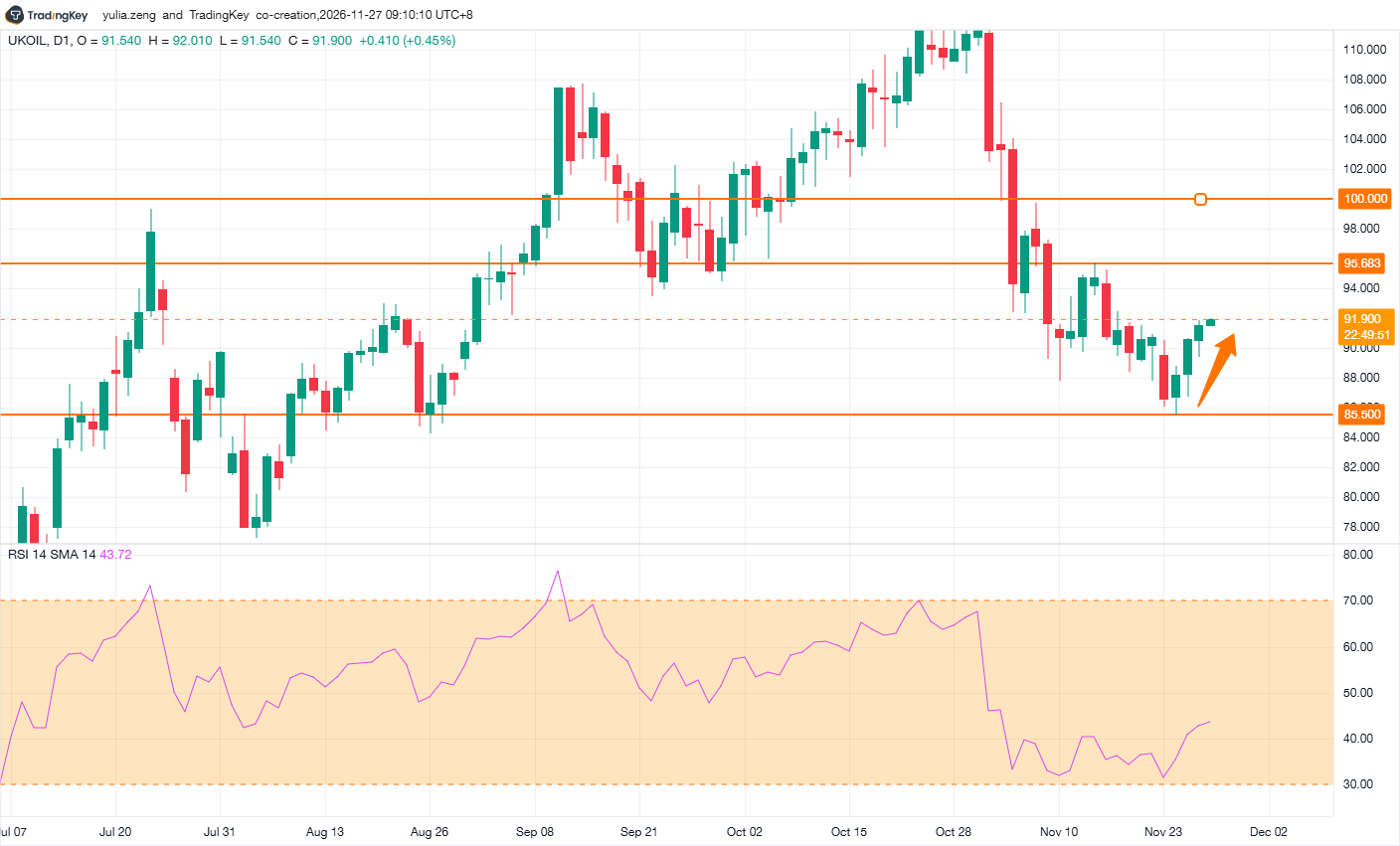
Source: TradingKey
On the daily chart, Brent crude has rebounded continuously after falling toward $85.50, indicating that support at this previous platform remains temporarily intact and short-term selling pressure has eased. However, the current price action remains a technical recovery following a steep plunge, and a trend reversal has yet to be confirmed. Having tumbled rapidly from above $110, oil prices still exhibit a weaker structure characterized by lower highs.
Momentum indicators have shown some improvement, with the 14-day RSI rebounding from oversold territory near 30 to 43.72, signaling that bearish momentum is waning. However, because the RSI remains below the 50 neutral threshold, buyers have yet to take control. A stabilization signal will become more reliable only if the RSI climbs above 50 and oil prices break above recent rebound highs.
To the upside, initial focus is on short-term resistance around $92–$93, with a breakout paving the way to test $95.68. This level represents a critical resistance converted from previous support and serves as a key gauge of whether the rebound can gain traction. If the daily close holds firmly above $95.68, oil prices could stage a further recovery toward $98 and the psychological $100 mark.
To the downside, the primary support lies at $89–$90, with core support still at $85.50. As long as this level is not decisively breached, Brent could continue to oscillate and build a base within the $85.50–$95.68 range. Conversely, if the rebound falters and the price breaks below $85.50 again on heavy volume, it would signal that the downtrend is not yet over, potentially triggering a further retreat toward $82 or even a test of the $78–$80 zone.
Recommended Articles


