




Gold Hovers Near 15-Month Low Ahead of US PCE as $3,500 Support Faces Test
TradingKey - The U.S. will release its October personal income and outlays report on Wednesday, November 25, Eastern Time, which includes the Personal Consumption Expenditures (PCE) price index closely watched by the Federal Reserve. This will be one of the most critical inflation releases ahead of the December 8–9 policy meeting, and the results could directly influence market expectations regarding the magnitude of rate hikes and the policy path for 2027. The revised estimate for U.S. third-quarter GDP will also be released at the same time, which could noticeably amplify market volatility.
Gold remained cautious ahead of the data release. During the Asian trading session on November 25, spot gold (XAUUSD) hovered near $3,550 to $3,560 per ounce, still close to its lowest level since September 2025. Following heavy selling last week, gold prices have since failed to stage a meaningful rebound, as a stronger dollar and rising Fed rate-hike expectations continue to curb returning buying interest.
The market expects headline PCE to rise 0.3% month-over-month in October, down from 0.5% in September, while the year-over-year rate could accelerate from 3.6% to 3.8%. Core PCE, which excludes food and energy prices, is projected to increase 0.3% month-over-month, unchanged from the previous month, with the year-over-year rate potentially ticking up from 3.1% to 3.2%. Personal income is expected to increase 0.4% month-over-month, and personal consumption expenditures are projected to grow 0.4%.
Interest rate markets have already priced in expectations of further policy tightening. The CME FedWatch Tool shows that markets are pricing in an approximately 96.4% probability of a 25-basis-point rate hike by the Fed in December and a 3.6% probability of a 50-basis-point hike, indicating that a hike of at least 25 basis points is almost fully priced in.
New York Fed President John Williams recently stated that U.S. inflation remains too high and monetary policy may need to tighten further, though the pace and magnitude of future rate hikes will depend on economic data. If core PCE comes in above expectations again, markets could ramp up bets on consecutive rate hikes or even more aggressive tightening, thereby continuing to push up real interest rates and weigh on gold.
The dollar's persistent strength has also added to the difficulty of a gold price rebound. The U.S. Dollar Index has recently traded near 104, briefly touching a near-20-month high. Because gold is priced in U.S. dollars, dollar appreciation increases purchasing costs for non-dollar investors; meanwhile, elevated U.S. Treasury yields also raise the opportunity cost of holding non-yielding gold.
How Gold May React After PCE Release?
Source: TradingKey
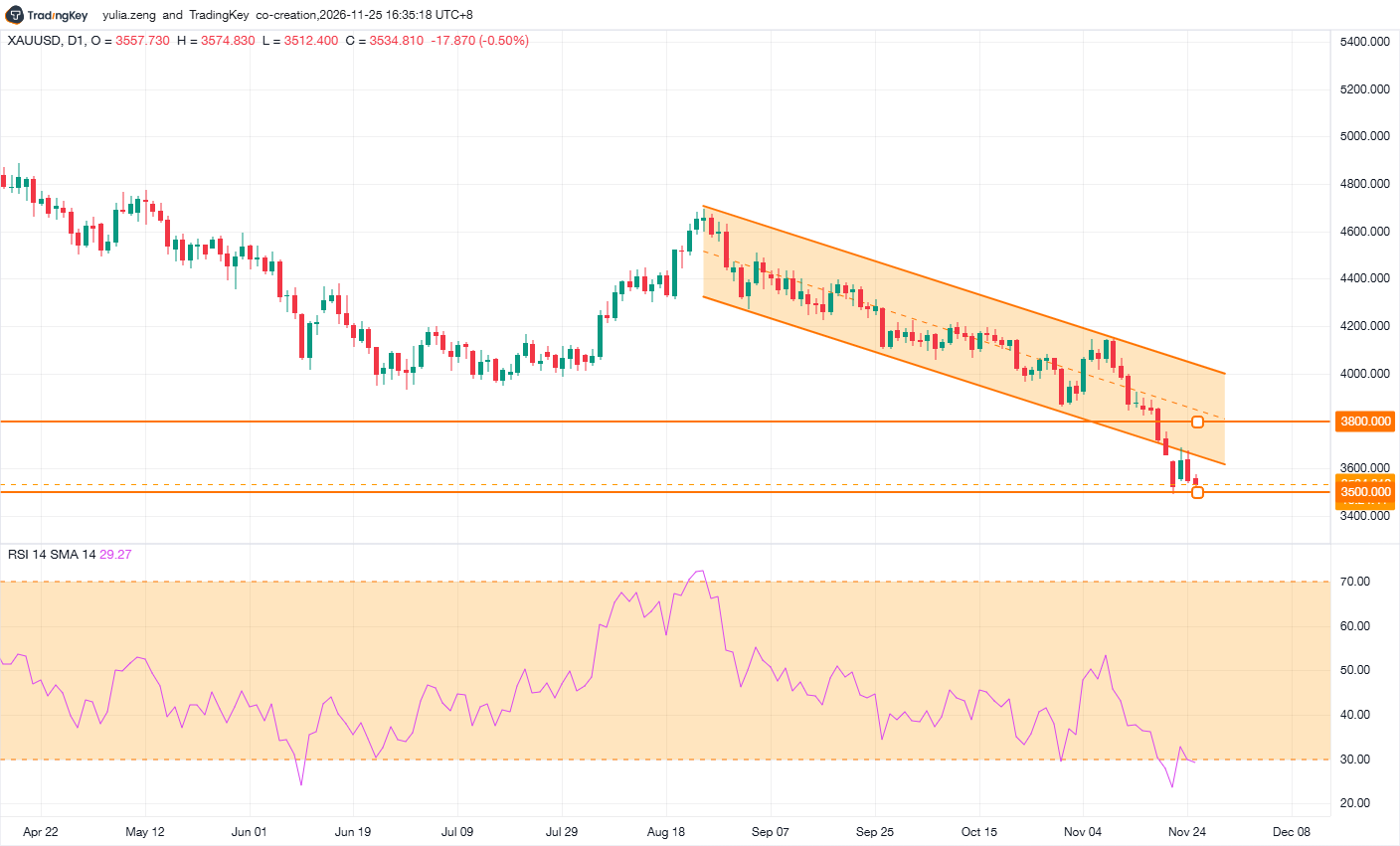
From a technical perspective, after peaking near $4,707 in late August, gold has continued to trade within a descending channel, posting lower highs and lower lows in a relatively clear bearish trend. Recently, gold prices broke further below the channel's lower boundary, last trading at $3,527 after touching an intraday low of $3,512, indicating that the downward trend has shifted from channel-bound consolidation to an accelerated decline, making $3,500 the most critical near-term line of defense.
The Relative Strength Index (RSI) has dropped to 29.02, entering oversold territory below 30. This suggests that short-term selling may have run its course, and a technical rebound cannot be ruled out following the release of the PCE data.
If core PCE rises 0.4% month-over-month or significantly exceeds 3.2% year-over-year, the US dollar and Treasury yields could move higher, and gold may test $3,500 again. Once this support level is decisively broken on the daily chart, market selling pressure could widen once more, leaving gold prices at risk of searching for lower support.
If core PCE aligns with expectations, gold's immediate reaction may be relatively muted, as a 25-basis-point rate hike in December is already fully priced in, and prices may continue to fluctuate between $3,500 and $3,600. In that case, the market will focus more on subcomponents such as services inflation, personal income, and consumer spending to determine whether US demand remains strong enough to support higher-for-longer monetary tightening.
If core PCE unexpectedly pulls back, particularly dropping to around 0.2% month-over-month, traders may lower their expectations for further rate hikes in 2027. A subsequent pullback in the US dollar and real yields would likely drive a relief rally in gold. However, only if gold breaks back above and holds $3,600 can the current downward pressure be alleviated; until then, any bounce remains closer to a technical rebound from oversold levels.
Recommended Articles


