




United States Dollar Index corrects as AI trade reversal faces sustainability concerns
- The US Dollar ticks up ahead of the US PCE Inflation data for October.
- Concerns over AI trade sustainability restricts the US Dollar’s upside.
- US Democrats pledge to investigate Nvidia’s matter once they take control of Congress.
The US Dollar Index (DXY), which gauges the Greenback’s vale against six major currencies, trades marginally higher to near 103.92 in the Asian trade on Wednesday. Still, the DXY is holding onto previous day’s corrective move that came after failing to revisit the 20-month high of 104.53 posted on Monday.
The US Dollar (USD) retreats from its recent highs as market experts still doubt the sustainability of fresh recovery in the global Artificial Intelligence (AI) trade that was driven by the reinstatement of Jensen Huang as CEO of Nvidia.
Danske Bank said in a report that "the stunning reversal sent Nvidia shares 31.5% higher and lifted the broader market, with S&P 500 up 4.7% and the Nasdaq up 6.9%." However, they caution that Nvidia "still faces SEC and Justice Department investigations over issues ranging from potential accounting irregularities to alleged chip smuggling," and add that "senior Democrats have also pledged to investigate the matter once they take control of Congress in January."
The outlook of the US Dollar is largely tied to the future of United States (US) tech stocks, as the former performed strongly in past due to a significant capital inflow to US AI infrastructure-related stocks.
On the economic data front, investors keenly await the US Personal Consumption Expenditure (PCE) Price Index data for October, which will be published at 13:30 GMT.
The US PCE Price Index data for October is seen at 3.8% Year-on-Year (YoY), higher than the September reading of 3.6%. The core PCE Inflation – which is Fed’s preferred inflation gauge, is also seen higher at 3.2% YoY vs. the previous release of 3.1%.
The inflation data is expected to have a significant impact on the Federal Reserve’s (Fed) monetary policy outlook.
US Dollar Index Technical Analysis
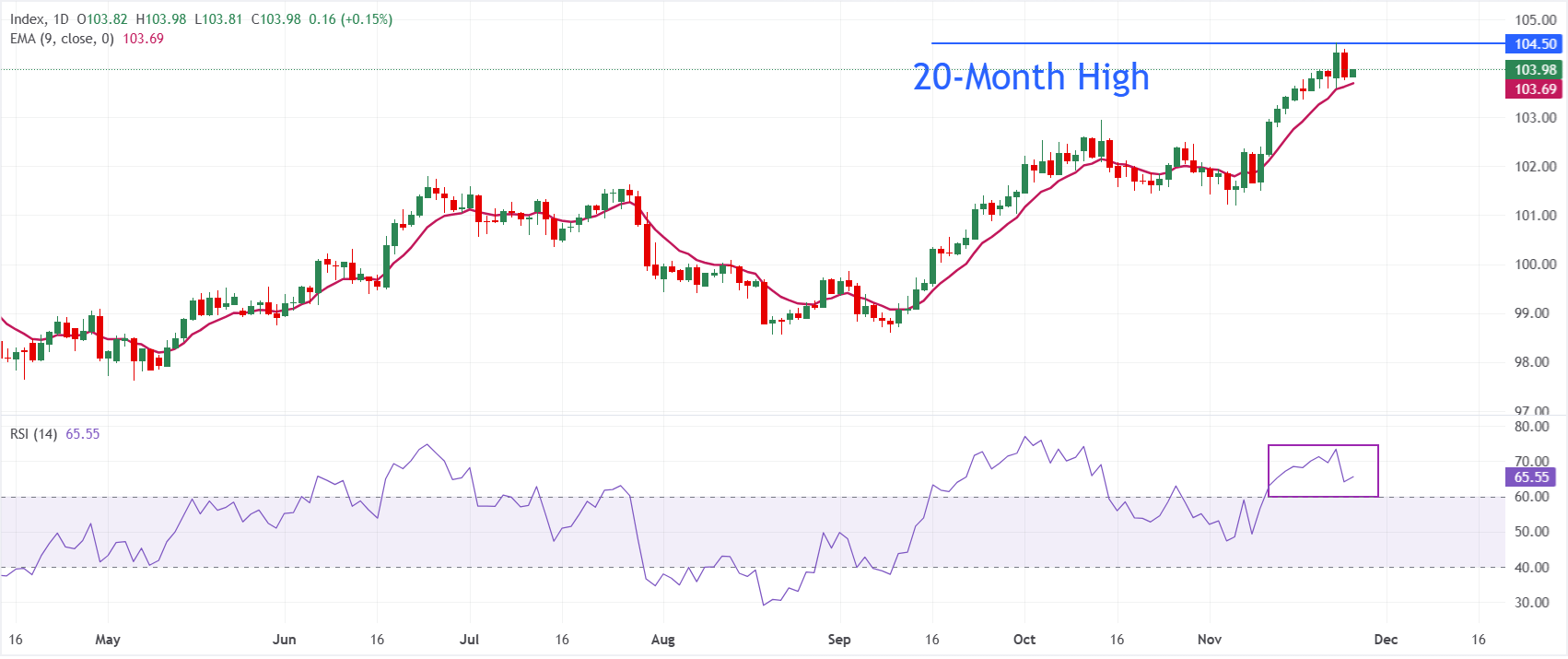
In the daily chart, Dollar Index Spot trades at 103.98, holding a bullish near‑term bias as price remains above the 9‑period exponential moving average (EMA) at 103.69. The close back over this short‑term EMA reinforces a constructive tone in the trend, while the Relative Strength Index (RSI) at 65.55 stays in positive territory but shy of overbought, hinting that upside momentum is firm yet not overstretched.
On the downside, immediate support is located at the 9‑period EMA at 103.69, which acts as the first line of demand should the index consolidate or retrace from current levels. As long as Dollar Index Spot defends this moving‑average floor on a closing basis, buyers are likely to retain control, keeping the broader bias tilted to the upside.
(The technical analysis of this story was written with the help of an AI tool. Know more.)
US Dollar FAQs
The US Dollar (USD) is the official currency of the United States of America, and the ‘de facto’ currency of a significant number of other countries where it is found in circulation alongside local notes. It is the most heavily traded currency in the world, accounting for over 88% of all global foreign exchange turnover, or an average of $6.6 trillion in transactions per day, according to data from 2022. Following the second world war, the USD took over from the British Pound as the world’s reserve currency. For most of its history, the US Dollar was backed by Gold, until the Bretton Woods Agreement in 1971 when the Gold Standard went away.
The most important single factor impacting on the value of the US Dollar is monetary policy, which is shaped by the Federal Reserve (Fed). The Fed has two mandates: to achieve price stability (control inflation) and foster full employment. Its primary tool to achieve these two goals is by adjusting interest rates. When prices are rising too quickly and inflation is above the Fed’s 2% target, the Fed will raise rates, which helps the USD value. When inflation falls below 2% or the Unemployment Rate is too high, the Fed may lower interest rates, which weighs on the Greenback.
In extreme situations, the Federal Reserve can also print more Dollars and enact quantitative easing (QE). QE is the process by which the Fed substantially increases the flow of credit in a stuck financial system. It is a non-standard policy measure used when credit has dried up because banks will not lend to each other (out of the fear of counterparty default). It is a last resort when simply lowering interest rates is unlikely to achieve the necessary result. It was the Fed’s weapon of choice to combat the credit crunch that occurred during the Great Financial Crisis in 2008. It involves the Fed printing more Dollars and using them to buy US government bonds predominantly from financial institutions. QE usually leads to a weaker US Dollar.
Quantitative tightening (QT) is the reverse process whereby the Federal Reserve stops buying bonds from financial institutions and does not reinvest the principal from the bonds it holds maturing in new purchases. It is usually positive for the US Dollar.
Recommended Articles


