




EUR/USD Price Forecast: Bearish bias persists below 1.1000
- EUR/USD treads water below 1.1000 amid thin liquidity due to the US Thanksgiving holiday.
- The technical structure remains bearish below the 21-, 50- and 100-day SMAs.
- Momentum remains bearish, though the narrowing MACD histogram suggests sellers are losing steam.
EUR/USD treads water just below 1.1000 on Thursday as the US Thanksgiving holiday keeps liquidity thin. At the time of writing, the pair trades near 1.0970, little changed on the day, after touching 1.0881 on Monday, its lowest level since April 2025.
Analysts at ING strike a cautiously constructive tone on EUR/USD, noting that "EUR/USD has held support at 1.0880 this week and a close tomorrow around the current level (1.0975) would suggest the first week of reversal since Dollar strength drove this 7% EUR/USD drop since late August."
They point out that "December normally sees a weaker Dollar and this week's EUR/USD drop substantially overshot short-term rate differentials," while "lower energy prices this month have also improved the Eurozone's terms of trade, which the Euro is yet to adjust to."
Against that backdrop, ING expects near-term consolidation rather than a decisive breakout, stating: "Expect EUR/USD to trade in a tight range not far from 1.0975 today, and it is not clear what the catalysts will be for a break back above 1.10 next week."
Technical analysis
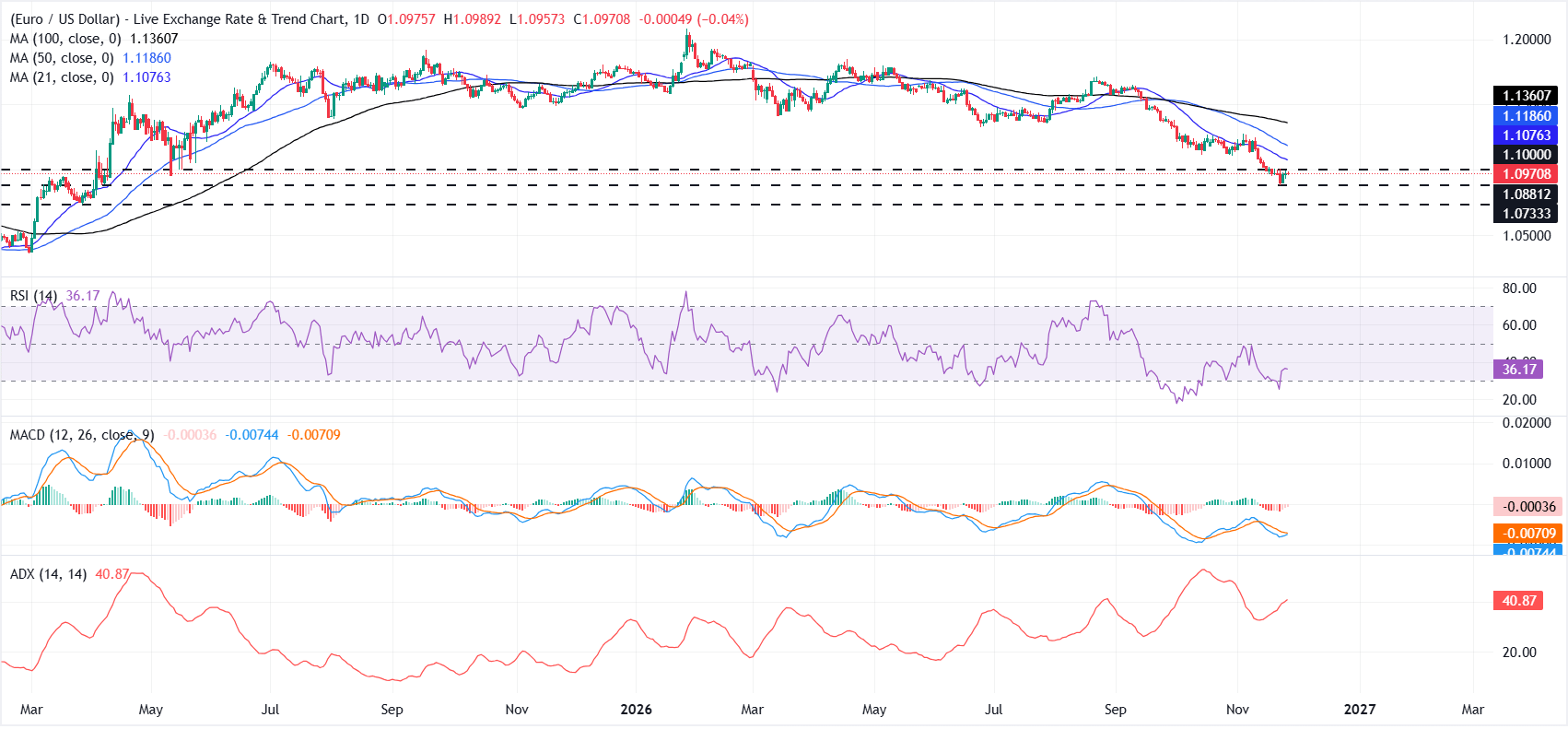
On the daily chart, EUR/USD remains below its declining 21-, 50- and 100-day Simple Moving Averages (SMAs). The cluster of descending SMAs above price hints that rallies are likely to be capped, while the Relative Strength Index (RSI) near 36 remains in weak territory.
The Moving Average Convergence Divergence (MACD) indicator is still marginally negative, though a slightly contracting downside histogram suggests selling pressure is losing some intensity rather than reversing outright.
Immediate resistance sits at the psychological 1.1000 level. A break above it would bring the 21-day SMA at 1.1076 into view, followed by the 50-day SMA at 1.1186 and the 100-day SMA at 1.1361.
On the downside, initial support lies at Monday’s low of 1.0881. A break below that level would expose the previous support at 1.0733. A move below 1.0733 would signal that the downtrend is likely to extend, while a sustained recovery above 1.1000 would be the first signal that bears are losing control.
(The technical analysis of this story was written with the help of an AI tool. Know more.)
Euro FAQs
The Euro is the currency for the 20 European Union countries that belong to the Eurozone. It is the second most heavily traded currency in the world behind the US Dollar. In 2022, it accounted for 31% of all foreign exchange transactions, with an average daily turnover of over $2.2 trillion a day. EUR/USD is the most heavily traded currency pair in the world, accounting for an estimated 30% off all transactions, followed by EUR/JPY (4%), EUR/GBP (3%) and EUR/AUD (2%).
The European Central Bank (ECB) in Frankfurt, Germany, is the reserve bank for the Eurozone. The ECB sets interest rates and manages monetary policy. The ECB’s primary mandate is to maintain price stability, which means either controlling inflation or stimulating growth. Its primary tool is the raising or lowering of interest rates. Relatively high interest rates – or the expectation of higher rates – will usually benefit the Euro and vice versa. The ECB Governing Council makes monetary policy decisions at meetings held eight times a year. Decisions are made by heads of the Eurozone national banks and six permanent members, including the President of the ECB, Christine Lagarde.
Eurozone inflation data, measured by the Harmonized Index of Consumer Prices (HICP), is an important econometric for the Euro. If inflation rises more than expected, especially if above the ECB’s 2% target, it obliges the ECB to raise interest rates to bring it back under control. Relatively high interest rates compared to its counterparts will usually benefit the Euro, as it makes the region more attractive as a place for global investors to park their money.
Data releases gauge the health of the economy and can impact on the Euro. Indicators such as GDP, Manufacturing and Services PMIs, employment, and consumer sentiment surveys can all influence the direction of the single currency. A strong economy is good for the Euro. Not only does it attract more foreign investment but it may encourage the ECB to put up interest rates, which will directly strengthen the Euro. Otherwise, if economic data is weak, the Euro is likely to fall. Economic data for the four largest economies in the euro area (Germany, France, Italy and Spain) are especially significant, as they account for 75% of the Eurozone’s economy.
Another significant data release for the Euro is the Trade Balance. This indicator measures the difference between what a country earns from its exports and what it spends on imports over a given period. If a country produces highly sought after exports then its currency will gain in value purely from the extra demand created from foreign buyers seeking to purchase these goods. Therefore, a positive net Trade Balance strengthens a currency and vice versa for a negative balance.
Recommended Articles


