




Strong US data leaves the Yen unmoved before Tokyo inflation
- USD/JPY holds between 158.50 and 159.50, unmoved by US inflation and growth.
- Japan's services producer prices rise 4.2% on the year, the most since 1990.
- BoJ board member Tamura speaks Thursday, the same day as Tokyo's November CPI.
Stronger US data and the fastest Japanese services inflation since 1990 pulled USD/JPY in opposite directions on Wednesday, and neither won. USD/JPY has moved less than a Yen all session and is just above 159.00, where it started. It's an eighth session inside the range that followed the November 13 high.
Japan's services producer prices rose 4.2% in the year to October, the most since 1990, adding to the case for a Bank of Japan (BoJ) hike in December. Finance Minister Katayama said on November 13 that she saw one-sided, rapid moves in the Yen, the day USD/JPY last traded above 160.00. Both are reasons it hasn't been back.
US core inflation beat its forecast, the economy grew at a 4.3% pace in the third quarter against 3.4% forecast, and jobless claims dropped to 189K. A December Fed hike was already almost fully priced, so the releases had little left to change. Treasury yields dropped while investors sold technology shares, which took away the usual reason for USD/JPY to rise on strong US numbers.
On the calendar
BoJ board member Tamura speaks at 01:00 GMT on Thursday. Tokyo's November Consumer Price Index (CPI) follows at 23:30 GMT, forecast at 3% both excluding fresh food, after 2.6%, and excluding food and energy, after 2.4%. Both feed the BoJ's December decision, the Japanese side of USD/JPY's rate gap.
Thanksgiving shuts US markets on Thursday, so Tokyo's figures come out with New York on holiday. The Fed's pre-meeting silence begins on Saturday, before a December 8-9 meeting that comes ahead of the BoJ's.
On the charts
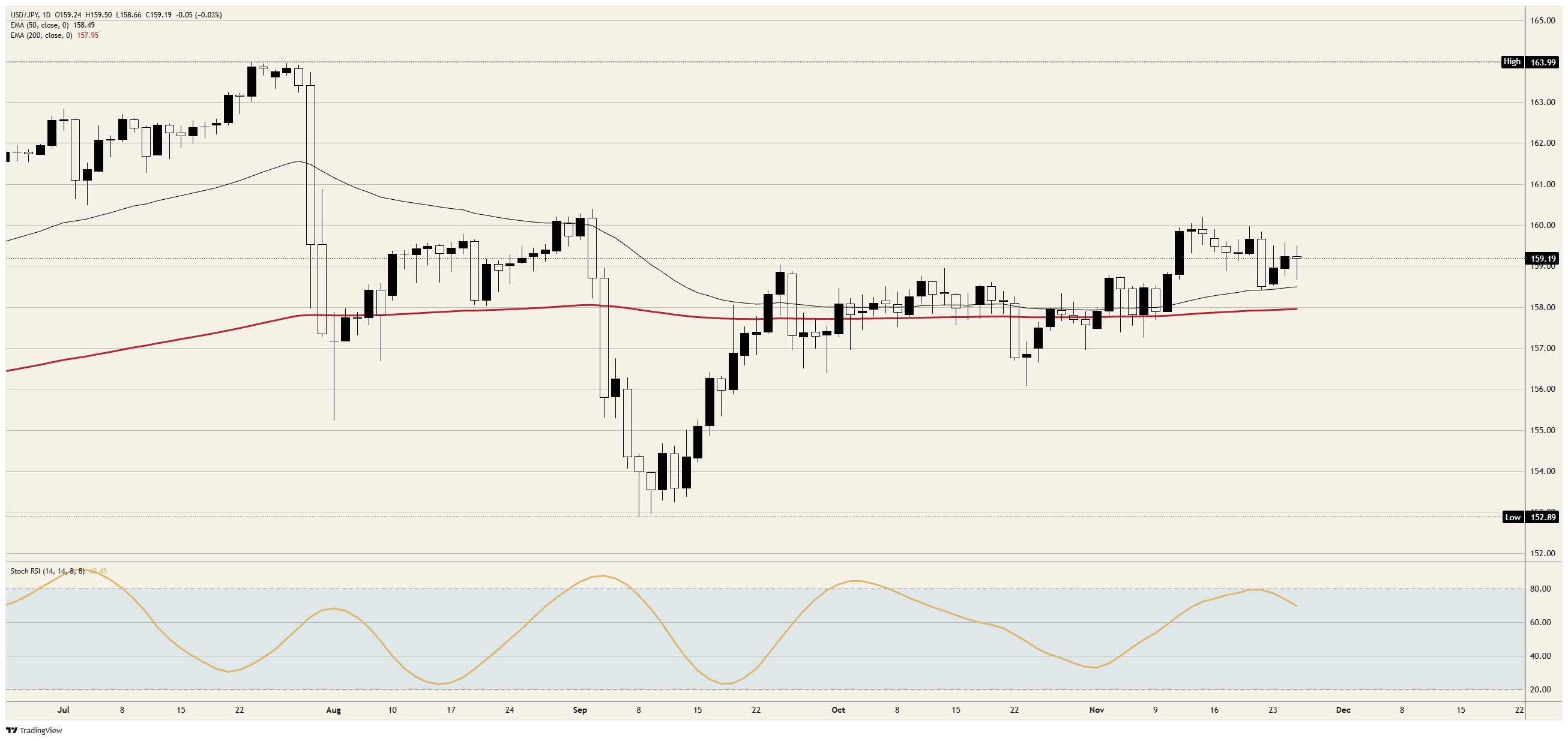
The highs of November 12 and 13, just above 160.00, were USD/JPY's first trades there since the start of September. Friday's low came down to the 50-day Exponential Moving Average (EMA) near 158.50, Wednesday's low stopped just above it, and the 200-day EMA is near 158.00. Daily momentum has turned down from the edge of overbought.
USD/JPY daily chart
Japanese Yen FAQs
The Japanese Yen (JPY) is one of the world’s most traded currencies. Its value is broadly determined by the performance of the Japanese economy, but more specifically by the Bank of Japan’s policy, the differential between Japanese and US bond yields, or risk sentiment among traders, among other factors.
One of the Bank of Japan’s mandates is currency control, so its moves are key for the Yen. The BoJ has directly intervened in currency markets sometimes, generally to lower the value of the Yen, although it refrains from doing it often due to political concerns of its main trading partners. The BoJ ultra-loose monetary policy between 2013 and 2024 caused the Yen to depreciate against its main currency peers due to an increasing policy divergence between the Bank of Japan and other main central banks. More recently, the gradually unwinding of this ultra-loose policy has given some support to the Yen.
Over the last decade, the BoJ’s stance of sticking to ultra-loose monetary policy has led to a widening policy divergence with other central banks, particularly with the US Federal Reserve. This supported a widening of the differential between the 10-year US and Japanese bonds, which favored the US Dollar against the Japanese Yen. The BoJ decision in 2024 to gradually abandon the ultra-loose policy, coupled with interest-rate cuts in other major central banks, is narrowing this differential.
The Japanese Yen is often seen as a safe-haven investment. This means that in times of market stress, investors are more likely to put their money in the Japanese currency due to its supposed reliability and stability. Turbulent times are likely to strengthen the Yen’s value against other currencies seen as more risky to invest in.
Recommended Articles


