




Gold Falls Below $3,500 to Hit Nearly 15-Month Low: What Is Causing Gold Prices to Fall Again?
TradingKey - On November 25 ET, spot gold (XAUUSD) broke below $3,500, tumbling 2.8% intraday to $3,454 per ounce. A sharp upward revision to US economic growth and a resurgence in inflation reinforced market expectations that the Federal Reserve will continue raising rates, while a stronger US dollar and higher real yields also weighed on gold's rebound.
The Federal Reserve's preferred inflation gauge continued to pick up. The US personal consumption expenditures (PCE) price index rose 0.3% month-over-month in October, in line with market expectations, while the year-over-year rate accelerated from 3.7% to 3.8%, reaching a nearly three-year high. Core PCE also climbed 0.3% month-over-month, with its year-over-year rate rising from 3.1% to 3.3%.
Meanwhile, the US government on Wednesday revised annualized third-quarter gross domestic product (GDP) growth upward from 3.4% to 4.3%, nearly double the second quarter's 2.2% pace. Against the backdrop of rising borrowing costs, the economy maintained robust growth, leaving more room for the Federal Reserve to raise interest rates further.
According to the CME FedWatch Tool, the probability of a 25-basis-point rate hike by the Federal Reserve in December stands at 96.4%, with a 3.6% probability of keeping rates unchanged. The Fed paused rate hikes in October to monitor price trends, but the latest data have yet to show any easing in inflationary pressures. Wall Street almost unanimously expects the Fed to raise rates at its mid-December meeting and hike again early next year. Robust economic growth coupled with sticky inflation has bolstered tightening expectations, while elevated real yields have also increased the opportunity cost of holding gold.
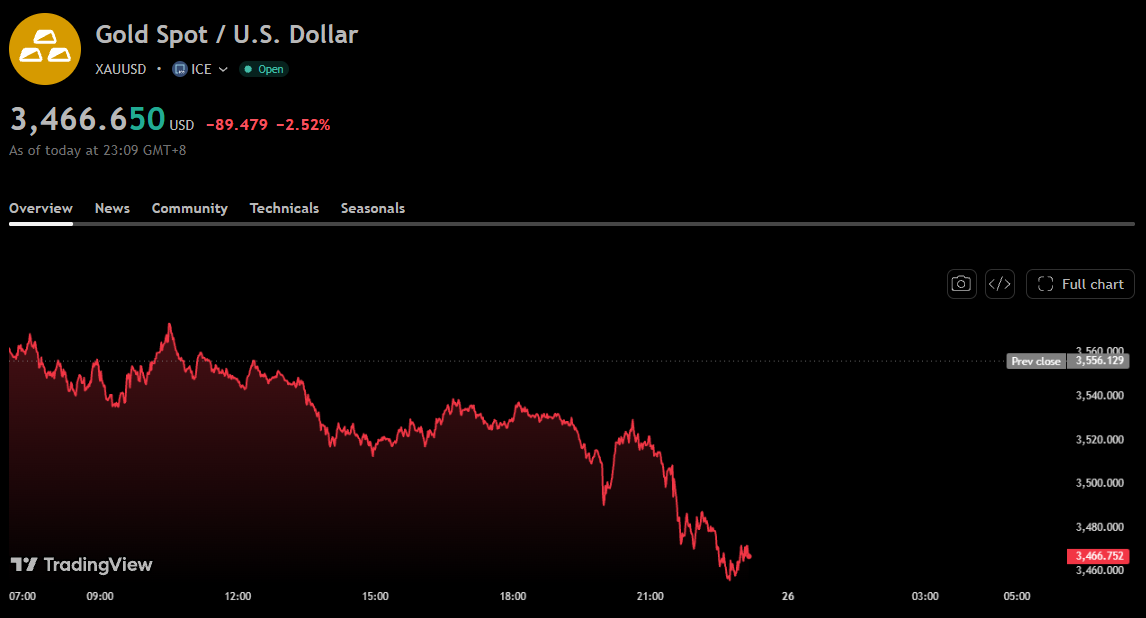
Spot gold price chart, source: TradingView
So far this year, this pressure has continued to weigh on gold's trajectory. Since February 2026, US real interest rates have risen by more than 100 basis points, and the Federal Reserve resumed rate hikes in September, causing gold prices to retreat more than 30% from their early-year highs. In November, US real interest rates climbed by another roughly 20 basis points, while the US Dollar Index broke above 104, which, combined with a broadening stock market selloff, further exacerbated downward pressure on gold.
Chirag Sheth, head of global business at Public Gold Bullion SG Pte, noted that market sentiment has turned so pessimistic that virtually any news is easily interpreted as bearish. Under these circumstances, gold prices could still drop by around 5%. However, he also pointed out that softer gold prices will attract long-term investors into the market.
Regarding the outlook, JPMorgan believes the window for a gold recovery will gradually open starting in the second quarter of 2027. The core rationale is that Brent crude prices are expected to retreat to $65 to $75 per barrel by then, and falling energy prices will help dissipate inflationary pressures, creating favorable conditions for a recovery in gold investment demand.
On the interest rate path, JPMorgan expects the Federal Reserve to deliver three more rate hikes—in December, January, and March of next year—before pausing, and then begin cutting rates in the first half of 2028. According to this forecast, gold could see a recovery opportunity ahead of the actual rate cuts, though this remains contingent upon retreating oil prices, cooling inflation, and a gradual easing of pressures for further monetary policy tightening.
Recommended Articles


