




Indian Rupee hits fresh seven-month high against US Dollar
- The Indian Rupee opens sharply higher against the US Dollar on Wednesday.
- Strong foreign portfolio inflows into Indian continue to strengthen the Indian Rupee.
- The sustainability of global AI trade could dampen FIIs’ buying in the Indian stock market.
The Indian Rupee (INR) resumes its upward trend against the US Dollar (USD) on Wednesday after a brief pause. The USD/INR pair slides to a fresh seven-month low at 92.50 as the consistent inflow of foreign capital into the Indian stock market keeps strengthening India’s forex reserves.
So far in November, Foreign Institutional Investors (FIIs) have remained net buyers in all full trading days and have increased their stake worth Rs. 1,17,622.38 crore.
The interest of overseas investors has increased significantly in past weeks as financial markets were looking beyond the global Artificial Intelligence (AI) trade due to concerns over viability of hyperscalers’ spending plans on AI infrastructure, following the victory of United States (US) Democrats in midterm elections.
Global AI trade unwinding was also fuelled last week after the resignation of Nvidia’s CEO Jensen Huang; however, his unexpected reinstatement has infused fresh blood in AI-related stocks again.
Nvidia leadership reversal reignites AI trade across US and Asia
Analysts at Danske Bank highlight the extraordinary turn of events at Nvidia, where the company "reinstated Jensen Huang as CEO, less than a week after the board had ruled out his return." They note that the board "said it had received input from 'senior levels' of the US government and saw no national security risk," while "President Trump said he had personally convinced the board."
Danske Bank reports that "the stunning reversal sent Nvidia shares 31.5% higher on Monday and lifted the broader market, with S&P 500 up 4.7% and the Nasdaq up 6.9%."
The AI-driven momentum was not confined to US markets. According to Danske Bank, "the AI trade is carrying through to Asia on Tuesday, with Taiwan up 9% and South Korea up 7%."
However, the bank cautioned that Nvidia "still faces SEC and Justice Department investigations over issues ranging from potential accounting irregularities to alleged chip smuggling," and add that "senior Democrats have also pledged to investigate the matter once they take control of Congress in January."
The concerns over the sustainability of AI trade reversal have also led to some correction in NASDAQ, notably Nvidia, on Tuesday.
This suggests that the INR’s future largely relies on the sustainability of the global AI trade reversal, which could force foreign capital to return to the AI trade.
US PCE Inflation data awaited
On Wednesday, investors will pay close attention to the US Personal Consumption Expenditure (PCE) Price Index data for October, which will be published at 13:30 GMT.
Commerzbank expects the data to underscore persistent price pressures, with “the inflation rate… expected to rise to 3.8% in October, and even without food and energy prices, the inflation rate is expected to be too high at 3.2%.”
The impact of the US PCE Inflation data is expected to be significant on the Federal Reserve’s (Fed) monetary policy outlook.
USD/INR Technical Analysis
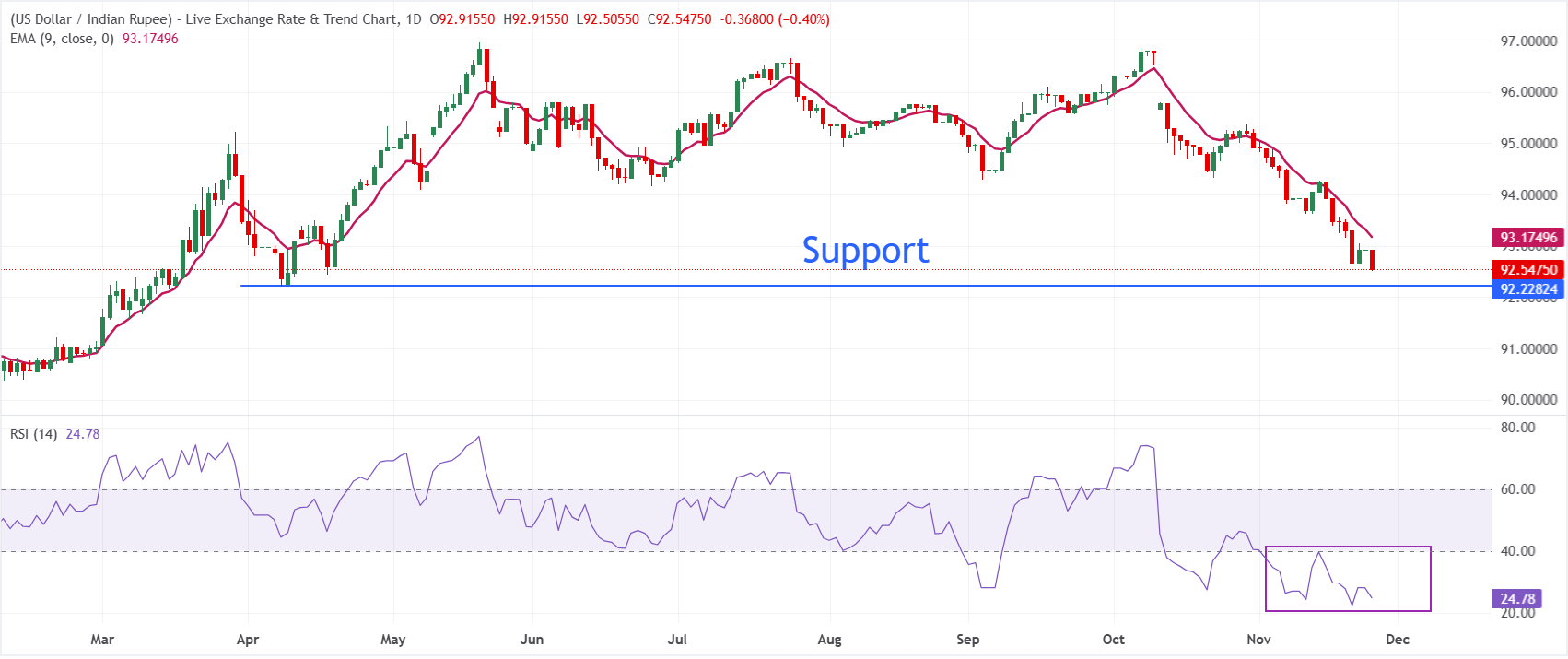
In the daily chart, USD/INR trades at 92.54, holding a bearish near-term bias as spot remains below the 9-period exponential moving average (EMA) at 93.18. The pair continues to grind lower beneath this short-term trend indicator, while the Relative Strength Index (RSI) at 24.78 sits in oversold territory, hinting that downside momentum is stretched even as the broader tone stays pressured.
On the topside, initial resistance is defined by the 9-day EMA at 93.18, which caps recovery attempts and would need to be reclaimed to ease immediate selling pressure. Looking down, the April 8 low at 92.22 is the key support level.
(The technical analysis of this story was written with the help of an AI tool. Know more.)
Indian Rupee FAQs
The Indian Rupee (INR) is one of the most sensitive currencies to external factors. The price of Crude Oil (the country is highly dependent on imported Oil), the value of the US Dollar – most trade is conducted in USD – and the level of foreign investment, are all influential. Direct intervention by the Reserve Bank of India (RBI) in FX markets to keep the exchange rate stable, as well as the level of interest rates set by the RBI, are further major influencing factors on the Rupee.
The Reserve Bank of India (RBI) actively intervenes in forex markets to maintain a stable exchange rate, to help facilitate trade. In addition, the RBI tries to maintain the inflation rate at its 4% target by adjusting interest rates. Higher interest rates usually strengthen the Rupee. This is due to the role of the ‘carry trade’ in which investors borrow in countries with lower interest rates so as to place their money in countries’ offering relatively higher interest rates and profit from the difference.
Macroeconomic factors that influence the value of the Rupee include inflation, interest rates, the economic growth rate (GDP), the balance of trade, and inflows from foreign investment. A higher growth rate can lead to more overseas investment, pushing up demand for the Rupee. A less negative balance of trade will eventually lead to a stronger Rupee. Higher interest rates, especially real rates (interest rates less inflation) are also positive for the Rupee. A risk-on environment can lead to greater inflows of Foreign Direct and Indirect Investment (FDI and FII), which also benefit the Rupee.
Higher inflation, particularly, if it is comparatively higher than India’s peers, is generally negative for the currency as it reflects devaluation through oversupply. Inflation also increases the cost of exports, leading to more Rupees being sold to purchase foreign imports, which is Rupee-negative. At the same time, higher inflation usually leads to the Reserve Bank of India (RBI) raising interest rates and this can be positive for the Rupee, due to increased demand from international investors. The opposite effect is true of lower inflation.
Recommended Articles


