




Euro extends recovery due to relief from drop in French bond yields
- Euro recovers further to near 1.1235 against the US Dollar amid a pullback in French bond yields.
- The US Dollar corrects as US Treasury Yields cool down after a strong rally.
- Investors shift their focus to the US CPI data for September.
The Euro (EUR) extends Thursday’s recovery move against the US Dollar (USD) on Friday. In the European trade, the EUR/USD pair is up 0.2% higher to near 1.1235. The Euro rebounds as yields offered on France bonds have corrected sharply.
10-year French bonds yields have overall corrected almost 3.4% or 17 basis points (bps) to 4.8% from its Thursday’s high.
The Euro had been an underperformer in the past few weeks due to widening difference between yields offered on French bonds compared to the rest of Eurozone. However, market experts believe that French fiscal risks are intact and the recovery move could prove to be short-lived.
Euro Price This week
The table below shows the percentage change of Euro (EUR) against listed major currencies this week. Euro was the weakest against the Australian Dollar.
| USD | EUR | GBP | JPY | CAD | AUD | NZD | CHF | |
|---|---|---|---|---|---|---|---|---|
| USD | 0.36% | 0.02% | 0.19% | -0.21% | -0.37% | 0.11% | 0.31% | |
| EUR | -0.36% | -0.34% | -0.09% | -0.55% | -0.73% | -0.26% | -0.02% | |
| GBP | -0.02% | 0.34% | 0.25% | -0.20% | -0.39% | 0.09% | 0.30% | |
| JPY | -0.19% | 0.09% | -0.25% | -0.39% | -0.47% | -0.04% | 0.14% | |
| CAD | 0.21% | 0.55% | 0.20% | 0.39% | -0.11% | 0.23% | 0.51% | |
| AUD | 0.37% | 0.73% | 0.39% | 0.47% | 0.11% | 0.49% | 0.69% | |
| NZD | -0.11% | 0.26% | -0.09% | 0.04% | -0.23% | -0.49% | 0.20% | |
| CHF | -0.31% | 0.02% | -0.30% | -0.14% | -0.51% | -0.69% | -0.20% |
The heat map shows percentage changes of major currencies against each other. The base currency is picked from the left column, while the quote currency is picked from the top row. For example, if you pick the Euro from the left column and move along the horizontal line to the US Dollar, the percentage change displayed in the box will represent EUR (base)/USD (quote).
Euro sentiment stays fragile as French risks linger
Analysts at ING caution that the recent reprieve for the Euro may prove short-lived, as France’s political and fiscal backdrop continues to weigh on sentiment. They argue that “we don’t feel Marine Le Pen’s huge fiscal tightening promise is enough to turn the tide for French bonds,” adding that “the euro may keep suffering from the French situation for longer” as markets remain wary of lingering fiscal and bond-market risks.
Meanwhile, the correction in the US Dollar due to a pullback in US Treasury Yields has also lend support to the EUR/USD pair. As of writing, the US Dollar Index (DXY), which gauges the Greenback’s value against six major currencies, trades marginally lower to near 102.00. The DXY fell on Thursday after failing to extend the rally above the yearly high at 102.54.
Going forward, investors will focus on the US Consumer Price Index (CPI) data for September, which will be published on Wednesday.
EUR/USD Technical Analysis
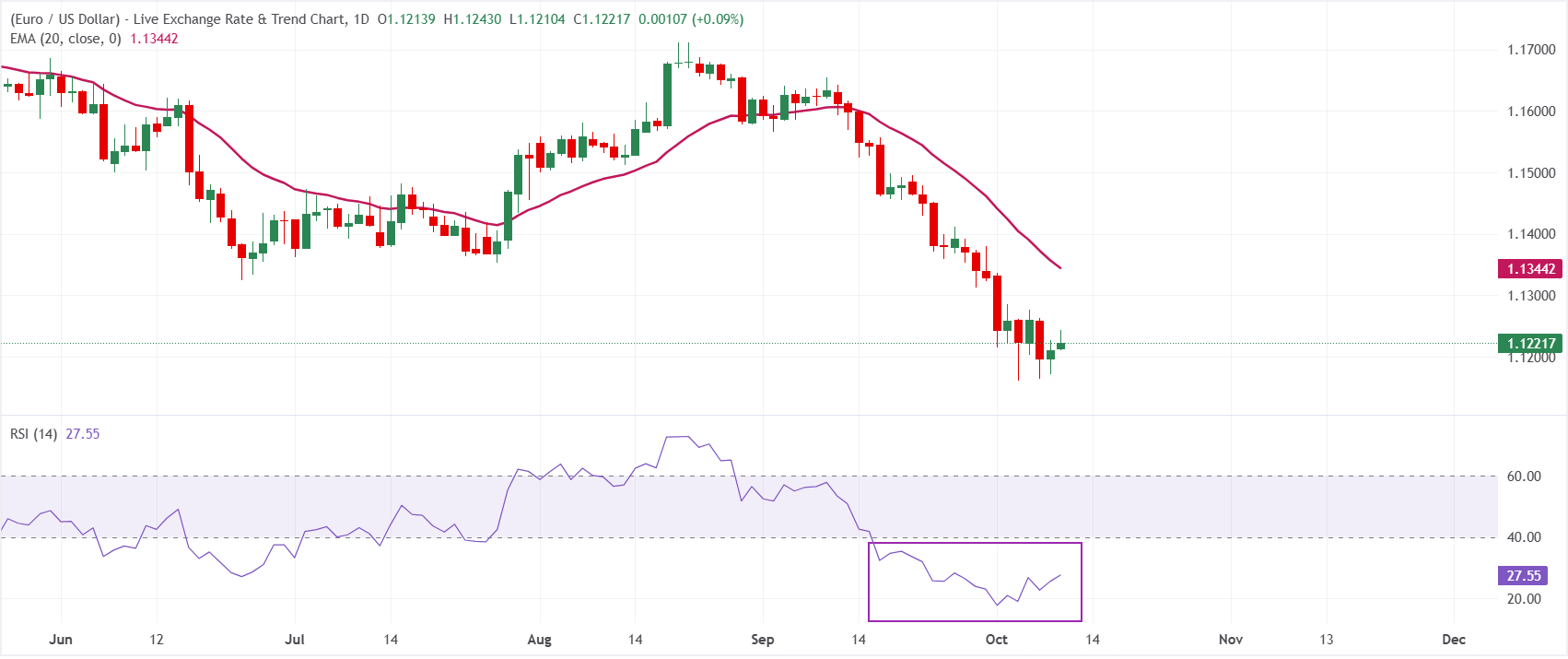
In the daily chart, EUR/USD trades at 1.1221, keeping a clear bearish tone as spot remains under the 20-period exponential moving average (EMA), which stands at 1.1344 and acts as immediate overhead resistance. The distance between price and the EMA suggests the pair is entrenched in a short-term downtrend, while the Relative Strength Index (RSI) around 27 hints at oversold conditions that could slow aggressive selling without yet implying a bullish reversal.
On the topside, initial resistance is located at the 20-day EMA at 1.1344, and a daily close above this barrier would be needed to ease bearish pressure and open the way for a corrective recovery. On the downside, with no nearby technical supports from the provided dataset, the pair remains vulnerable to further declines, and traders will likely look to price action and any emerging higher lows to identify a provisional floor if selling resumes.
(The technical analysis of this story was written with the help of an AI tool. Know more.)
Euro FAQs
The Euro is the currency for the 20 European Union countries that belong to the Eurozone. It is the second most heavily traded currency in the world behind the US Dollar. In 2022, it accounted for 31% of all foreign exchange transactions, with an average daily turnover of over $2.2 trillion a day. EUR/USD is the most heavily traded currency pair in the world, accounting for an estimated 30% off all transactions, followed by EUR/JPY (4%), EUR/GBP (3%) and EUR/AUD (2%).
The European Central Bank (ECB) in Frankfurt, Germany, is the reserve bank for the Eurozone. The ECB sets interest rates and manages monetary policy. The ECB’s primary mandate is to maintain price stability, which means either controlling inflation or stimulating growth. Its primary tool is the raising or lowering of interest rates. Relatively high interest rates – or the expectation of higher rates – will usually benefit the Euro and vice versa. The ECB Governing Council makes monetary policy decisions at meetings held eight times a year. Decisions are made by heads of the Eurozone national banks and six permanent members, including the President of the ECB, Christine Lagarde.
Eurozone inflation data, measured by the Harmonized Index of Consumer Prices (HICP), is an important econometric for the Euro. If inflation rises more than expected, especially if above the ECB’s 2% target, it obliges the ECB to raise interest rates to bring it back under control. Relatively high interest rates compared to its counterparts will usually benefit the Euro, as it makes the region more attractive as a place for global investors to park their money.
Data releases gauge the health of the economy and can impact on the Euro. Indicators such as GDP, Manufacturing and Services PMIs, employment, and consumer sentiment surveys can all influence the direction of the single currency. A strong economy is good for the Euro. Not only does it attract more foreign investment but it may encourage the ECB to put up interest rates, which will directly strengthen the Euro. Otherwise, if economic data is weak, the Euro is likely to fall. Economic data for the four largest economies in the euro area (Germany, France, Italy and Spain) are especially significant, as they account for 75% of the Eurozone’s economy.
Another significant data release for the Euro is the Trade Balance. This indicator measures the difference between what a country earns from its exports and what it spends on imports over a given period. If a country produces highly sought after exports then its currency will gain in value purely from the extra demand created from foreign buyers seeking to purchase these goods. Therefore, a positive net Trade Balance strengthens a currency and vice versa for a negative balance.
Recommended Articles


