


Nvidia Could Generate $741 Billion in Revenue Next Year. Here’s What That Means for the Stock.
Key Points
Nvidia CFO and interim CEO Colette Kress said Nvidia's revenue will grow 75% next year.
That's above previous guidance, and suggests strong earnings growth in fiscal 2028.
The stock looks incredibly cheap, which means one of three things.
- Motley Fool Issues Rare "Total Conviction" Buy Alert ›
Nvidia's (NASDAQ:NVDA) earnings report last week, without Jensen Huang leading the company, went better than expected. Revenue climbed 103% year over year to $115.8 billion, and earnings per share climbed to $2.70, up 108%. Both came in above analysts' expectations.
Perhaps more important was CFO and interim CEO Colette Kress's fiscal 2028 guidance. Last quarter she said she expects 70% revenue growth. This quarter, she increased it to 75%. That's despite higher-than-expected revenue growth last quarter and strong fourth-quarter guidance.
Missed AI’s "Act 1"? Act 2 Could Be 15x Bigger. Most investors think they missed the AI boat because they didn't buy Nvidia in 2005. But according to our analysts, we’re only at the end of "Act 1"—the R&D phase. "Act 2" is the global rollout. Continue »
Her fourth-quarter guidance calls for $130 billion in revenue, bringing fiscal 2027 total revenue to $423.7 billion. A 75% growth rate implies $741 billion in revenue next year. Here's what that means for the stock.
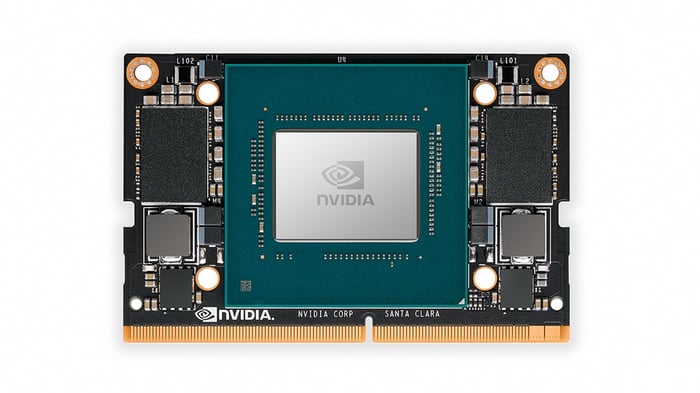
Image source: Nvidia.
Nvidia stock is incredibly cheap right now
With the recent sell-off in shares, the company has a market cap of about $4 trillion as of this writing. That means the stock is priced just over 5 times next year's sales. Its stock price has dropped to 10 times analysts' expectations for next year's earnings.
There are a few reasons why a stock would be so cheap.
- The market may be indicating that the analysts are overconfident in the business and their estimates are too high. Kress's increased 2028 outlook decreases that likelihood, although it's possible Kress is overconfident as well.
- The market may be indicating that the earnings aren't sustainable and an earnings downcycle will hit extremely hard in the not-too-distant future. But Nvidia is an asset-light, fabless semiconductor stock, so while earnings might drop and its margin might contract, it doesn't face the same cyclical pressure as semiconductor stocks with huge capital investment requirements.
- The market believes the risks to the company are extremely high, requiring a larger margin of safety to buy the stock. With growing uncertainty about the future of artificial intelligence stocks, this is the clear reason for Nvidia's current stock price.
Kress looked to put investors at ease during the earnings call. She said her 75% revenue growth outlook is based on "data center readiness, the strength and durability of end customer demand, and our customers' access to capital." She noted the $32 billion in financial commitments to neocloud companies require those partners to secure their own capital for data centers first. She stressed that Nvidia has a multi-year roadmap in place and it's "business as usual."
Is it time to buy shares of Nvidia?
While Nvidia shares look incredibly cheap right now, there's a lot of uncertainty about the business. While Huang has been reinstated as CEO, investors need to know whether he knowingly or unknowingly sold chips that ultimately landed in China, and what percentage of Nvidia's sales they accounted for. There could be legal repercussions as well, in the form of fines and further sales restrictions, which would impact Nvidia's bottom line.
Nvidia is also increasingly reliant on neocloud companies continuing to build quickly, a trend that faces both regulatory and credit risks. While Nvidia's GPUs remain best-in-class and can remain so even without Huang, the risk is that hyperscalers and leading AI labs will run more of their software on custom silicon instead of GPUs.
To be sure, the market appears to be pricing in the risks to Nvidia at the current price. But there are other AI stocks that have been caught up in the broader AI sell-off and look like great opportunities with less uncertainty. For now, a wait-and-see approach may be most prudent for Nvidia stock.
Should you buy stock in Nvidia right now?
Before you buy stock in Nvidia, consider this:
The Motley Fool Stock Advisor analyst team just identified what they believe are the 10 best stocks for investors to buy now… and Nvidia wasn’t one of them. The 10 stocks that made the cut could produce monster returns in the coming years.
Consider when Netflix made this list on December 17, 2004... if you invested $1,000 at the time of our recommendation, you’d have $305,941!* Or when Nvidia made this list on April 15, 2005... if you invested $1,000 at the time of our recommendation, you’d have $771,325!*
Now, it’s worth noting Stock Advisor’s total average return is 719% — a market-crushing outperformance compared to 192% for the S&P 500. Don't miss the latest top 10 list, available with Stock Advisor, and join an investing community built by individual investors for individual investors.
See the 10 stocks »
*Stock Advisor returns as of November 24, 2026.
Adam Levy has no position in any of the stocks mentioned. The Motley Fool has positions in and recommends Nvidia. The Motley Fool has a disclosure policy.
Recommended Articles


