


Nvidia Sees Biggest Single-Day Gain in 23 Years as Jensen Huang's Return Sparks Over 30% Stock Surge: Is It Still a Good Time to Buy?
TradingKey - Nvidia posts its largest single-day gain in 23 years as Jensen Huang officially returns to restore AI confidence; is it still a buy after surging over 30%?
During US trading hours on November 23, Eastern Time, Nvidia (NVDA)'s board of directors voted unanimously to reappoint Jensen Huang as President and CEO and return him to the board, driving the stock to surge 31.48% in a single day, touching an intraday high of $171.50 before closing at $165.05, with its single-day market cap surging by over $950 billion.
Faced with such a dramatic single-day surge in Nvidia, many investors are torn between the fear of missing out (FOMO) on the resumption of the primary uptrend and the fear of chasing at the peak of short-term sentiment. Simply put, the risk-reward ratio of aggressively chasing Nvidia with a full position in the short term has deteriorated significantly, and blindly chasing prices at the open or at highs is not advised. However, from the perspective of medium- to long-term fundamentals and valuation recovery, patiently waiting for a technical pullback and chip consolidation following the sharp run-up still holds strategic value for phased position building.
Previously, the market had imposed an extremely harsh valuation penalty on Nvidia due to Jensen Huang's departure, external succession uncertainties, and regulatory investigations, causing the stock to suffer a deep pullback in just two weeks, plunging from a high of $190 to a low of $125—a cumulative drop of more than 30%.
As the White House and executive branch shifted toward a supportive stance and the board ultimately gave final approval for Jensen Huang to take the helm again, the market's deepest concerns—a 'lack of leadership, wavering R&D direction, and customer defection'—were completely dispelled in a single day, triggering concentrated short-covering and institutional buying.
Although the long-term thesis has turned bullish once again, a single-day gain of more than 30% is an extreme move for a mega-cap stock, and short-term traders must face regulatory and technical resistance head-on. While Jensen Huang's reinstatement has restored confidence, the external regulatory overhang surrounding chip export controls, remote-access regulations, and early December congressional hearings has not disappeared overnight. If subsequent hearings or regulators release any cautious commentary, the heavily overextended stock price could easily experience a sharp shakeout.
Furthermore, Nvidia's technical indicators are severely overbought, with price divergence expanding significantly. The single-day surge has pushed the short-term share price far above its 5-day and 10-day moving averages, driving technical indicators into extreme overbought territory. Without horizontal consolidation or a retest for confirmation, the market lacks sufficient follow-through buying momentum to absorb tens of billions of dollars in turnover directly.
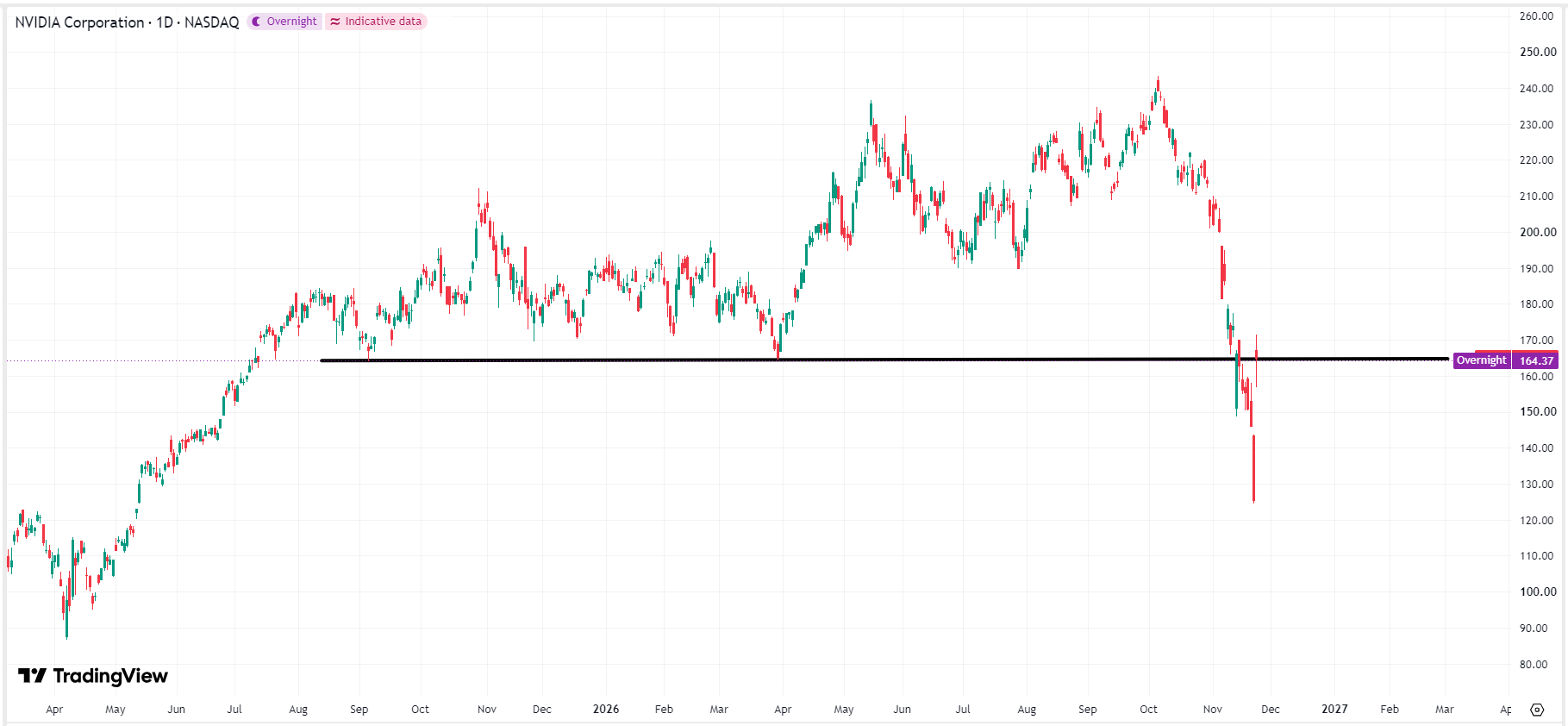 Nvidia stock price chart, Source: TradingView
Most importantly, during its gap-down plunge and high-level consolidation in mid-November, Nvidia accumulated a massive overhang of trapped positions in the $160 to $165 range. Having surged over 30%, the stock has rapidly approached this resistance zone, where 'break-even selling pressure' from trapped capital and 'short-term profit-taking' from yesterday's dip buyers are highly likely to collide, triggering severe volatility or even giving back gains with long upper shadows. During overnight trading, Nvidia's pullback below $165 was clear evidence of this overhead pressure.
Over the next 3 to 5 trading days, observe whether Nvidia, when testing $165, consolidates mildly on shrinking volume to build momentum or forms a heavy-volume, long bearish engulfing reversal. The former would indicate healthy ownership turnover, making it suitable for follow-up buying; the latter would signal that building a double bottom will take more time, requiring patience to wait for a secondary pullback.
Recommended Articles


