


Is the Worst Over for Nvidia Stock?
Key Points
Nvidia turned in another quarter of great growth and raised guidance for fiscal 2028.
However, longer-term worries still persist.
- Motley Fool Issues Rare "Total Conviction" Buy Alert ›
Nvidia (NASDAQ:NVDA) calmed some investor fears by raising fiscal 2028 guidance following the departure of founder and CEO Jensen Huang. However, the strong Nov. 17 report and fiscal 2028 forecast don't necessarily mean the worst is over for the stock, as longer-term worries persist, even with Huang unexpectedly being reinstated as CEO on Monday morning.
Let's dig into Nvidia's fiscal third-quarter results and prospects to see whether the semiconductor stock is a buy.
Missed Nvidia in 2009? This Rare Signal Is Flashing Again. In 2009, a "Double Down" signal flashed for a little-known chipmaker called Nvidia. For the first time in years, that same "Total Conviction" signal is flashing for a company 1/100th the size of Nvidia. Continue »
Huge growth continues
The biggest recent news for Nvidia came after the quarterly report, when Huang was welcomed back. Before that, the company had raised its revenue forecast for next year from 70% growth to 75% growth due to increased confidence in both supply and demand. There had been a growing concern that the company would reduce its forecast as it tries to flush out sales that eventually make their way to China illegally, so this was a big relief.
Showing confidence in the stock and business, Nvidia said it plans to repurchase $227 billion worth of shares by the end of fiscal 2028. Meanwhile, then-interim CEO and CFO Colette Kress was peppered with questions concerning everything from increased competition to margins and pricing power to neocloud financing to export controls and a potential data center slowdown in 2028.
While Kress handled these questions well, they are unlikely to go away. In the meantime, as competitors start to catch up and artificial intelligence (AI) models ironically weaken Nvidia's CUDA moat, the company's biggest strength is availability, having locked up scarce components, like high bandwidth memory (HBM) and fab capacity. This will continue to fuel results next fiscal year but could erode over time.
As for the quarterly results themselves, they were once again spectacular. Nvidia's Q3 revenue soared 103% to $115.8 billion, well above the $109.1 billion analyst consensus. Adjusted earnings per share (EPS), meanwhile, skyrocketed 111% to $2.68 from $1.27, coming in above analyst estimates of $2.48.
Data center segment revenue once again led the way, up 110% year over year to $107.6 billion. Nvidia's smaller edge computing segment, meanwhile, saw revenue jump 42% to $8.2 billion.
Within its data center segment, hyperscaler revenue climbed 71% to $60.1 billion, helped by the ramp-up of its Vera Rubin platform. AI cloud, industrial, and enterprise (ACIE) revenue surged 195% to $47.5 billion. The company said the growth was driven by the start of Vera Rubin shipments to neocloud customers and AI labs starting to build their own data centers.
One of the big drivers for Nvidia in the coming year will be the continued ramp-up of Vera Rubin. The platform contributed $20 billion in revenue in the quarter, which it said was the fastest product ramp in its history. With Vera Rubin costing about $40 billion per gigawatt of compute capacity versus $25 billion for Blackwell, Nvidia gets a very nice price lift as customers move to its newest system.
The company continues to generate a huge amount of cash, with operating cash flow of $48.3 billion and free cash flow of $28.1 billion in the quarter. It ended the period with cash and marketable securities of $53.5 billion and $32.3 billion in debt. It also has $65.5 billion in non-marketable securities, which are its investments in non-public companies, and $44.2 billion in marketable equity securities, which are investments in public companies.
Looking ahead, Nvidia guided for fiscal Q4 revenue to come in around $130 billion, which would represent 91% growth.

Image source: Getty Images.
Is the stock a buy?
Nvidia is growing rapidly, and the stock is cheap, trading at a forward price-to-earnings ratio below 10 times analyst estimates for fiscal 2028 earnings. The issue is what comes next.
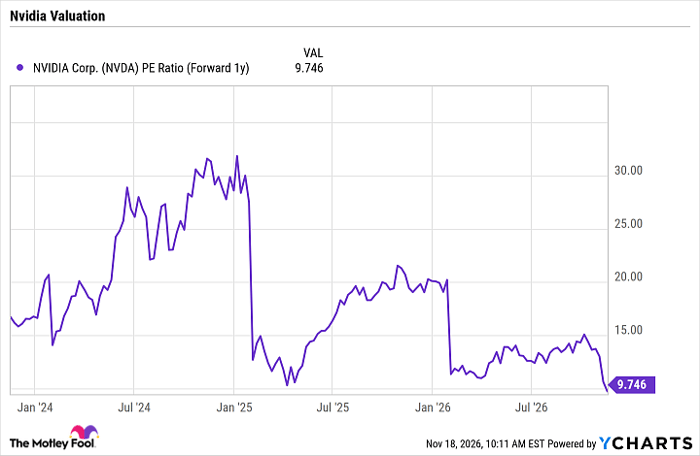
NVDA PE Ratio (Forward 1y) data by YCharts
Application-specific integrated circuits (ASICs), which are custom AI chips, and Advanced Micro Devices (NASDAQ:AMD) graphics processing units (GPUs) are catching up and, in some cases, outperforming Nvidia's GPUs on a price-to-performance basis. Meanwhile, Anthropic's (NASDAQ:ANT) Claude Mythos model just made it a whole lot easier to have models run on other chips. While Nvidia’s supply chain advantages will protect it in the near-to-medium term, there could be a serious risk of future price erosion and margin compression.
As such, despite the quarterly report and Huang’s return easing some immediate concerns, I'd stay on the sidelines for now.
Should you buy stock in Nvidia right now?
Before you buy stock in Nvidia, consider this:
The Motley Fool Stock Advisor analyst team just identified what they believe are the 10 best stocks for investors to buy now… and Nvidia wasn’t one of them. The 10 stocks that made the cut could produce monster returns in the coming years.
Consider when Netflix made this list on December 17, 2004... if you invested $1,000 at the time of our recommendation, you’d have $305,941!* Or when Nvidia made this list on April 15, 2005... if you invested $1,000 at the time of our recommendation, you’d have $771,325!*
Now, it’s worth noting Stock Advisor’s total average return is 719% — a market-crushing outperformance compared to 192% for the S&P 500. Don't miss the latest top 10 list, available with Stock Advisor, and join an investing community built by individual investors for individual investors.
See the 10 stocks »
*Stock Advisor returns as of November 23, 2026.
Geoffrey Seiler has positions in Advanced Micro Devices and Anthropic. The Motley Fool has positions in and recommends Advanced Micro Devices and Nvidia. The Motley Fool recommends Anthropic. The Motley Fool has a disclosure policy.
Recommended Articles


