


Why Saturday’s Historic Starship Catch Changes the Bull Case for SpaceX Stock
Key Points
Space Exploration Technologies successfully caught the upper stage of its Starship rocket for the first time.
As competitors struggle, the company is on its way to becoming a space monopoly.
- 10 stocks we like better than Space Exploration Technologies ›
This past weekend was a big one for the space sector, with Space Exploration Technologies (NASDAQ:SPCX) showing it's light-years ahead of its competition. For the first time, SpaceX successfully caught the upper stage of its Starship rocket using mechanical arms attached to its launch tower. It was a major milestone for the company, setting the stage for its future space ambitions.
Also this weekend, rival United Launch Alliance (ULA), a joint venture between Boeing (NYSE:BA) and Lockheed Martin (NYSE:LMT), had a major setback. Its Vulcan rocket failed, destroying 40 Amazon (NASDAQ:AMZN) Leo satellites in the process.
Missed Nvidia in 2009? This Rare Signal Is Flashing Again. In 2009, a "Double Down" signal flashed for a little-known chipmaker called Nvidia. For the first time in years, that same "Total Conviction" signal is flashing for a company 1/100th the size of Nvidia. Continue »
This weekend's results show the growing distance that SpaceX is gaining over its competitors in the space sector. Its achievement also comes months after Blue Origin's New Glenn rocket exploded on the ground in May, destroying the company's only launch pad. Space competitors are clearly struggling with launches, which is also hurting Amazon's efforts to get its Leo satellite internet service, which will compete with Amazon's Starlink, off the ground.
Still, not everything went well for SpaceX this weekend. It decided to abandon trying to catch Starship's Super Heavy booster, which it diverted to the Gulf of Mexico, where it exploded before reaching the water.
The Super Heavy Booster is the much more expensive part of Starship. According to PayLoad Research, a Starship rocket costs around $90 million, with the Super Heavy booster making up about $63 million of the total. However, the Super Heavy Booster is the easier part of the rocket to catch, and SpaceX has already caught it on its own multiple times.
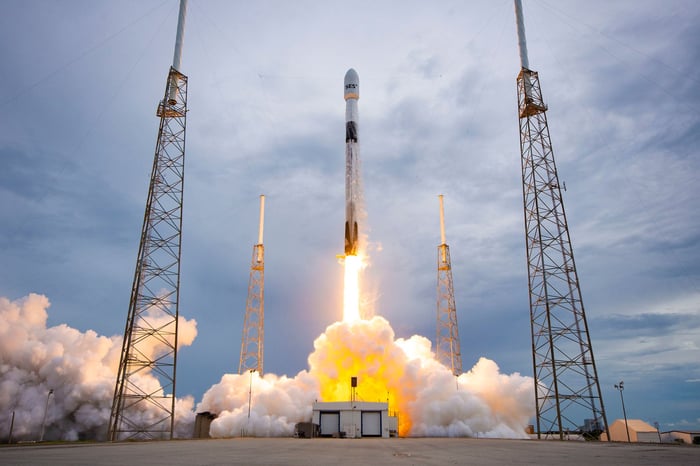
Image source: SpaceX.
A space monopoly
Having a fully reusable rocket is paramount for SpaceX to achieve some of its loftier goals, like orbital data centers and Earth-to-Earth cargo transport. By rapidly reusing a $90 million rocket multiple times rather than just once, SpaceX not only saves a lot of money but also greatly increases the number of launches it can perform.
This completely changes the economics of space and sets the company up for strong growth and the ability to disrupt industries, essentially shifting SpaceX's space segment from being a low-margin launch business into a scalable logistics business, where fuel and maintenance are the main recurring costs.
It also positions SpaceX as a monopoly in the orbital economy. By being the only company with massive, rapidly reusable rockets, SpaceX would control the entire market. It could price its services below competitors to win deals and capture the bulk of the market, while its huge cost advantage would allow it to pocket strong margins. Meanwhile, it would have a huge structural advantage that would allow it to build out Starlink or orbital data centers at costs well below competitors that would have to pay retail launch prices.
SpaceX still faces obstacles to achieving some of its loftier goals. It doesn't matter if SpaceX can launch data centers into space at a cost much lower than competitors' if it can't overcome some important hurdles.
One obstacle it will need to overcome is getting chips that can withstand cosmic radiation, which can flip bits and corrupt data. It is currently working with Nvidia (NASDAQ:NVDA) on a solution. It also needs to be able to develop a cooling solution, as currently there is no way to cool these systems in the vacuum of space. Meanwhile, with Earth-to-Earth transport, it will need to get past a lot of political red tape to launch rockets from places like China to the U.S.
Overall, this past weekend helped put SpaceX in the driver's seat and gave investors another reason to get excited about the stock. While it still has hurdles to overcome before entering some exciting new markets, its lead just keeps growing. That makes this growth stock a buy.
Should you buy stock in Space Exploration Technologies right now?
Before you buy stock in Space Exploration Technologies, consider this:
The Motley Fool Stock Advisor analyst team just identified what they believe are the 10 best stocks for investors to buy now… and Space Exploration Technologies wasn’t one of them. The 10 stocks that made the cut could produce monster returns in the coming years.
Consider when Netflix made this list on December 17, 2004... if you invested $1,000 at the time of our recommendation, you’d have $305,941!* Or when Nvidia made this list on April 15, 2005... if you invested $1,000 at the time of our recommendation, you’d have $771,325!*
Now, it’s worth noting Stock Advisor’s total average return is 719% — a market-crushing outperformance compared to 192% for the S&P 500. Don't miss the latest top 10 list, available with Stock Advisor, and join an investing community built by individual investors for individual investors.
See the 10 stocks »
*Stock Advisor returns as of November 22, 2026.
Geoffrey Seiler has positions in Amazon. The Motley Fool has positions in and recommends Amazon, Boeing, Lockheed Martin, Nvidia, and Space Exploration Technologies. The Motley Fool has a disclosure policy.
Recommended Articles


