


Accenture (ACN) Crashed 18% After Earnings — Is a Forward P/E Below 10 a Buying Opportunity?
TradingKey - Accenture (NYSE: ACN) finished the trading session at $127.98 on June 18. This came on the heels of a 17.97% drop, a single-day plunge that was widely referred to by Bloomberg as the steepest fall since Accenture went public after the firm unveiled its fiscal 2026 Q3 earnings. This quarter was anything but an epic failure. EPS was $3.80, which outpaced consensus by $0.08 to $0.09. The operating margin was 17.0%, 20 basis points better than expected. Free cash flow, meanwhile, was an amazing $3.6 billion for the quarter, something you’d expect most large companies to announce as the main headline of the quarter. So why did the stock fall close to 18%? Because of what Accenture expects to happen in the future; not what happened in Q3.
Today, June 22, the stock is trading at $127.98 with an RSI of 20.86 (deeply oversold) as it builds a double-bottom near the $129.16 price level (1.618 Fibonacci extension). The stock trades at less than 10X forward earnings. For now, investors should ask: did the market price in serious deterioration, or did they overshoot?
What Actually Caused the 18% Crash — Three Simultaneous Headwinds and a Guidance Cut
The sell-off wasn’t related to Q3 results. Revenue of $18.7 billion was about $214 million below consensus; bookings were $19.32 billion, a 2% decrease USD and 3% decrease locally year-over-year. A decline in bookings is a warning signal that precedes a downturn in current quarter results. It’s that combination of declining bookings and cut guidance that creates a bearish outlook on current revenues.
The company cut the top end of its guidance on full-year fiscal 2026 revenue growth by citing three separate factors: an approximately $100 million headwind from the conflict in the Middle East, customers choosing to defer large managed-service agreements into FY 2027, because they are taking a wait-and-see approach to the Warsh Fed’s higher-for-longer rates policy, and continued weakness in federal consulting sales in the U.S. Earlier that same morning, Accenture announced it would spend $4.18 billion to acquire a controlling stake in Dragos, plus full ownership of runZero and NetRise, in order to expand its services offerings into operational technology (OT) security and industrial cybersecurity.
It makes sense, OT security is a growing market as critical infrastructure faces more cyberattacks. But announcing a large investment at the same time that Accenture lowered its revenue expectations for this year caused analysts to wonder if it would be more difficult than expected to integrate the businesses and whether capital would be spent effectively. Evercore ISI lowered its price target on Accenture to $180 from $250, although they maintained an Outperform rating on the stock.
For months, the big question has been whether there is a shift in demand towards using AI to automate the implementation and managed services consulting for which Accenture has been hired. The bookings data gives this new relevance.
The AI Cannibalisation Question — Why This Sell-Off Is Bigger Than a Single Guidance Cut
Accenture has touted itself as an AI transformation champion. And in the first nine months of FY26, Accenture says it logged 104 bookings of $100 million or more, up 13% year-over-year. And says that large-scale AI reinvention projects is one of the key growth drivers. And all that makes sense, of course. But the problem is, Accenture is also seeing AI automation reduce Accenture’s biggest revenue segment by far, labor-intensive managed services and system integration work. Accenture is a consulting firm that helps its clients build AI-powered systems, and that over time means Accenture’s clients end up building systems that need fewer consultants to run.
Accenture’s management has acknowledged this and said that the company will still be able to capture the build-and-integrate work as run-and-maintenance work compresses, but the bookings slow-up raises the question of whether it’s transitioning into that revenue stream as fast as it’s moving out of legacy revenue. With respect to the bull case here at $128, the only meaningful counter is that of Accenture’s free cash flow.
FCF of $3.6 billion in a single quarter annualizes to $14.4 billion, above even the raised full-year guidance range of $10.8 billion to $11.5 billion, and Accenture has returned $8.2 billion to shareholders year-to-date via dividends and buybacks, including $1.2 billion in buybacks in Q3 alone.
A business like this, making that kind of free cash flow and consistently returning it to shareholders, shouldn’t trade at a forward price-to-earnings ratio of 10 or less unless there’s something going wrong with free cash flow itself or the market is just overreacting. The latter seems the more plausible option here. The guidance cut is real. The AI cannibalization risk is real. The RSI is at 20.86 with a double bottom forming is also real.
ACN Technical Setup — RSI 20.86 Extreme Oversold, Double Bottom at $129, Target $155.60
On the daily time frame, the stock closed at $127.98 after a 17.97% gap down. The 1.618 Fib at $129.16 appears to line up with a double bottom, and the RSI at 20.86 is extremely oversold, which has only happened before on the worst stock market dislocations, and price is forming positive divergence on its recent lows. Resistance from both the 50-EMA at $179.18 and the 200-EMA at $221.91 is much higher up. Volume on the gap down was at institutional capitulation levels and confirms the exhaustion of the move.
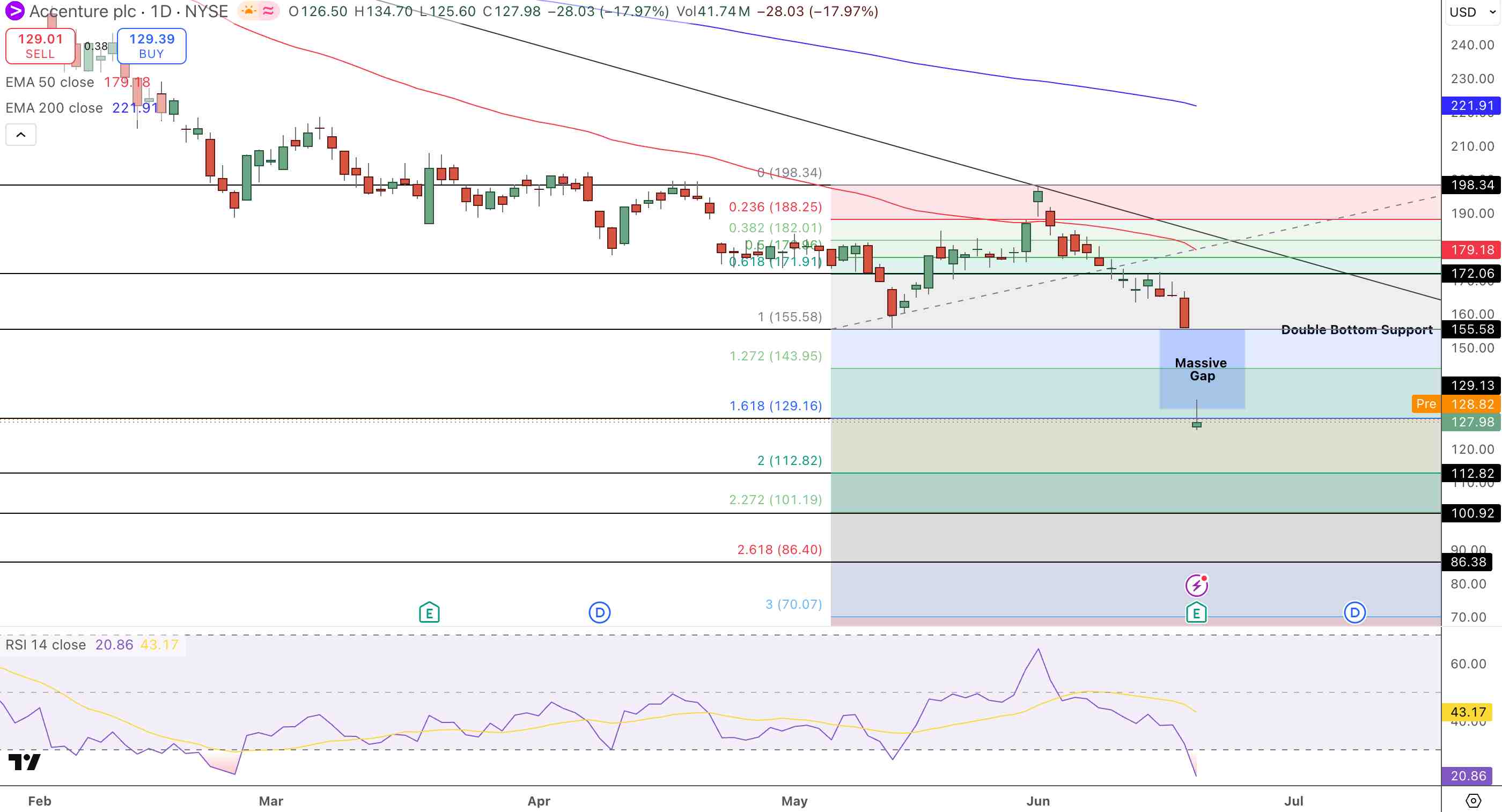
Accenture (ACN) Price Chart - Source: Tradingview
A close above $129.10 and the double bottom breakout could target $155.60, which is where the 1.0 Fib and previous support reside. The suggested stop loss below $112.80 represents the lower boundary of the double bottom.
- Entry: Long above $129.10, break of lower boundary of double bottom
- Target: $155.60, 1.0 Fib extension, and double bottom breakout
- Stop: Close below $112.80, double bottom fails
- RSI: 20.86, extremely oversold, with positive divergence forming
- Forward P/E: Below 10x, below historical levels for Accenture
Why Did Accenture's Shares Plummet 18% Post Earnings?
The stock of Accenture (ACN) fell 17.97% to $127.98 to mark its biggest-ever single-day drop after the company surpassed Wall Street's Q3 fiscal 2026 profit estimates at $3.80, compared to a consensus spread of $3.71 to $3.75. The company also revealed a widening of its operating margin, but that wasn't enough to overcome a disappointing outlook for the rest of the year. Year-over-year, new bookings dropped 2% in U.S. dollar terms and 3% in constant currency to $19.32 billion.
On top of that, Accenture cut the top end of its full-year revenue growth guidance to account for three immediate problems: Middle East troubles (estimated to have caused $100 million in losses), large deferred contracts for managed services (caused by the Fed's higher-for-longer rate policy), and a still-ailing U.S. federal services business. The decision to acquire a cyber security business for $4.18 billion at the same time may have also spooked investors.
Is AI Disrupting Accenture's Business Model?
The booking decline prompted this fundamental question, which is now more critical than ever. In the nine months to date, Accenture said it landed 104 clients with $100 million-plus bookings. These clients signed deals that were up 13% from a year-ago period. Accenture positions itself as the firm that will help clients install the infrastructure for generative AI. But investors worry that generative AI will make the labor-intensive services Accenture traditionally charges for, in managed services and systems integration, less attractive. Management says that Accenture's work installing new AI systems will make up for any short-term pain as its customers reduce reliance on managed services, but the slowing bookings trend suggests that the transition may take longer than expected.
Is ACN a Buy at $128 After the Record Crash?
Bull case: A relative strength index of 20.86 suggests the stock is extremely oversold while it starts to form a positive divergence, and there's also the possibility of a double-bottom pattern forming at the 1.618 Fibonacci Extension level. Free cash flow of $3.6 billion per quarter annualizes well ahead of what is now a lowered guidance estimate, and the stock is trading at less than 10 times forward earnings, the lowest valuation in the company's public market history for a business of this size and quality.
Bear case: Weak bookings may be an early warning signal that revenue and earnings growth are about to deteriorate, the risk of jobs being replaced by AI is a long-term, structural problem, and the company has not seen the effects of conflicts in the Middle East or its U.S. government business resolve. Target is $155.60 if the stock closes the next trading day above $129.10. Stop is $112.80.
Bottom Line
The company suffered its largest one-day drop ever on June 18 when shares sank 17.97%. The selloff occurred not after the quarter, for which the company surpassed consensus profit estimates and reported $3.6 billion of free cash flow, but because new bookings slowed, management trimmed 2026 revenue guidance to account for three immediate headwinds, and the company announced plans to acquire a $4.18 billion cyber security business. The fundamental question is whether the company's traditional business model is being disrupted by AI.
At a price of $127.98 per share, Accenture has an RSI of 20.86, it's forming a double-bottom at the 1.618 Fibonacci Extension level, and it's trading at less than 10 times forward earnings. Together with free cash flow of $3.6 billion a quarter, the technical and valuation setup suggests that this is one of the stock's most oversold moments in recent history. Target is $155.60 if the stock closes the next trading day above $129.10. Stop is $112.80. The bulls hope that Accenture's ability to generate free cash flow and return capital to shareholders will be fine regardless of the AI job displacement debate. The bears believe that declining new bookings signal an inevitable near-term slowdown in revenue for the rest of 2026.
Recommended Articles


