

Gold nears record highs as dovish Fed outlook underpins demand
- Gold extends gains as investors reassess the Fed’s monetary policy path into 2026 following a third rate cut this year.
- A softer US Dollar and persistent geopolitical tensions continue to underpin bullion.
- Technically, XAU/USD eyes record highs after breaking out of a two-week consolidation.
Gold (XAU/USD) extends its advance on Friday as expectations build for further monetary policy easing by the Federal Reserve (Fed) after this week’s interest rate cut. At the time of writing, XAU/USD is trading around $4,335, just shy of its all-time high near $4,381, marked on October 20.
The latest leg higher helped Bullion break out of a two-week consolidation range, as markets continue to reassess the Fed’s policy path into 2026. The shift in sentiment follows Wednesday’s decision to lower borrowing costs by 25 basis points (bps), marking the third rate cut this year.
While the Fed stopped short of offering clear forward guidance, Chair Jerome Powell signalled that near-term rate hikes are unlikely, reiterating the familiar data-dependent stance while highlighting risks on both sides of the Fed’s dual mandate. The less hawkish outlook than markets had anticipated prompted traders to price in two rate cuts next year, even as the latest dot plot points to just one.
Elsewhere, persistent geopolitical tensions continue to provide steady underlying support for Gold, with XAU/USD on track to post solid weekly gains.
Market movers: Fed outlook, institutional demand and geopolitics drive sentiment
- Gold is back again near record highs, up over 60% year-to-date and on track for its best annual performance since 1979. The rally has been driven by strong central bank demand, robust ETF inflows, dovish Fed outlook, and persistent geopolitical tensions. Major banks expect the trend to extend into 2026, with Goldman Sachs saying on Wednesday it sees significant upside to its end-2026 Gold price forecast of $4,900 per ounce, while Bank of America expects prices to push toward $5,000 an ounce.
- Structural demand pick-up for Bullion from Indian pension funds, as regulatory reform now allows the National Pension System (NPS) and other pension schemes to allocate a portion of assets to SEBI-regulated Gold and Silver ETFs. This marks the first time Indian pension funds can gain direct exposure to precious metals.
- The Greenback remains under pressure, making Gold cheaper for overseas buyers as markets lean dovish on the Fed. The US Dollar Index (DXY), which tracks the Greenback's value against a basket of six major currencies, trades near 98.47 after slipping to an eight-week low on Thursday, and is on course for a third weekly decline.
- The Fed’s rate decision was not unanimous, passing on a 9-3 vote. Governor Stephen Miran once again advocated a larger 50-bps cut, while Chicago Fed President Austan Goolsbee and Kansas City Fed President Jeffrey Schmid preferred to leave rates unchanged. Markets now look to remarks from Goolsbee, Schmid, and Cleveland Fed President Beth Hammack later on Friday.
- Geopolitical tensions remain elevated amid slow progress in US-led Russia-Ukraine peace talks in Europe. Ukrainian President Volodymyr Zelensky has raised serious concerns over a US proposal to designate the contested Donbas region as a “free economic zone.” US President Donald Trump has voiced frustration with the pace of negotiations, hinting he could skip peace talks in Europe this weekend.
Technical analysis: XAU/USD eyes record highs after breakout
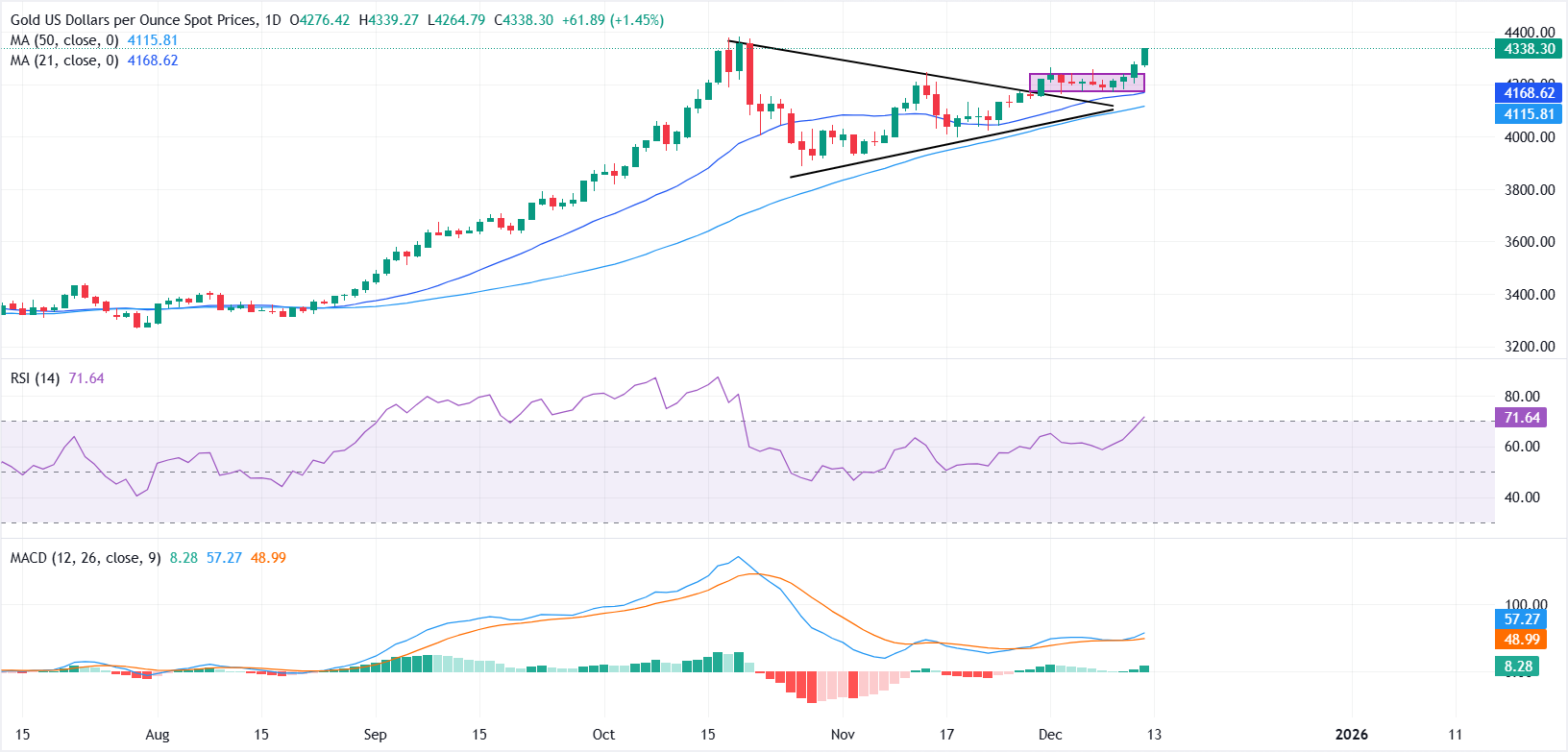
XAU/USD has finally managed to break out of its recent consolidation phase after repeated pullbacks were capped near the $4,250 area, with price action resuming the broader uptrend and trading comfortably above key moving averages on the daily chart.
On the upside, $4,350 emerges as the next near-term resistance, ahead of a potential retest of the all-time high near $4,381. A sustained break above this zone would likely open the door for fresh record highs, provided bullish momentum continues to strengthen.
On the downside, $4,250 now acts as strong initial support. A deeper pullback could find buyers near the 21-day Simple Moving Average (SMA) at $4,168, which remains a key short-term level to defend for bulls.
Momentum indicators support the constructive outlook. The Relative Strength Index (RSI) is holding above 70, pointing to strong upside momentum, though it also warns of near-term overbought conditions. Meanwhile, the Moving Average Convergence Divergence (MACD) line extends above the Signal line and stands over the zero mark, while the histogram expands positively, suggesting strengthening bullish momentum.
Gold FAQs
Gold has played a key role in human’s history as it has been widely used as a store of value and medium of exchange. Currently, apart from its shine and usage for jewelry, the precious metal is widely seen as a safe-haven asset, meaning that it is considered a good investment during turbulent times. Gold is also widely seen as a hedge against inflation and against depreciating currencies as it doesn’t rely on any specific issuer or government.
Central banks are the biggest Gold holders. In their aim to support their currencies in turbulent times, central banks tend to diversify their reserves and buy Gold to improve the perceived strength of the economy and the currency. High Gold reserves can be a source of trust for a country’s solvency. Central banks added 1,136 tonnes of Gold worth around $70 billion to their reserves in 2022, according to data from the World Gold Council. This is the highest yearly purchase since records began. Central banks from emerging economies such as China, India and Turkey are quickly increasing their Gold reserves.
Gold has an inverse correlation with the US Dollar and US Treasuries, which are both major reserve and safe-haven assets. When the Dollar depreciates, Gold tends to rise, enabling investors and central banks to diversify their assets in turbulent times. Gold is also inversely correlated with risk assets. A rally in the stock market tends to weaken Gold price, while sell-offs in riskier markets tend to favor the precious metal.
The price can move due to a wide range of factors. Geopolitical instability or fears of a deep recession can quickly make Gold price escalate due to its safe-haven status. As a yield-less asset, Gold tends to rise with lower interest rates, while higher cost of money usually weighs down on the yellow metal. Still, most moves depend on how the US Dollar (USD) behaves as the asset is priced in dollars (XAU/USD). A strong Dollar tends to keep the price of Gold controlled, whereas a weaker Dollar is likely to push Gold prices up.
Artigos Recomendados


