




AUD/JPY climbs as risk appetite improves, BoJ decision looms
- AUD/JPY trades above 94.00 as improved risk sentiment and stronger-than-expected China Retail Sales support the Aussie.
- The Bank of Japan is expected to hold its rates at 0.50% on Tuesday, which could support the strength of AUD/JPY.
- The Australian Dollar remains firm on diverging policy outlooks between the RBA and BoJ.
AUD/JPY is trading firmer on Monday, supported by improved risk sentiment and diverging policy outlooks between the Reserve Bank of Australia (RBA) and the Bank of Japan (BoJ).
The pair is holding near 94.46 at the time of writing, up over 1% on the day, extending gains as investors shift capital into higher-yielding currencies, driven by diverging monetary policy outlooks and an increase in risk sentiment.
Investor risk appetite improved after alleged diplomatic overtures from Iran via Gulf intermediaries, signaling a potential interest in easing tensions with Israel. While no truce or formal agreement has been reached, the reports helped improve market sentiment.
As a result, demand for safe-haven currencies like the Japanese Yen (JPY) waned, while the Australian Dollar (AUD) found support from stronger May Retail Sales in China.
Traders are also watching the BoJ policy decision on Tuesday, where the central bank is widely expected to hold rates at 0.5% and may provide updated guidance on the pace of tapering its government bond purchases.
With the RBA maintaining a relatively hawkish bias, monetary policy divergence continues to favor the upside for AUD/JPY.
AUD/JPY surges above 94.00
AUD/JPY is trading higher on Monday, holding near 94.46 at the time of writing. After rebounding off the 50-day Simple Moving Average (SMA) at 92.42, the pair has moved above the midpoint of the November–April decline, at 94.23.
A Morning Star reversal pattern, a three-candlestick pattern that often signals a bullish trend reversal, has formed above the 38.2% Fibonacci retracement at 92.30, highlighting a shift in momentum following last week’s pullback.
Immediate resistance is located at 94.23. A close above this level could pave the way toward 96.16, which marks the 61.8% Fibonacci retracement, followed by the psychological barrier at 97.00.
On the downside, initial support is seen at 92.30, aligning with both the Morning Star base and the 38.2% Fibonacci level. Below that, the 23.6% retracement at 89.91 offers deeper support, with the March low at 86.05 marking a critical downside target if bearish pressure returns.
AUD/JPY daily chart
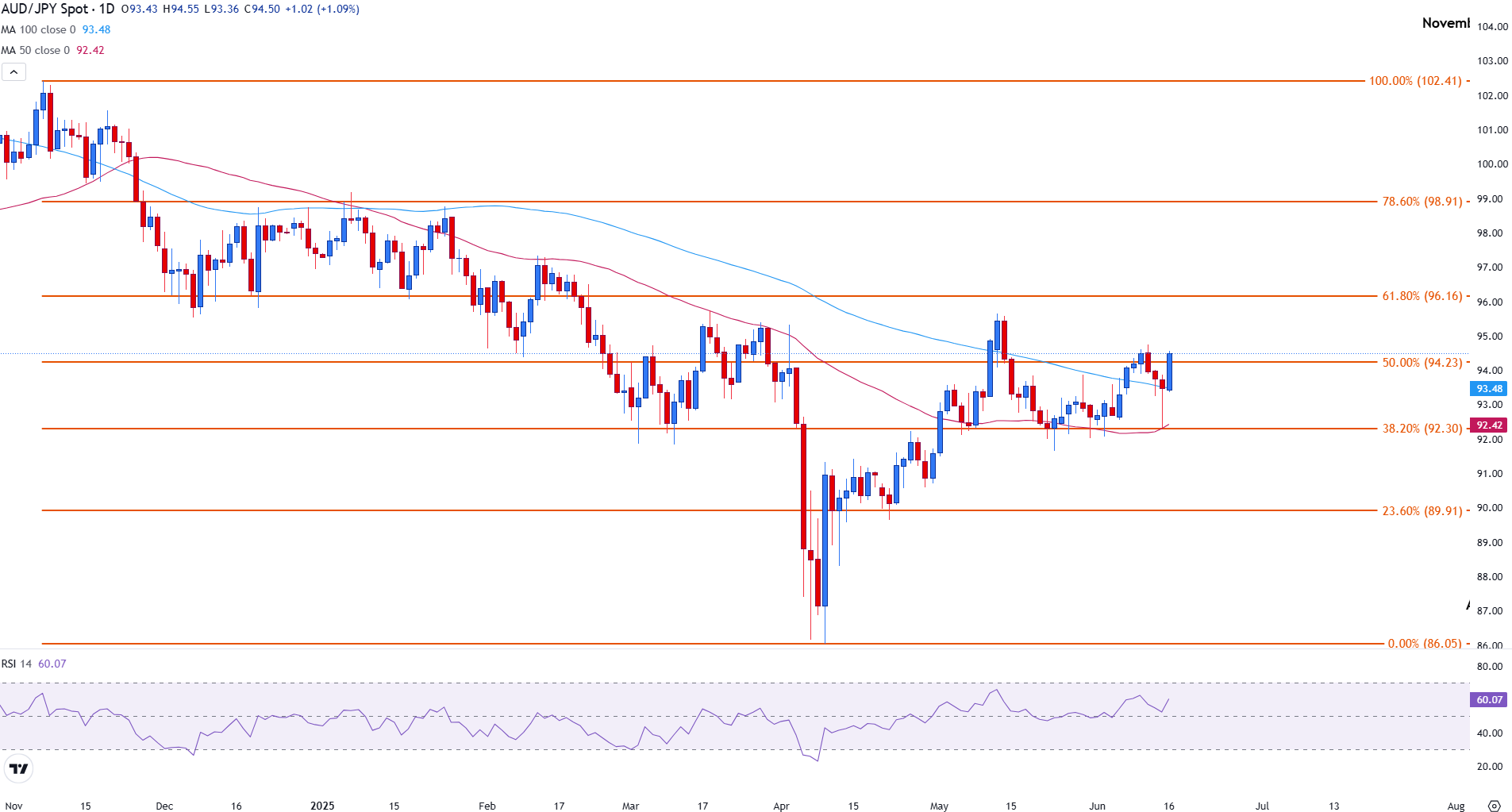
Meanwhile, the Relative Strength Index (RSI) on the daily timeframe is nearing 60, turning higher without breaching overbought territory.
This suggests that bullish momentum is building but still has room to extend before entering exhaustion, as the RSI is not yet in overbought territory, indicating potential for further upward movement.
Economic Indicator
BoJ Interest Rate Decision
The Bank of Japan (BoJ) announces its interest rate decision after each of the Bank’s eight scheduled annual meetings. Generally, if the BoJ is hawkish about the inflationary outlook of the economy and raises interest rates it is bullish for the Japanese Yen (JPY). Likewise, if the BoJ has a dovish view on the Japanese economy and keeps interest rates unchanged, or cuts them, it is usually bearish for JPY.
Read more.Next release: Tue Jun 17, 2025 03:00
Frequency: Irregular
Consensus: 0.5%
Previous: 0.5%
Source: Bank of Japan
Bank of Japan FAQs
The Bank of Japan (BoJ) is the Japanese central bank, which sets monetary policy in the country. Its mandate is to issue banknotes and carry out currency and monetary control to ensure price stability, which means an inflation target of around 2%.
The Bank of Japan embarked in an ultra-loose monetary policy in 2013 in order to stimulate the economy and fuel inflation amid a low-inflationary environment. The bank’s policy is based on Quantitative and Qualitative Easing (QQE), or printing notes to buy assets such as government or corporate bonds to provide liquidity. In 2016, the bank doubled down on its strategy and further loosened policy by first introducing negative interest rates and then directly controlling the yield of its 10-year government bonds. In March 2024, the BoJ lifted interest rates, effectively retreating from the ultra-loose monetary policy stance.
The Bank’s massive stimulus caused the Yen to depreciate against its main currency peers. This process exacerbated in 2022 and 2023 due to an increasing policy divergence between the Bank of Japan and other main central banks, which opted to increase interest rates sharply to fight decades-high levels of inflation. The BoJ’s policy led to a widening differential with other currencies, dragging down the value of the Yen. This trend partly reversed in 2024, when the BoJ decided to abandon its ultra-loose policy stance.
A weaker Yen and the spike in global energy prices led to an increase in Japanese inflation, which exceeded the BoJ’s 2% target. The prospect of rising salaries in the country – a key element fuelling inflation – also contributed to the move.
Artigos Recomendados


