


Fed Minutes to provide fresh clues as markets reassess interest rate expectations
- The FOMC Minutes could provide fresh clues on how divided officials were before Kevin Warsh takes over as Fed Chair.
- Investors will scrutinize whether policymakers questioned the Fed’s easing bias in April.
- Persistent inflation pressures and higher Oil prices have shifted market expectations from rate cuts toward possible tightening.
The Minutes of the United States (US) Federal Reserve’s (Fed) April 28-29 monetary policy meeting will be published on Wednesday at 18:00 GMT. The US central bank decided to leave the policy rate unchanged at the 3.50%-3.75% range at that meeting, although the decision revealed an unusually high degree of disagreement within the Committee.
Fed Governor Stephen Miran voted in favor of a 25-basis-point (bps) rate cut, while Cleveland Fed President Beth Hammack, Minneapolis Fed President Neel Kashkari and Dallas Fed President Lorie Logan dissented against maintaining an easing bias in the policy statement.
Jerome Powell and company opted to hold rates in April
The Federal Open Market Committee (FOMC) kept rates unchanged in April for a third consecutive meeting, but the focus quickly shifted to the internal divide over the future policy direction. While policymakers broadly agreed on keeping rates steady, disagreement emerged over the communication surrounding the next move.
In the post-meeting statement, the Federal Reserve retained language suggesting an easing bias, implying that future policy adjustments could still lean toward rate reductions if conditions warrant. However, several policymakers appeared increasingly uncomfortable with maintaining that message amid rising inflation risks.
Since the April meeting, the macroeconomic backdrop has shifted significantly. Inflation concerns have intensified following stronger-than-expected price data and higher energy costs linked to geopolitical tensions. Consumer Price Index (CPI) inflation accelerated to 3.8% YoY in April, its highest level in three years, while elevated Oil prices continue to fuel fears of broader price pressures.
At the same time, labor market data remains relatively resilient, reducing the urgency for policy easing. April’s Nonfarm Payrolls showed 115K new jobs created in the US, below the stellar 185K reported in March, but well above the 62K expected.
Previewing the release, Bank of America analysts expect the publication to reinforce the Fed’s recent hawkish tone. They noted that policymakers likely focused on persistent inflation risks and upside pressures linked to geopolitical developments, while Wells Fargo analysts expect the Minutes to provide additional details on whether non-voting members also viewed the next policy move as being equally likely to be a hike or a cut.
The publication could also attract additional attention because it represents the final set of Minutes linked to Jerome Powell’s tenure as Fed Chair before Kevin Warsh officially takes over leadership of the central bank.
When will FOMC Minutes be released and how could it affect the US Dollar?
The FOMC will release the Minutes of the April 28-29 policy meeting at 18:00 GMT on Wednesday.
Market expectations on interest rates have changed sharply over recent weeks. Fed funds futures have shifted away from pricing rate cuts and now reflect growing expectations that rates could remain unchanged for an extended period, with some investors even seeing the risk of higher rates later this year.
According to the FdWatch tool, the chances of a Fed 25 bps rate hike by December sit at 40.1%, against only 43.4% for a hold.
This positioning suggests that the US Dollar (USD) could react strongly if the Minutes reveal broader support for removing the easing bias or indicate that more officials discussed conditions that could eventually justify tighter monetary policy.
The Greenback could gather additional strength if policymakers express rising concerns that inflation risks are becoming more persistent, particularly if discussions show that upside risks outweigh concerns about economic growth.
Conversely, the US Dollar could come under pressure if the publication highlights that most policymakers still considered inflation shocks linked to energy prices as temporary and continued to see the next policy move leaning toward easing once price pressures moderate.
Nevertheless, any market reaction could remain limited as investors may prefer to wait for additional inflation and labor market data before reassessing expectations for the June FOMC meeting under Kevin Warsh’s leadership.
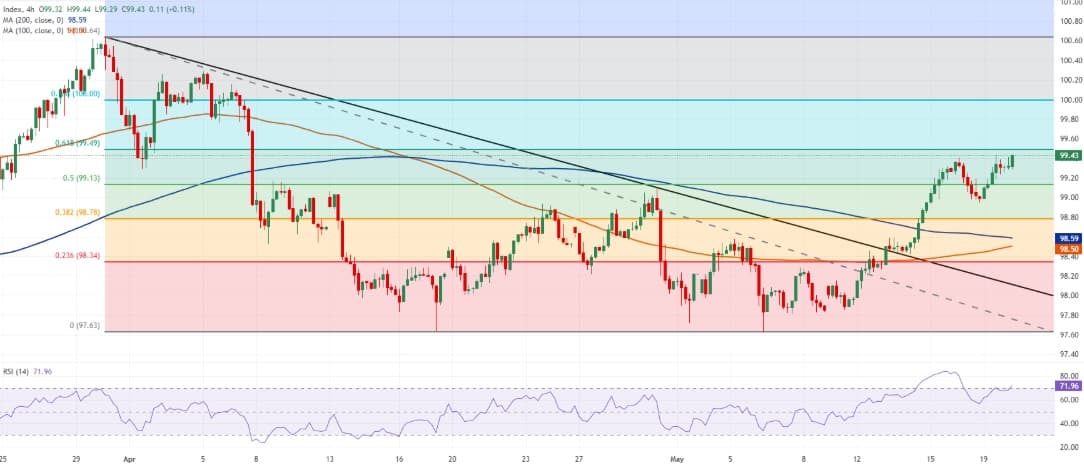
The US Dollar Index (DXY) trades at 99.43 at the time of writing. The near-term tone is bullish as price holds above both the 100-period and 200-period Simple Moving Averages (SMAs) on the 4-hour chart, reinforcing a constructive structure after breaking and moving above the prior downward trend-line resistance. Momentum is stretched, with the Relative Strength Index (RSI) hovering in overbought territory near 72, which suggests upside pressure persists but also leaves the index vulnerable to a corrective pause if buyers lose conviction just below nearby Fibonacci resistance.
On the topside, immediate resistance emerges at the 61.8% Fibonacci retracement, drawn from the March 31 high to the April 17 low, at 99.49, with a break there exposing the 78.6% Fibonacci retracement at the 100.00 round level and the recent swing high near 100.64 as a more significant barrier. On the downside, initial support aligns with the 50% retracement at 99.13, ahead of a broader demand band clustered around the 38.2% Fibonacci retracement at 98.78, the 200-period SMA near 98.59 and the 100-period SMA around 98.50, while deeper pullbacks would look to the 23.6% Fibonacci retracement at 98.34 and the prior swing low at 97.63 to limit losses.
(The technical analysis of this story was written with the help of an AI tool.)
Fed FAQs
Monetary policy in the US is shaped by the Federal Reserve (Fed). The Fed has two mandates: to achieve price stability and foster full employment. Its primary tool to achieve these goals is by adjusting interest rates. When prices are rising too quickly and inflation is above the Fed’s 2% target, it raises interest rates, increasing borrowing costs throughout the economy. This results in a stronger US Dollar (USD) as it makes the US a more attractive place for international investors to park their money. When inflation falls below 2% or the Unemployment Rate is too high, the Fed may lower interest rates to encourage borrowing, which weighs on the Greenback.
The Federal Reserve (Fed) holds eight policy meetings a year, where the Federal Open Market Committee (FOMC) assesses economic conditions and makes monetary policy decisions. The FOMC is attended by twelve Fed officials – the seven members of the Board of Governors, the president of the Federal Reserve Bank of New York, and four of the remaining eleven regional Reserve Bank presidents, who serve one-year terms on a rotating basis.
In extreme situations, the Federal Reserve may resort to a policy named Quantitative Easing (QE). QE is the process by which the Fed substantially increases the flow of credit in a stuck financial system. It is a non-standard policy measure used during crises or when inflation is extremely low. It was the Fed’s weapon of choice during the Great Financial Crisis in 2008. It involves the Fed printing more Dollars and using them to buy high grade bonds from financial institutions. QE usually weakens the US Dollar.
Quantitative tightening (QT) is the reverse process of QE, whereby the Federal Reserve stops buying bonds from financial institutions and does not reinvest the principal from the bonds it holds maturing, to purchase new bonds. It is usually positive for the value of the US Dollar.
추천 기사


