

USD/INR drops further amid caution ahead of Fed’s monetary policy
- The Indian Rupee gains further against the US Dollar as US Trade Representative Switzer confirms that he will visit India for trade talks.
- Investors expect the Fed to cut interest rates by 25 bps to 3.50%-3.75%.
- This week, investors will focus on India’s retail CPI data, scheduled for release on Friday.
The Indian Rupee (INR) rises further against the US Dollar (USD) on Wednesday. The USD/INR pair falls to near 90.00 as the Indian Rupee bounces back on the announcement that United States (US) Deputy Trade Representative Rick Switzer will visit India on December 10-11 to take forward trade discussions.
Trade negotiators from India would look to push for reducing tariffs on exports to the US, which currently stands at 50%, one of the highest among Washington’s trading partners.
Signs from the meeting that the US and India have progressed towards reaching a consensus would be favorable for the Indian Rupee, which has lost significant interest from overseas investors due to trade deal uncertainty.
So far in December, Foreign Institutional Investors (FIIs) have turned out to be net sellers in all trading days, and have offloaded stake worth Rs. 14,819.29 crores. FIIs have also remained net sellers in the last five months.
On the domestic front, investors will focus on the retail Consumer Price Index (CPI) data for November, which will be released on Friday. According to a December 4-8 Reuters poll, India’s retail inflation grew at an annualized pace of 0.7%, faster than 0.25% in October.
Daily digest market movers: Investors await Fed’s guidance on the interest rate outlook
- A further recovery move by the Indian Rupee against the US Dollar is also driven by caution among investors ahead of the Federal Reserve’s (Fed) monetary policy, which will be announced at 19:00 GMT.
- As of writing, the US Dollar Index (DXY), which gauges the Greenback’s value against six major currencies, ticks down to near 99.20
- The CME FedWatch tool shows that the probability of the Fed cutting interest rates by 25 basis points (bps) to 3.50%-3.75% in the December policy meeting is 87.6%. This will be the third interest rate cut by the Fed in a row. Firm Fed dovish expectations are driven by weak United States (US) labour market conditions.
- Lately, a significant number of Federal Open Market Committee (FOMC) members also supported the need of further policy expansion amid downside employment risks. In late November, New York Fed Bank President John Williams stated that there is room for further interest rate cuts in the near term as the policy is still modestly restrictive, while warning that the "economic growth has slowed and the labour market gradually cooled".
- As the Fed is almost certain to bring borrowing rates down further, the major driver for the US Dollar’s outlook will be Fed’s guidance on interest rates. Investors would like to know whether the Fed will announce a pause to the ongoing monetary-easing campaign or lean towards a data-dependent approach.
- Financial market participants will also focus on the Fed’s dot plot, which shows where policymakers collectively see the Federal Funds Rate heading in the near-to-longer term.
Technical Analysis: USD/INR falls to near 90.00
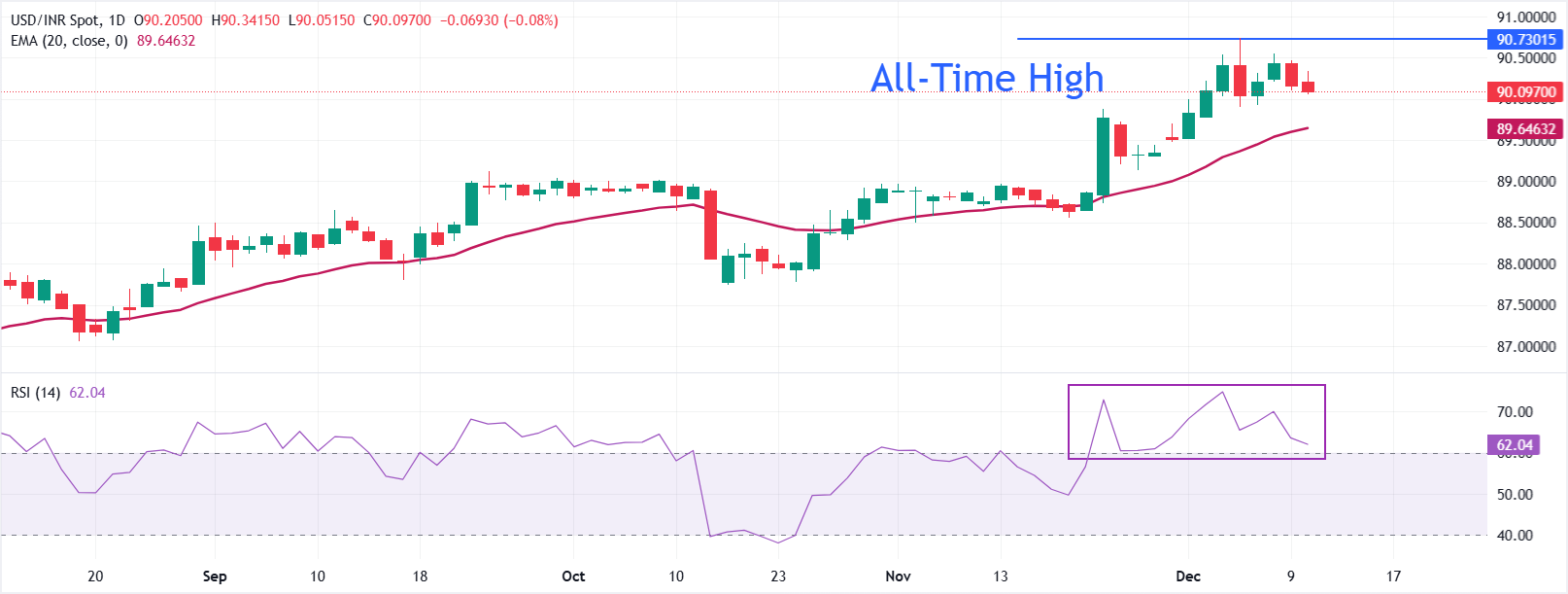
USD/INR trades near 90.00 in the opening session on Wednesday. The upward-sloping 20-day Exponential Moving Average (EMA) at 89.6463 underscores a steady uptrend, with spot holding above it.
The 14-day Relative Strength Index (RSI) at 62 has eased from earlier overbought readings, indicating firm yet moderating momentum.
Trend strength would remain in place while price stays above the 20-day EMA, where pullbacks could find support. A renewed push in momentum toward the RSI 70.00 band could extend gains, whereas a drop toward 50.00 would signal consolidation. Buyers defending the 20-day EMA would keep the path higher intact, while a close below it could open a deeper correction toward the November 13 high at 88.97.
(The technical analysis of this story was written with the help of an AI tool)
Indian Rupee FAQs
The Indian Rupee (INR) is one of the most sensitive currencies to external factors. The price of Crude Oil (the country is highly dependent on imported Oil), the value of the US Dollar – most trade is conducted in USD – and the level of foreign investment, are all influential. Direct intervention by the Reserve Bank of India (RBI) in FX markets to keep the exchange rate stable, as well as the level of interest rates set by the RBI, are further major influencing factors on the Rupee.
The Reserve Bank of India (RBI) actively intervenes in forex markets to maintain a stable exchange rate, to help facilitate trade. In addition, the RBI tries to maintain the inflation rate at its 4% target by adjusting interest rates. Higher interest rates usually strengthen the Rupee. This is due to the role of the ‘carry trade’ in which investors borrow in countries with lower interest rates so as to place their money in countries’ offering relatively higher interest rates and profit from the difference.
Macroeconomic factors that influence the value of the Rupee include inflation, interest rates, the economic growth rate (GDP), the balance of trade, and inflows from foreign investment. A higher growth rate can lead to more overseas investment, pushing up demand for the Rupee. A less negative balance of trade will eventually lead to a stronger Rupee. Higher interest rates, especially real rates (interest rates less inflation) are also positive for the Rupee. A risk-on environment can lead to greater inflows of Foreign Direct and Indirect Investment (FDI and FII), which also benefit the Rupee.
Higher inflation, particularly, if it is comparatively higher than India’s peers, is generally negative for the currency as it reflects devaluation through oversupply. Inflation also increases the cost of exports, leading to more Rupees being sold to purchase foreign imports, which is Rupee-negative. At the same time, higher inflation usually leads to the Reserve Bank of India (RBI) raising interest rates and this can be positive for the Rupee, due to increased demand from international investors. The opposite effect is true of lower inflation.
추천 기사


