


Ripple Price Forecast: XRP holds broadly steady as whales' selling pressure eases
- XRP price hovers around $1.38 on Wednesday, easing slightly after a rebound in the past two days.
- On-chain data shows that whales are sharply reducing flows to exchanges, suggesting reduced selling pressure.
- US-listed spot ETFs record a mild outflow of $3.88 million on Tuesday, marking the fourth consecutive day of withdrawals.
Ripple (XRP) holds at around $1.38 as of writing on Wednesday, trimming some of the 4% gains seen earlier in the week, as Institutional demand continues to fade. However, on-chain data suggests that whale selling pressure has eased with inflows to exchanges by large-wallet holders declining significantly. The combination of steady price action and improving on-chain metrics could help support XRP’s near-term outlook if institutional demand returns.
XRP distribution risk fades as selling pressure eases
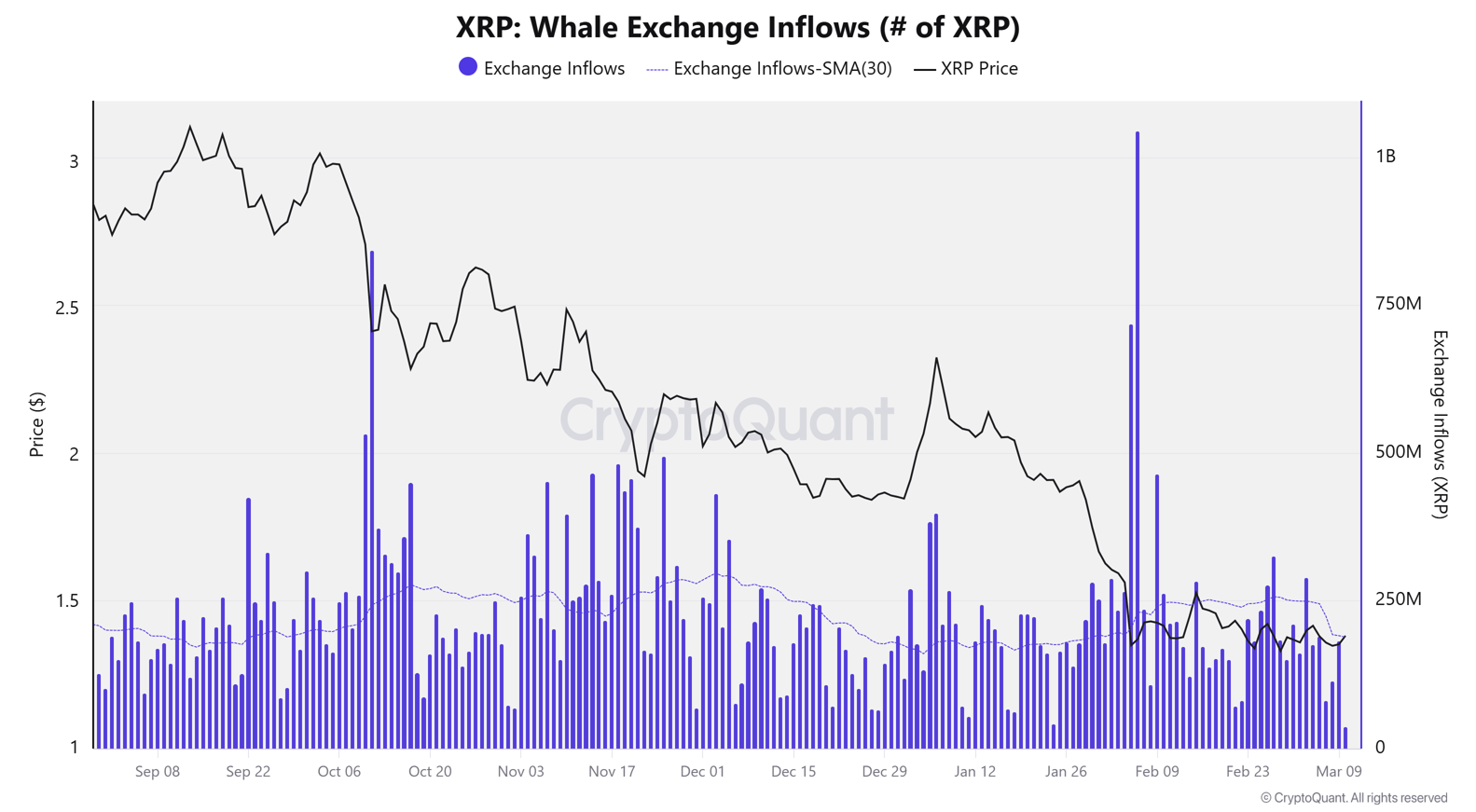
On-chain data from Crypto Quant indicate that XRP whales have remained on the sidelines, with flows to exchanges falling significantly. The chart below shows that daily XRP whale inflows to exchanges peaked at 1.04 billion on February 6 and have been steadily decreasing, with a reading of 35.90 million on Wednesday, an 96.55% decline.
In addition, inflows of XRP into Binance have plummeted after two massive spikes on May 10 and October 11, 2025. Inflows have fallen to only 3.62 million XRP, down from a peak of 672 million in May and 362 million in October, indicating that selling pressure on exchanges has significantly eased.

Ripple secures Australian license
Ripple announced on Wednesday its plans to secure an Australian Financial Services License (AFSL), further expanding its regulated footprint in the Asia Pacific.
“The license enables Ripple to expand its payments offering in Australia, enabling financial institutions, fintechs, and enterprises seeking faster, more efficient ways to move value across borders while operating within established regulatory frameworks,” said Ripple’s press release.
The announcement had no such immediate effect on Ripple’s native token XRP, as it traded at $1.38 as of writing on Wednesday. However, the announcement could be bullish for the token in the long term, as it lets Ripple expand its global operations.
Fading institutional demand
Institutional demand for XRP remained weak so far this week. SoSoValue data shows that spot XRP ETFs recorded a mild outflow of $3.88 million on Tuesday, marking the fourth consecutive day of withdrawals since March 5. If these trends continue and intensify, XRP could see a correction in the upcoming days.

XRP technical outlook: Price action remains locked inside a descending parallel channel
XRP trades at $1.38 on Wednesday, up nearly 3% so far this week but down slightly on the day. XRP holds within a descending parallel channel that has guided the market lower from above $2.80, keeping the broader near-term tone bearish despite the recent stabilization above $1.35.
Price action remains well below the 50-day, 100-day, and 200-day Exponential Moving Averages (EMAs) clustered between roughly $1.52 and $2.00, which continue to cap any recovery attempts and frame the current move as a short-term bounce inside a broader downtrend.
Momentum conditions stay subdued, with the Relative Strength Index (RSI) on the daily chart hovering in the mid-40s and the Moving Average Convergence Divergence (MACD) line marginally above its signal line near the zero area, hinting at only modest upside traction against a still-dominant downside structure.
Initial support aligns around the $1.30 horizontal level, just above the lower half of the descending channel, where prior reactions suggest dip-buying interest could re-emerge; a daily close below this floor would expose the channel base near $1.17 and deepen the bearish phase.
On the topside, immediate resistance is seen around the recent highs near $1.43, with further barriers at the 50-day EMA around $1.52 and then the mid-channel zone ahead of $1.60. A sustained break above these levels would be needed to challenge the broader bearish bias and open the way toward the distant horizontal resistance near $1.90 at the upper boundary of the channel.
-1773216600050-1773216600051.png)
(The technical analysis of this story was written with the help of an AI tool.)
Ripple FAQs
Ripple is a payments company that specializes in cross-border remittance. The company does this by leveraging blockchain technology. RippleNet is a network used for payments transfer created by Ripple Labs Inc. and is open to financial institutions worldwide. The company also leverages the XRP token.
XRP is the native token of the decentralized blockchain XRPLedger. The token is used by Ripple Labs to facilitate transactions on the XRPLedger, helping financial institutions transfer value in a borderless manner. XRP therefore facilitates trustless and instant payments on the XRPLedger chain, helping financial firms save on the cost of transacting worldwide.
XRPLedger is based on a distributed ledger technology and the blockchain using XRP to power transactions. The ledger is different from other blockchains as it has a built-in inflammatory protocol that helps fight spam and distributed denial-of-service (DDOS) attacks. The XRPL is maintained by a peer-to-peer network known as the global XRP Ledger community.
XRP uses the interledger standard. This is a blockchain protocol that aids payments across different networks. For instance, XRP’s blockchain can connect the ledgers of two or more banks. This effectively removes intermediaries and the need for centralization in the system. XRP acts as the native token of the XRPLedger blockchain engineered by Jed McCaleb, Arthur Britto and David Schwartz.
추천 기사


