


Gold slips toward $4,000 as Oil above $100 clouds Fed rate outlook
- Gold falls 0.50% to $4,039 as US Treasury yields reach 5.040%.
- WTI surges near $103 amid escalating Middle East supply risks.
- December Fed hike odds stand at 85% ahead of FOMC decision.
Gold (XAU/USD) price retreats 0.50% on Wednesday as the US-Iran conflict seems far from ending while investors await the Federal Reserve’s (Fed) monetary policy decision at 18:00 GMT. The XAU/USD pair trades at $4,039 at the time of writing.
XAU/USD retreats as rising Treasury yields and renewed inflation risks weigh ahead of Warsh's press conference
Traders remain cautious ahead of the Fed. US equity markets are subdued, US Treasury yields edge higher, and Oil prices remain underpinned by the Middle East conflict.
Bullion remains on the defensive as the US 10-year Treasury yield rises three basis points to 5.040%. Meanwhile, the Greenback cools off ahead of the FOMC’s decision, with the US Dollar Index (DXY), which measures the performance of the American currency against six other currencies, down 0.09% to 102.27.
The focus is on the Fed’s decision. Money markets had almost fully priced in that the Fed funds rate will be unchanged at 3.75%-4%, though questions will arise at Fed Chair Kevin Warsh press conference about why not raise rates today, when West Texas Intermediate (WTI), the US Oil benchmark, is close to $103 per barrel, up more than 3%, and gasoline prices are $1.20 higher than a year ago at $4.24, according to AAA Fuel Prices.
Also, in the last Summary of Economic Projections (SEP), the majority of the board penciled in at least another interest rate increase this year. Along with this, traders would look for hints from Warsh about the future of interest rates, even though he doesn’t like to forward-guide the markets.
Tensions between the Houthis and Saudi Arabia remain high, following an attack by the Iran-backed group in Yemen on a Saudi refinery, which pushed energy prices higher on concerns of supply disruptions.
After the Fed’s meeting, Gold traders will also eye the release of the Core Personal Consumption Expenditures (PCE) Price Index, the Fed’s preferred inflation measure, on Thursday. A hot reading, along with strong Gross Domestic Product (GDP) figures, will cement the case for another rate hike at the December meeting.
The swaps market had priced in 21 basis points of tightening, or an 85% chance that the Fed will hike in the December meeting, according to Prime Terminal.
Meanwhile, higher interest rates are negative for Gold prices, despite its appeal as an inflation hedge.
Of note, analysts polled by Reuters revised their forecasts for Gold downward toward the end of 2026.
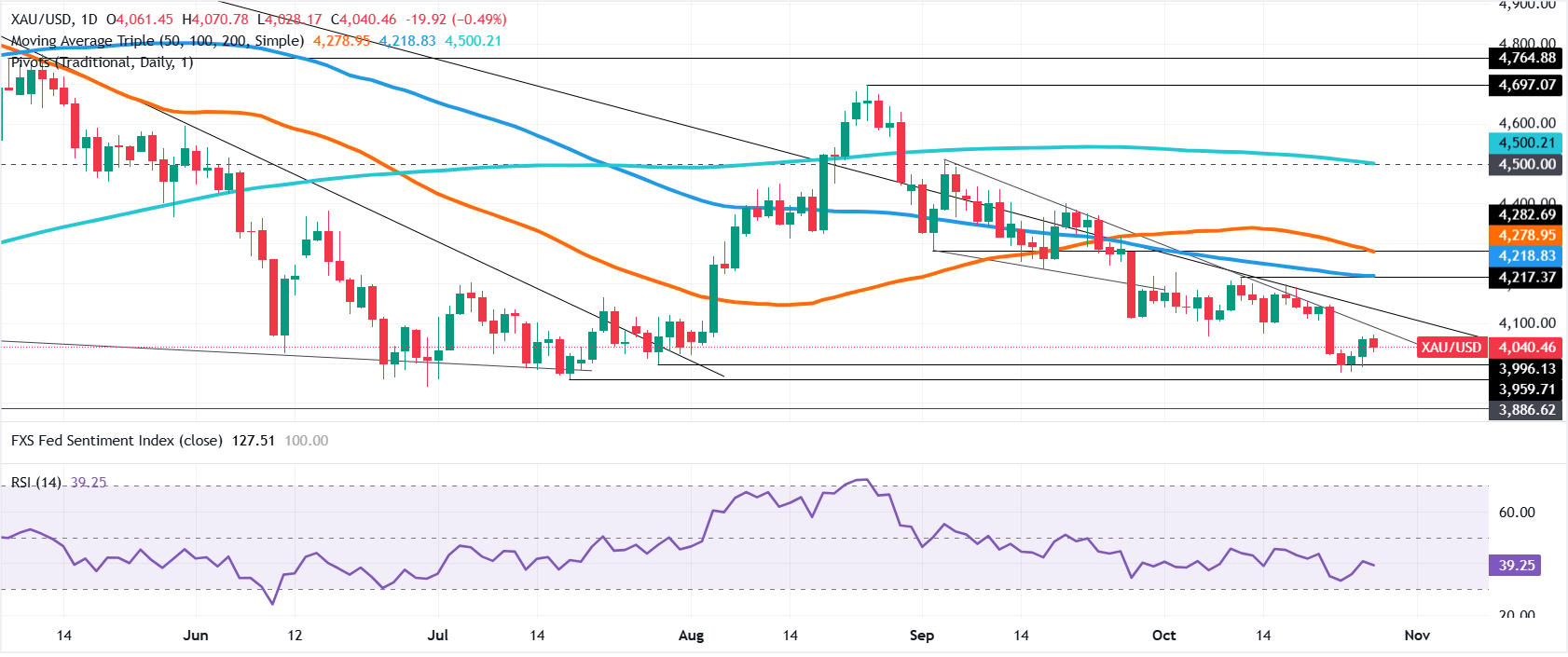
XAU/USD technical analysis: Gold consolidates within $4,000-$4,100
Even though Gold formed a ‘bullish harami’ candle pattern, price action on Wednesday puts in doubt the validity of the pattern. If the candle closes the day near current prices, it could open the door to some consolidation.
Momentum has shifted negatively. The Relative Strength Index (RSI) is bearish, pointing downwards, aligned with price action. Given the mixed signals, price action will remain at around familiar levels until the Fed’s decision.
On the upside, the next area of interest is a resistance trendline drawn from the September highs near $4,100. A breach of this level will expose $4,200. The next key resistance levels are the 100-day Simple Moving Average (SMA) at $4,218 and the 50-day SMA at $4,278.
If XAU/USD falls below $4,000, it could test last Friday’s low of $3,975. The next key support levels are the July 17 low of $3,959 and the year-to-date (YTD) low of $3,941.
Gold FAQs
Gold has played a key role in human’s history as it has been widely used as a store of value and medium of exchange. Currently, apart from its shine and usage for jewelry, the precious metal is widely seen as a safe-haven asset, meaning that it is considered a good investment during turbulent times. Gold is also widely seen as a hedge against inflation and against depreciating currencies as it doesn’t rely on any specific issuer or government.
Central banks are the biggest Gold holders. In their aim to support their currencies in turbulent times, central banks tend to diversify their reserves and buy Gold to improve the perceived strength of the economy and the currency. High Gold reserves can be a source of trust for a country’s solvency. Central banks added 1,136 tonnes of Gold worth around $70 billion to their reserves in 2022, according to data from the World Gold Council. This is the highest yearly purchase since records began. Central banks from emerging economies such as China, India and Turkey are quickly increasing their Gold reserves.
Gold has an inverse correlation with the US Dollar and US Treasuries, which are both major reserve and safe-haven assets. When the Dollar depreciates, Gold tends to rise, enabling investors and central banks to diversify their assets in turbulent times. Gold is also inversely correlated with risk assets. A rally in the stock market tends to weaken Gold price, while sell-offs in riskier markets tend to favor the precious metal.
The price can move due to a wide range of factors. Geopolitical instability or fears of a deep recession can quickly make Gold price escalate due to its safe-haven status. As a yield-less asset, Gold tends to rise with lower interest rates, while higher cost of money usually weighs down on the yellow metal. Still, most moves depend on how the US Dollar (USD) behaves as the asset is priced in dollars (XAU/USD). A strong Dollar tends to keep the price of Gold controlled, whereas a weaker Dollar is likely to push Gold prices up.
추천 기사


