


The Japanese Yen gives back half a record intervention
- USD/JPY trades near 159.50, its highest level since the July intervention.
- More than half of the 900-pip intervention drop retraced in a dozen sessions.
- Japan's July trade deficit is forecast to widen to 680 billion Yen.
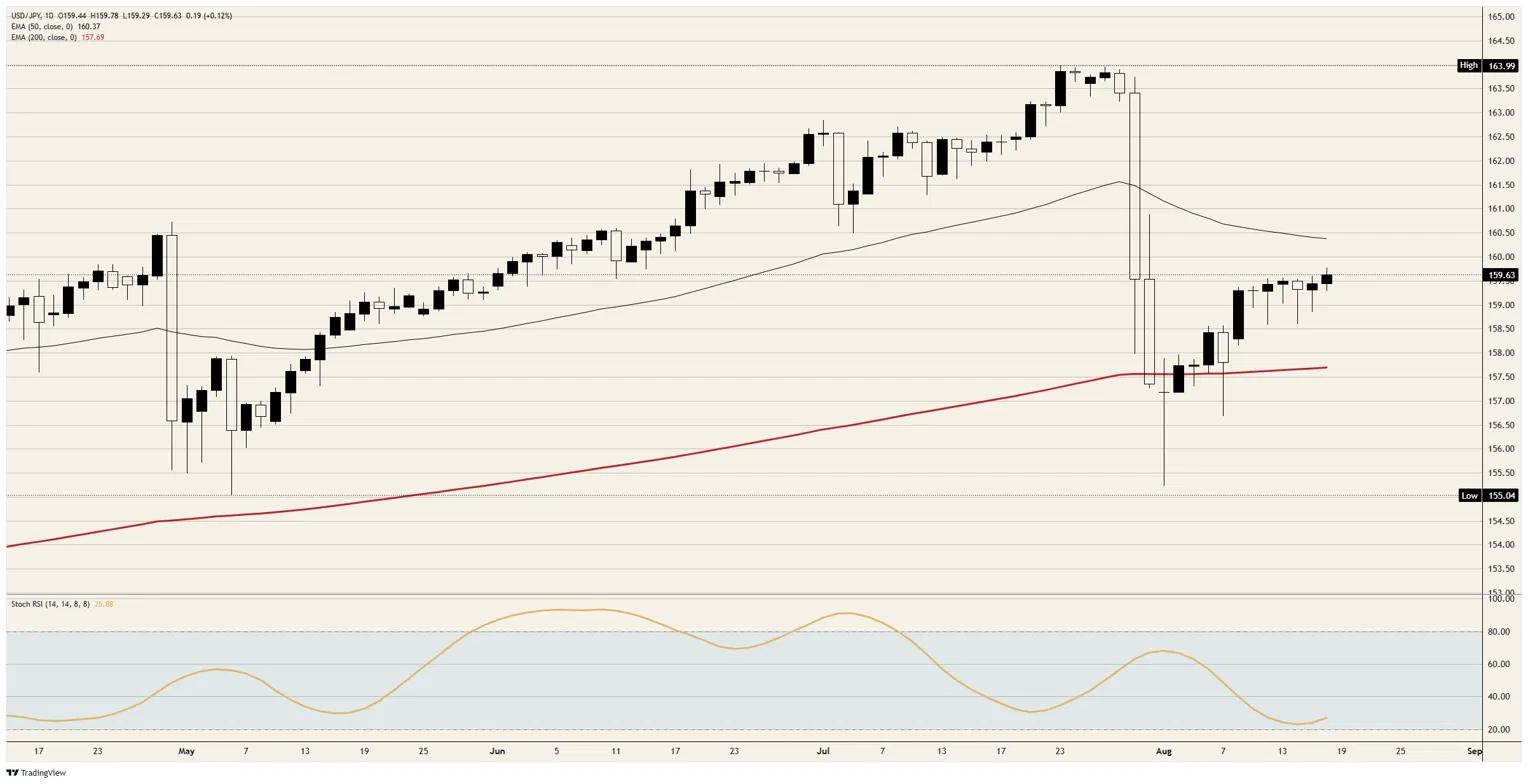
The Dollar trades near 159.50 against the Yen on Tuesday after a session high just short of 160.00, the strongest level the pair has reached since Tokyo and Washington intervened together at the end of July. That operation drove close to 900 pips out of the rate across two sessions, from just short of 164.00 down to the 155.00 handle.
More than half of it has been ground back in the dozen sessions since, and grinding is the right word, because the recovery has been built on small bodies and narrow ranges rather than on any single reversal. Tuesday's 49-pip range fits the pattern exactly, and the run of higher session highs through August has not once needed a headline to justify itself.
The government is selling what the ministry bought
Japan spent close to 14 trillion Yen defending the currency, a record single-session operation followed by a rare coordinated round with the United States Treasury, the first joint Yen-buying action between the two countries since 1998. That is a very large cheque written against a level rather than against a cause, and the cause has since moved further out of reach.
The administration's plan to cut the consumption tax on food to 1% for two years carries no identified funding, which amounts to a fiscal loosening aimed at an inflation problem the weak currency is helping to create. Japanese government bond yields have risen in response, but American yields have risen with them, so the differential that actually drives the pair has barely narrowed at all.
A policy rate that is still negative in real terms
The Bank of Japan raised to 1.00% in June and has held there since, the highest policy rate since 1995, and it is still not enough. National inflation on the headline gauge ran at 1.7% YoY in the latest reading, which leaves the real policy rate negative on the simplest arithmetic available. Minutes from the June meeting show a board worried that crude costs are broadening into consumer prices.
That combination explains why traders have begun pricing a September move, and also why the move may not help. A quarter point against a Federal Reserve upper bound of 3.75% closes almost none of the gap, and the terms-of-trade drain that a shut Strait of Hormuz imposes on an economy importing nearly all of its energy is not a problem 25 basis points repairs.
Growth gives the board no cover for it either, with the preliminary second-quarter reading showing the economy expanding at an annualised 1.1% against expectations near 2% as robust exports were outweighed by weak domestic demand. That is precisely the composition that makes tightening politically expensive, so the currency problem and the growth problem now pull the committee in opposite directions.
Three prints and a set of minutes
Japan's July trade figures land at 23:50 GMT on Wednesday, August 19, with the merchandise balance forecast to widen to a deficit of 680 billion Yen from 406.9 billion. Imports are seen up 26.5% YoY against exports at 19.9%, which is the energy bill written out in a single line. A gap widening by more than half in one month is not a currency story the Bank of Japan can price away.
National inflation follows at 23:30 GMT on Thursday, with the core gauge excluding fresh food forecast at 1.8% from 1.6% and the headline measure at 1.7%, both still short of the 2% target. A central bank whose own inflation reading sits under target has a thin case for the increase its currency needs.
The Dollar side of the pair gets its event first and it is the larger of the two, because minutes of the July 28-29 Federal Open Market Committee (FOMC) meeting publish at 18:00 GMT on Wednesday, covering the 9-3 hold that produced the first unified three-way dissent since September 2016.
Those minutes were written before the payrolls contraction, the July Consumer Price Index (CPI) and the retail sales miss that cut September hike odds to roughly 31% from above 82%. They record an argument rather than a forecast, and the Dollar will trade the conditions attached to that argument rather than the headcount behind it.
Levels to watch
Resistance: The 160.00 handle sits in immediate reach after a session high just beneath it, with the declining 50-day Exponential Moving Average (EMA) just short of 160.50 directly behind. A daily close above 160.50 opens 161.50.
Support: The 159.00 handle has contained every pullback this month and 158.00 marks the shelf beneath it. The rising 200-day EMA just above 157.50 is the floor the entire post-intervention structure depends on.
Bias: Bullish. Every Japanese driver in the week ahead points the same way, from a widening trade deficit to a core gauge short of target, and the daily Stochastic Relative Strength Index (Stoch RSI) near 27 leaves room above rather than warning of exhaustion. The risk here is official rather than technical, because the last round was confirmed only after the fact and the ministry has said it will not hesitate to repeat it. A daily close beneath 158.00 invalidates.
USD/JPY daily chart
Japanese Yen FAQs
The Japanese Yen (JPY) is one of the world’s most traded currencies. Its value is broadly determined by the performance of the Japanese economy, but more specifically by the Bank of Japan’s policy, the differential between Japanese and US bond yields, or risk sentiment among traders, among other factors.
One of the Bank of Japan’s mandates is currency control, so its moves are key for the Yen. The BoJ has directly intervened in currency markets sometimes, generally to lower the value of the Yen, although it refrains from doing it often due to political concerns of its main trading partners. The BoJ ultra-loose monetary policy between 2013 and 2024 caused the Yen to depreciate against its main currency peers due to an increasing policy divergence between the Bank of Japan and other main central banks. More recently, the gradually unwinding of this ultra-loose policy has given some support to the Yen.
Over the last decade, the BoJ’s stance of sticking to ultra-loose monetary policy has led to a widening policy divergence with other central banks, particularly with the US Federal Reserve. This supported a widening of the differential between the 10-year US and Japanese bonds, which favored the US Dollar against the Japanese Yen. The BoJ decision in 2024 to gradually abandon the ultra-loose policy, coupled with interest-rate cuts in other major central banks, is narrowing this differential.
The Japanese Yen is often seen as a safe-haven investment. This means that in times of market stress, investors are more likely to put their money in the Japanese currency due to its supposed reliability and stability. Turbulent times are likely to strengthen the Yen’s value against other currencies seen as more risky to invest in.
추천 기사


