


Intervention bought the Japanese Yen a price, not a buyer
- USD/JPY trades just above 159.00, up 0.93% and 400 pips off the low.
- A record 8.45 trillion Yen single-session defence has been half retraced.
- Japan's June current account swung to a 92.3 billion Yen deficit.
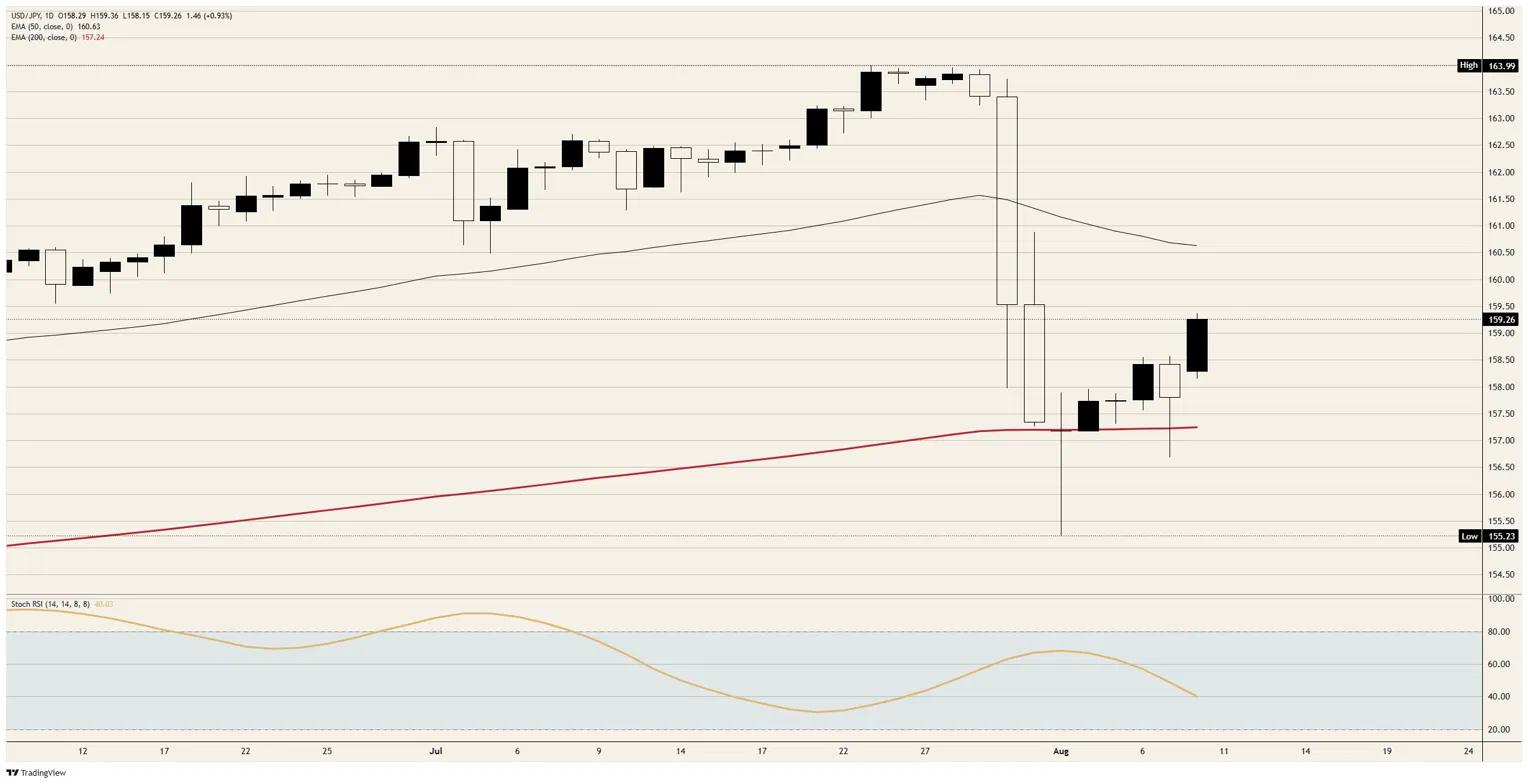
The Yen has surrendered close to a full percent through the session, with the pair up 0.93% and changing hands just above 159.00 after a 120-pip range running from the 158.00 handle to short of 159.50. That recovers roughly half of the drop from the multi-decade peak just short of 164.00 to the spike low a shade above 155.00, and it has been recovered inside a fortnight. The 200-day Exponential Moving Average (EMA) just above 157.00 has held every test put to it since.
What the tape has absorbed to get back here is larger than anything in the historical record, which is what makes the retracement worth pricing rather than the direction of it. Monday's lift is being reported as markets calling a bluff, and that reading has the causation backwards. The bluff was called by a data release, and it landed at 23:50 GMT on Sunday.
The most expensive floor on the board
Tokyo spent a record 8.45 trillion Yen in a single session defending the currency and followed it with roughly 5.3 trillion more in coordination with the US Treasury, the first joint Yen-buying operation between the two countries since 1998. The finance ministry has said it will not hesitate to repeat the exercise and has flagged access to the Federal Reserve's repo facility for foreign monetary authorities, which is a deliberate signal about the depth of the ammunition behind the threat.
None of that has held the level for more than a handful of sessions, which is the outcome intervention reliably produces when it is fighting a flow rather than a price. Buying a currency with reserves is a one-off transaction that removes supply once and impressively. It does not manufacture a buyer for next month, and next month is where this argument gets decided.
The number that explains the fade
Japan's June current account swung to a deficit of 92.3 billion Yen against a consensus looking for a surplus of close to 1.5 trillion and a May reading just short of 4 trillion. That is the first monthly deficit in roughly a year and a half, a swing of more than 4 trillion Yen inside thirty days, and it printed hours before the Tokyo session that began this leg higher.
The composition matters more than the headline, because the swing runs through an import bill inflated by a war premium on energy and by a currency that makes every cargo dearer in local terms. A country running an external surplus generates natural demand for its own money every month without anybody deciding anything. A country that stops running one has to buy its currency deliberately, which is exactly what the ministry has been doing at record cost.
The Yen's week is entirely American
The policy gap underneath all of this has not narrowed by a basis point since the operation began. The Bank of Japan (BoJ) sits at 1.00% against a US range of 3.50% to 3.75%, and September 16 is priced at 49.93% for a quarter-point increase against 50.07% for a hold, with October 28 at 76.50% for at least one move and the current range given no chance of surviving December 9. Carry that wide does not unwind because a finance ministry disapproves of it.
The cross-check is the Dollar itself, which spent the back half of last week at its weakest level since early June and has recovered only marginally to start this one. The pair is up close to 1% regardless. That is not a description of Dollar demand. It is a Yen losing ground even to a Dollar that nobody else particularly wants.
Nothing Japanese appears on the calendar for the remainder of the week, which leaves the pair trading American releases exclusively. July consumer prices arrive at 12:30 GMT on Wednesday with consensus at 0.1% MoM from -0.4% and the core rate at 0.2% from 0%, taking the annual core to 2.5% from 2.6%. Producer prices follow on Thursday at 4.9% YoY from 5.5%, retail sales on Friday at 0.2% MoM, and two regional Fed presidents speak either side of the Thursday release.
Levels
Resistance: The session high short of 159.50 is the immediate line, with the 160.00 handle above it and the 50-day EMA near 160.50 marking the roof of the intervention crater. The multi-decade peak just short of 164.00 is the medium-term objective.
Support: The 158.00 handle carried the session low, and 157.50 sits beneath it. The 200-day EMA just above 157.00 is the structural floor and the level the entire recovery is built on.
Bias: Bullish while 157.00 holds, objectives 160.00 then the 50-day EMA near 160.50, with the daily Stochastic Relative Strength Index (Stoch RSI) near 40 and turning higher out of mid-range. Invalidation on a daily close beneath 157.00. The risk to the call is a gap rather than a trend, because the next operation arrives without a warning shot.
USD/JPY daily chart
Japanese Yen FAQs
The Japanese Yen (JPY) is one of the world’s most traded currencies. Its value is broadly determined by the performance of the Japanese economy, but more specifically by the Bank of Japan’s policy, the differential between Japanese and US bond yields, or risk sentiment among traders, among other factors.
One of the Bank of Japan’s mandates is currency control, so its moves are key for the Yen. The BoJ has directly intervened in currency markets sometimes, generally to lower the value of the Yen, although it refrains from doing it often due to political concerns of its main trading partners. The BoJ ultra-loose monetary policy between 2013 and 2024 caused the Yen to depreciate against its main currency peers due to an increasing policy divergence between the Bank of Japan and other main central banks. More recently, the gradually unwinding of this ultra-loose policy has given some support to the Yen.
Over the last decade, the BoJ’s stance of sticking to ultra-loose monetary policy has led to a widening policy divergence with other central banks, particularly with the US Federal Reserve. This supported a widening of the differential between the 10-year US and Japanese bonds, which favored the US Dollar against the Japanese Yen. The BoJ decision in 2024 to gradually abandon the ultra-loose policy, coupled with interest-rate cuts in other major central banks, is narrowing this differential.
The Japanese Yen is often seen as a safe-haven investment. This means that in times of market stress, investors are more likely to put their money in the Japanese currency due to its supposed reliability and stability. Turbulent times are likely to strengthen the Yen’s value against other currencies seen as more risky to invest in.
추천 기사


