


The Australian Dollar clears a big figure on an intervention it will come to regret
- AUD/USD trades above 0.7000 after a 1.06% advance, taking out the 50-day EMA and posting its strongest session in weeks.
- The domestic week was dovish, with a soft second-quarter inflation report pricing an August hike out of the Reserve Bank's curve.
- The Yen gained close to 2% on the Aussie in the same hour, which is the exposure that matters if Tokyo returns for a second round.
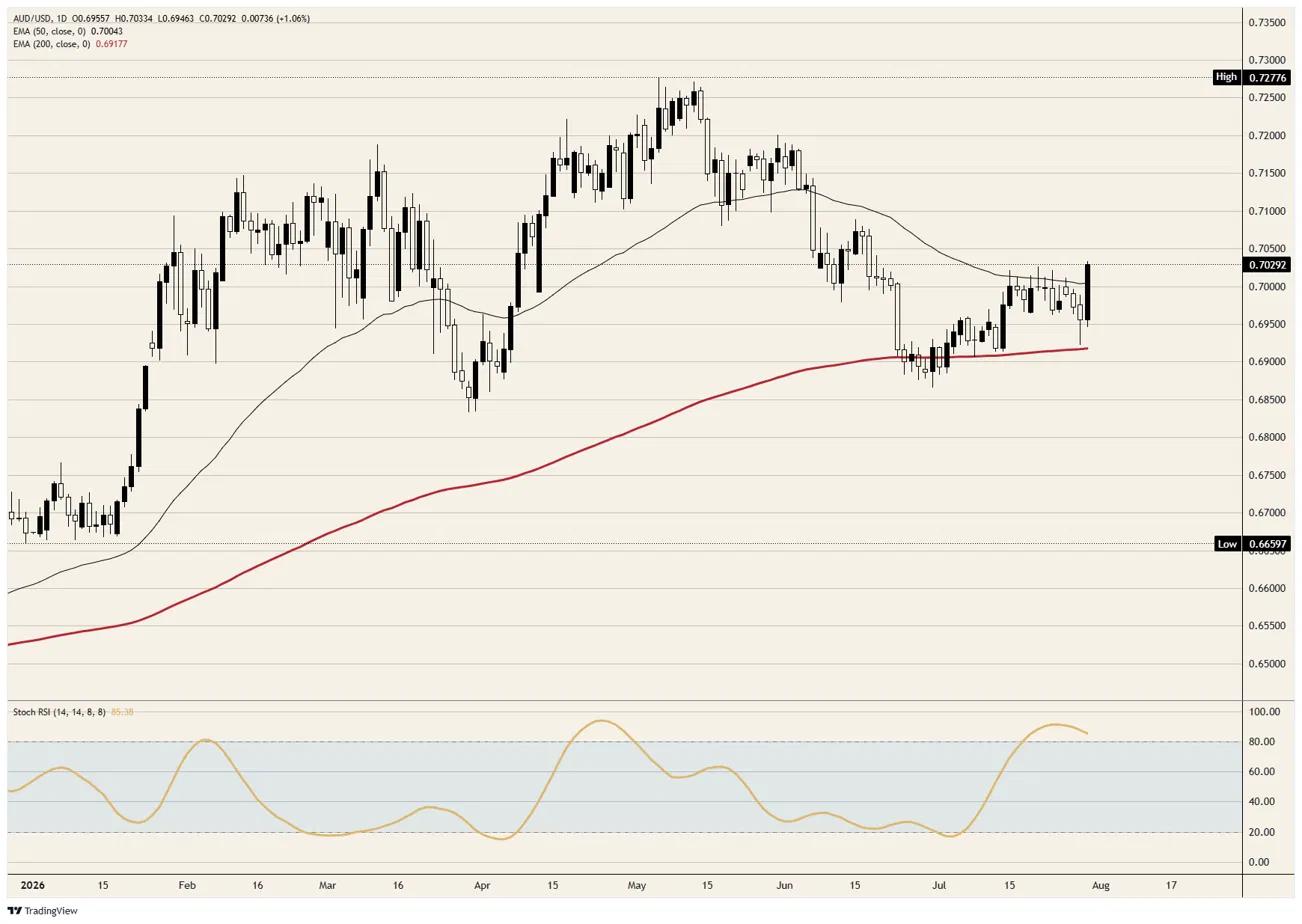
AUD/USD trades above 0.7000, up 1.06% and roughly 85 pips clear of a session low set just below 0.6950 in the early European hours. The advance cut through the 50-day Exponential Moving Average (EMA) sitting at 0.7000, a level the pair has been rejected at repeatedly since June. None of it originated in Australia.
A dovish week at home
Australia's second-quarter inflation report on Wednesday undercut what was left of the tightening case. The trimmed mean measure the Reserve Bank of Australia targets printed 3.6% YoY, below the 3.8% the Bank itself forecast in May, and the monthly headline rate eased to 3.8% from 4.0% against a consensus that expected no improvement at all. Markets took the August hike out of the curve within the hour. The Governor had warned only days earlier that a further increase may still be required to return inflation to target, and the curve priced her out anyway.
The activity data pointed the other way and nobody cared. Building permits jumped 7.2% MoM in June against a consensus looking for a 1.5% decline, and the July flash surveys held in expansion with the composite at 52.6. The Aussie sat within 20 pips of 0.6950 through the entire Asian session and then made its low of the day roughly five hours after the permits release.
The move came from Tokyo
The session turned at 13:30 GMT, when USD/JPY collapsed more than five Yen in minutes on suspected Japanese intervention that Tokyo has not confirmed. One trading desk recorded roughly 8.1 billion Dollars of selling in the pair across core venues inside the ten minutes that followed. The Dollar Index fell to a seven-week low near 100, and every Dollar pair on the board went with it.
American data had softened the ground an hour earlier without doing the work. Advance second-quarter Gross Domestic Product (GDP) growth of 1.5% missed a 2.1% consensus and core Personal Consumption Expenditures (PCE) inflation printed 0.1% MoM against 0.2%, which was worth a few tenths of a percent to the Dollar. The five-Yen move was worth the rest, and the Aussie's 1.06% is overwhelmingly the second thing.
The carry problem
The trade the Aussie actually carries is not the one against the Dollar. Australia's cash rate sits at 4.35% against 1.00% in Japan, which makes the Aussie one of the natural longs funded in Yen, and the Yen took close to 2% out of it on Thursday. A currency that gains 1.06% on the Dollar while losing 2% to its own funding currency has not had a good day. It has had a profitable one.
Intervention of this size rarely arrives on its own, and Tokyo has historically worked in multi-day bursts rather than single strikes. A second round would land on the same leveraged positions from the same direction, and the Aussie sits in the middle of them. That exposure is larger than anything the Australian calendar can produce over the next fortnight.
What lands next
Friday opens with Australian producer prices at 01:30 GMT against a 3% previous, alongside the Chinese official manufacturing and non-manufacturing surveys at the same time. Both carry a consensus of exactly 50.0, the line between expansion and contraction, which leaves no room for a comfortable reading in either direction. The Bank of Japan decision and quarterly Outlook Report follow, with a hold at 1.00% expected and the press conference at 06:30 GMT.
Next week thins out at home. The private Chinese manufacturing survey lands Monday and the services equivalent Wednesday, Australian trade figures arrive Thursday against a previous deficit near 3 billion Australian Dollars, and the United States delivers its manufacturing survey Monday, private payrolls Wednesday, and Nonfarm Payrolls Friday against a 57K previous. The Reserve Bank meets on 11 August.
With a September Federal Reserve hike priced at 63% and the Australian central bank now expected to sit still through August, the rate differential is narrowing from both ends. That is the case for reading Thursday's gain as borrowed rather than earned, and for treating 0.7000 as a level the Aussie has been handed rather than one it has taken.
Levels and bias
Resistance: First at 0.7050, immediately above the session high. A daily close above there opens 0.7100, with the May peak short of 0.7300 the ceiling for the year so far.
Support: 0.7000 is the pivot, reinforced by the 50-day EMA at the same level. Below it sits 0.6950, then the 200-day EMA just above 0.6900, which has flattened out and has held every test since early July.
Bias: Bullish while 0.7000 holds, targeting 0.7100. The daily Stochastic Relative Strength Index (Stoch RSI) at 85 says the move is stretched rather than broken, and the genuine risk to it is a second Japanese operation rather than anything scheduled in Canberra. Losing 0.7000 returns the pair to the range it has occupied since June.
AUD/USD daily chart
Australian Dollar FAQs
One of the most significant factors for the Australian Dollar (AUD) is the level of interest rates set by the Reserve Bank of Australia (RBA). Because Australia is a resource-rich country another key driver is the price of its biggest export, Iron Ore. The health of the Chinese economy, its largest trading partner, is a factor, as well as inflation in Australia, its growth rate and Trade Balance. Market sentiment – whether investors are taking on more risky assets (risk-on) or seeking safe-havens (risk-off) – is also a factor, with risk-on positive for AUD.
The Reserve Bank of Australia (RBA) influences the Australian Dollar (AUD) by setting the level of interest rates that Australian banks can lend to each other. This influences the level of interest rates in the economy as a whole. The main goal of the RBA is to maintain a stable inflation rate of 2-3% by adjusting interest rates up or down. Relatively high interest rates compared to other major central banks support the AUD, and the opposite for relatively low. The RBA can also use quantitative easing and tightening to influence credit conditions, with the former AUD-negative and the latter AUD-positive.
China is Australia’s largest trading partner so the health of the Chinese economy is a major influence on the value of the Australian Dollar (AUD). When the Chinese economy is doing well it purchases more raw materials, goods and services from Australia, lifting demand for the AUD, and pushing up its value. The opposite is the case when the Chinese economy is not growing as fast as expected. Positive or negative surprises in Chinese growth data, therefore, often have a direct impact on the Australian Dollar and its pairs.
Iron Ore is Australia’s largest export, accounting for $118 billion a year according to data from 2021, with China as its primary destination. The price of Iron Ore, therefore, can be a driver of the Australian Dollar. Generally, if the price of Iron Ore rises, AUD also goes up, as aggregate demand for the currency increases. The opposite is the case if the price of Iron Ore falls. Higher Iron Ore prices also tend to result in a greater likelihood of a positive Trade Balance for Australia, which is also positive of the AUD.
The Trade Balance, which is the difference between what a country earns from its exports versus what it pays for its imports, is another factor that can influence the value of the Australian Dollar. If Australia produces highly sought after exports, then its currency will gain in value purely from the surplus demand created from foreign buyers seeking to purchase its exports versus what it spends to purchase imports. Therefore, a positive net Trade Balance strengthens the AUD, with the opposite effect if the Trade Balance is negative.
추천 기사


