


The Australian Dollar sells a speech and waits for the number that decides August
- AUD/USD slips around 0.25% to trade beneath 0.7000, the weakest of the majors after a morning address from the Reserve Bank of Australia's Governor.
- Second-quarter inflation lands at 01:30 GMT Wednesday, sixteen hours before the Federal Reserve decision and thirteen days before the domestic meeting it will decide.
- A central bank asking out loud whether it has already done enough is not a central bank lining up its next move.
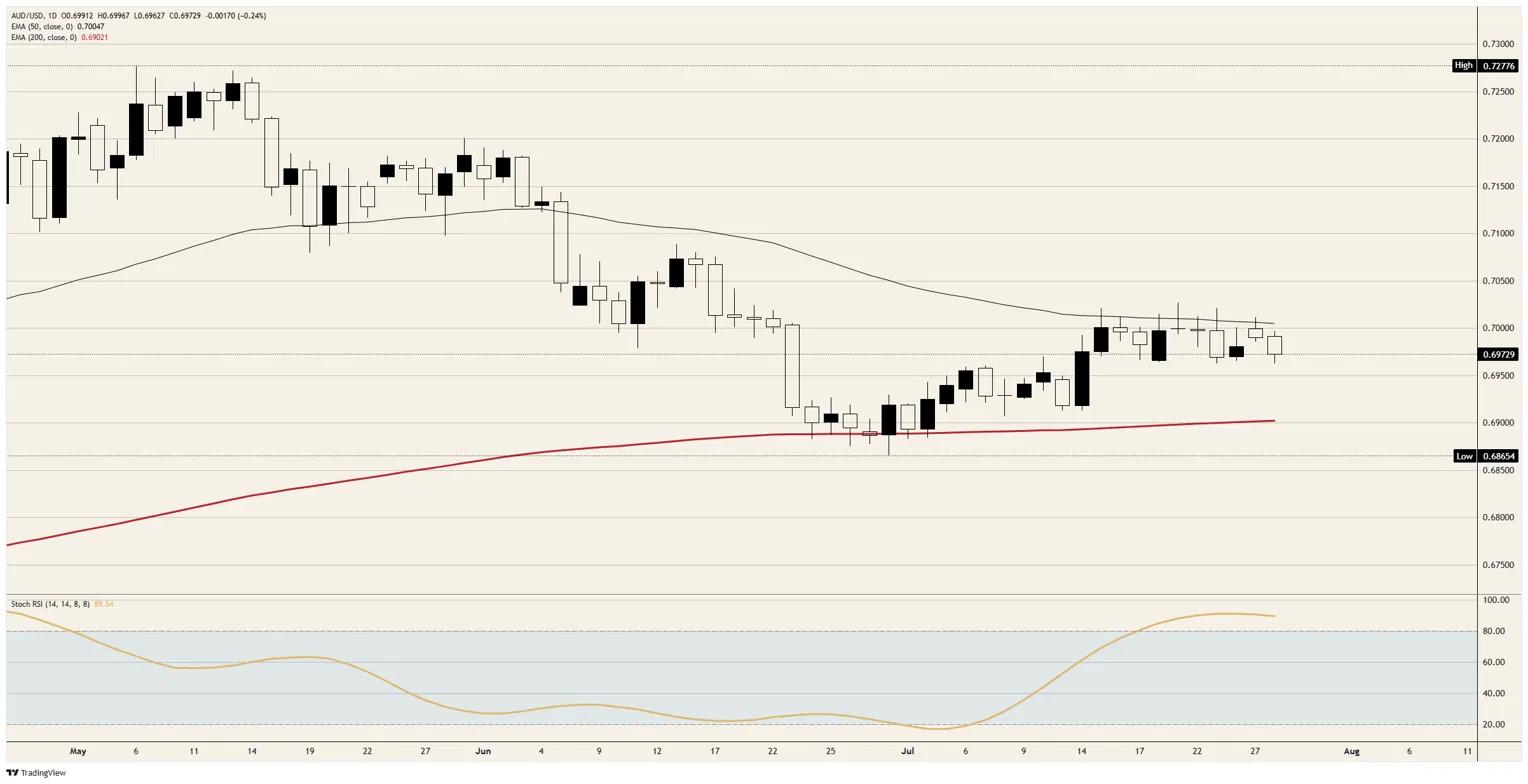
The Aussie trades just beneath 0.7000 on Tuesday, down around 0.25% and last in the G10 queue, after a Sydney address from the Reserve Bank of Australia's Governor gave the hike case nothing to eat. The session covers barely 35 pips, from a floor above 0.6950 to a high that stopped short of the figure, which is now the fifth consecutive week that 0.7000 has capped the currency.
The speech was not dovish in content. It held that underlying inflation remains too high and could rise further as war-driven energy costs feed through, that a further easing in demand growth is required with demand still running ahead of supply, and that the board is prepared to tighten again if needed.
The framing did the damage, not the content
What moved the currency was the question the Governor chose to pose, which was whether this year's three hikes have already done the job. Committees preparing to move do not spend a set-piece speech wondering aloud whether the work is already behind them, and traders marked down the 11 August meeting accordingly.
The awkward timing is that the repricing happened sixteen hours before the release that actually decides the meeting. Australia's second-quarter Consumer Price Index arrives at 01:30 GMT Wednesday, and the domestic rate market has effectively pre-committed to an answer it has not seen.
What the print has to do
The calendar carries the monthly headline at 0.2% MoM against a -0.7% prior, the annual rate unchanged at 4%, the monthly trimmed mean at 0.4% and the annual trimmed mean previously at 3.6%. The quarterly trimmed mean is the number the board actually reads, and forecasts near 0.9% for the quarter would lift the annual pace toward 3.7%.
That would sit a full point above the top of the 2% to 3% target band, in an economy that added more than 76K jobs in June with unemployment steady at 4.4%. Set against a May forecast round that had already pushed the June-quarter headline projection up to 4.8%, an in-line print leaves August genuinely live and Tuesday's selling looking hasty by less than a day.
The reverse case is equally clean. A quarterly trimmed mean nearer 0.8% would take the annual pace back toward 3.5% and vindicate the repricing in a single line, killing the domestic meeting and handing the currency over to the Dollar until the middle of August. There is no middle outcome that leaves 11 August ambiguous, which is rare enough on an inflation release to be worth the overnight watch.
Winning at home is not winning the pair
None of which guarantees the currency anything, because the other side of the quote is doing more work. Rate futures put a July hike from the Federal Reserve at just over 30%, cumulative odds of at least one hike by December above 91%, and two or more near 58%. One Australian quarter-point delivered on 11 August competes against a terminal rate that keeps hardening. The domestic policy rate has stood at 4.35% since the third hike of the year, and the gap that matters is the one the market expects rather than the one currently posted.
The commodity leg offers no help either. Iron Ore has spent the summer beneath $100 a tonne on ample seaborne supply and compressed Chinese steel margins, which strips the traditional support out of the Aussie's story. Tuesday made the point neatly: Korea's benchmark fell close to 11% and Japan's nearly 4%, while Australia's own index rose, and the currency was still the weakest major on the board. This was a rates move rather than a risk move.
The week ahead
Wednesday runs the double bill, with domestic inflation at 01:30 GMT and the Federal Open Market Committee at 18:00 GMT, the latter carrying no Summary of Economic Projections and therefore leaving everything to the statement and the press conference. Thursday brings June building permits at -1.5% MoM against -1.1%, then June core Personal Consumption Expenditures out of the United States at 12:30 GMT, forecast at 0.2% MoM and 3.3% YoY.
Friday closes the week with second-quarter Producer Price Index data at 01:30 GMT against a 3% YoY prior, alongside Chinese manufacturing and non-manufacturing Purchasing Managers' Indexes, both expected at 50 after 50.3 and 50.2. A pair of prints on the line between expansion and contraction is the last thing this currency needs on a Friday.
Technical outlook
Resistance: 0.7000 is the immediate cap and has held for five straight weeks, with the 50-day Exponential Moving Average sitting fractionally above it. The mid-July high near 0.7050 is the level that would break the sequence, and above that the May peak short of 0.7300 becomes the reference.
Support: 0.6950 is Tuesday's floor and the first objective, with the rising 200-day Exponential Moving Average near 0.6900 the structural line beneath it. The summer base just above 0.6850 has not been revisited since early July.
Bias: Bearish. The daily Stochastic Relative Strength Index near 90 has been pinned in overbought territory for a week without producing a break of 0.7000, which is the clearest exhaustion signal on the chart. Sell into the moving average. Invalidation is a daily close above 0.7050.
AUD/USD daily chart
Australian Dollar FAQs
One of the most significant factors for the Australian Dollar (AUD) is the level of interest rates set by the Reserve Bank of Australia (RBA). Because Australia is a resource-rich country another key driver is the price of its biggest export, Iron Ore. The health of the Chinese economy, its largest trading partner, is a factor, as well as inflation in Australia, its growth rate and Trade Balance. Market sentiment – whether investors are taking on more risky assets (risk-on) or seeking safe-havens (risk-off) – is also a factor, with risk-on positive for AUD.
The Reserve Bank of Australia (RBA) influences the Australian Dollar (AUD) by setting the level of interest rates that Australian banks can lend to each other. This influences the level of interest rates in the economy as a whole. The main goal of the RBA is to maintain a stable inflation rate of 2-3% by adjusting interest rates up or down. Relatively high interest rates compared to other major central banks support the AUD, and the opposite for relatively low. The RBA can also use quantitative easing and tightening to influence credit conditions, with the former AUD-negative and the latter AUD-positive.
China is Australia’s largest trading partner so the health of the Chinese economy is a major influence on the value of the Australian Dollar (AUD). When the Chinese economy is doing well it purchases more raw materials, goods and services from Australia, lifting demand for the AUD, and pushing up its value. The opposite is the case when the Chinese economy is not growing as fast as expected. Positive or negative surprises in Chinese growth data, therefore, often have a direct impact on the Australian Dollar and its pairs.
Iron Ore is Australia’s largest export, accounting for $118 billion a year according to data from 2021, with China as its primary destination. The price of Iron Ore, therefore, can be a driver of the Australian Dollar. Generally, if the price of Iron Ore rises, AUD also goes up, as aggregate demand for the currency increases. The opposite is the case if the price of Iron Ore falls. Higher Iron Ore prices also tend to result in a greater likelihood of a positive Trade Balance for Australia, which is also positive of the AUD.
The Trade Balance, which is the difference between what a country earns from its exports versus what it pays for its imports, is another factor that can influence the value of the Australian Dollar. If Australia produces highly sought after exports, then its currency will gain in value purely from the surplus demand created from foreign buyers seeking to purchase its exports versus what it spends to purchase imports. Therefore, a positive net Trade Balance strengthens the AUD, with the opposite effect if the Trade Balance is negative.
추천 기사


