


AUD/USD Price Forecast: Advancing 20-day EMA backs more upside towards 0.7300
- AUD/USD claws back its early losses as the Australian Dollar bounces back ahead of the Trump-Xi meeting.
- The US Dollar opened strongly as US President Trump dismissed Iran’s counterproposal.
- The Aussie pair sees more upside as the 20-day EMA continues to advance.
The AUD/USD pair recovers a majority of its opening losses and is marginally down to near 0.7240 during the early European trading session on Monday. The Aussie pair recovers as the Australian Dollar (AUD) trades firmly ahead of United States (US) President Donald Trump’s visit to China on May 13, which will last till May 15.
Australian Dollar Price Today
The table below shows the percentage change of Australian Dollar (AUD) against listed major currencies today. Australian Dollar was the strongest against the New Zealand Dollar.
| USD | EUR | GBP | JPY | CAD | AUD | NZD | CHF | |
|---|---|---|---|---|---|---|---|---|
| USD | 0.21% | 0.31% | 0.25% | 0.02% | 0.10% | 0.36% | 0.25% | |
| EUR | -0.21% | 0.10% | 0.00% | -0.23% | -0.10% | 0.15% | 0.03% | |
| GBP | -0.31% | -0.10% | -0.09% | -0.30% | -0.20% | 0.05% | -0.07% | |
| JPY | -0.25% | 0.00% | 0.09% | -0.22% | -0.10% | 0.14% | 0.01% | |
| CAD | -0.02% | 0.23% | 0.30% | 0.22% | 0.12% | 0.31% | 0.24% | |
| AUD | -0.10% | 0.10% | 0.20% | 0.10% | -0.12% | 0.24% | 0.14% | |
| NZD | -0.36% | -0.15% | -0.05% | -0.14% | -0.31% | -0.24% | -0.10% | |
| CHF | -0.25% | -0.03% | 0.07% | -0.01% | -0.24% | -0.14% | 0.10% |
The heat map shows percentage changes of major currencies against each other. The base currency is picked from the left column, while the quote currency is picked from the top row. For example, if you pick the Australian Dollar from the left column and move along the horizontal line to the US Dollar, the percentage change displayed in the box will represent AUD (base)/USD (quote).
US President Trump and Chinese leader Xi Jinping are expected to discuss various issues regarding Middle East conflicts, Taiwan, Artificial Intelligence (AI), nuclear weapons, and critical minerals, according to US officials, Reuters reported.
A positive outcome of the Trump-Xi meeting will be favorable for the Australian Dollar, given that the Australian economy relies heavily on its exports to Beijing.
Earlier in the day, the Aussie pair opened lower as the US Dollar (USD) strengthened, following US President trump’s rejection to Iran’s counter proposal, which demands the recognition of Tehran’s authority over the Strait of Hormuz, compensation for war damages and the release of Frozen Iranian assets. The US Dollar Index (DXY) holds its opening gains, trading 0.26% higher around 98.10.
AUD/USD technical analysis
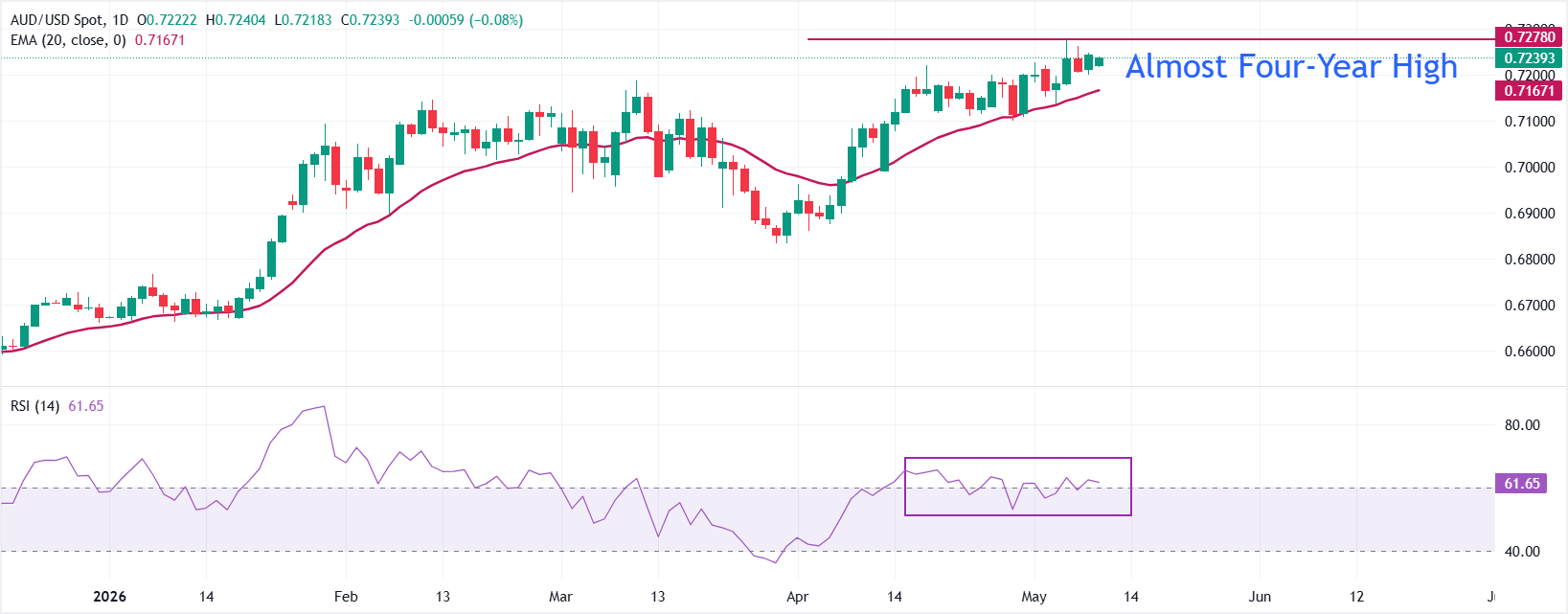
AUD/USD bounces back to near 0.7240 during the European trade. The pair maintains a constructive bullish bias as spot holds above the 20-period Exponential Moving Average (EMA) at 0.7167, suggesting the recent advance remains underpinned by short-term trend support.
The Relative Strength Index (RSI) at around 62 leans to the bullish side without yet signaling overbought conditions, hinting that buyers still retain control in the near term.
On the downside, initial support is located at the 20-day EMA near 0.7167, where a break would signal fading upside momentum and expose a deeper corrective phase toward 0.7100. Looking up, the pair might aim to visit 0.7300 if it breaks above the almost four-year high of 0.7277 posted last week. The pair could extend the advance towards 0.7400 if it manages to stabilize above 0.7300.
(The technical analysis of this story was written with the help of an AI tool.)
Australian Dollar FAQs
One of the most significant factors for the Australian Dollar (AUD) is the level of interest rates set by the Reserve Bank of Australia (RBA). Because Australia is a resource-rich country another key driver is the price of its biggest export, Iron Ore. The health of the Chinese economy, its largest trading partner, is a factor, as well as inflation in Australia, its growth rate and Trade Balance. Market sentiment – whether investors are taking on more risky assets (risk-on) or seeking safe-havens (risk-off) – is also a factor, with risk-on positive for AUD.
The Reserve Bank of Australia (RBA) influences the Australian Dollar (AUD) by setting the level of interest rates that Australian banks can lend to each other. This influences the level of interest rates in the economy as a whole. The main goal of the RBA is to maintain a stable inflation rate of 2-3% by adjusting interest rates up or down. Relatively high interest rates compared to other major central banks support the AUD, and the opposite for relatively low. The RBA can also use quantitative easing and tightening to influence credit conditions, with the former AUD-negative and the latter AUD-positive.
China is Australia’s largest trading partner so the health of the Chinese economy is a major influence on the value of the Australian Dollar (AUD). When the Chinese economy is doing well it purchases more raw materials, goods and services from Australia, lifting demand for the AUD, and pushing up its value. The opposite is the case when the Chinese economy is not growing as fast as expected. Positive or negative surprises in Chinese growth data, therefore, often have a direct impact on the Australian Dollar and its pairs.
Iron Ore is Australia’s largest export, accounting for $118 billion a year according to data from 2021, with China as its primary destination. The price of Iron Ore, therefore, can be a driver of the Australian Dollar. Generally, if the price of Iron Ore rises, AUD also goes up, as aggregate demand for the currency increases. The opposite is the case if the price of Iron Ore falls. Higher Iron Ore prices also tend to result in a greater likelihood of a positive Trade Balance for Australia, which is also positive of the AUD.
The Trade Balance, which is the difference between what a country earns from its exports versus what it pays for its imports, is another factor that can influence the value of the Australian Dollar. If Australia produces highly sought after exports, then its currency will gain in value purely from the surplus demand created from foreign buyers seeking to purchase its exports versus what it spends to purchase imports. Therefore, a positive net Trade Balance strengthens the AUD, with the opposite effect if the Trade Balance is negative.
추천 기사


