




EUR/USD trims some gains with the US Dollar still under pressure
- EUR/USD retreats towards the 1.1850 area after hitting four-month highs at 1.1907 the previous day.
- Trump's tariffs on South Korea and the US government shutdown concerns are likely to keep US Dollar rallies limited.
- Bears should break below 1.1830 to confirm a downside reversal.
The Euro (EUR) extends losses to near 1.1850 against the US Dollar (USD) at the time of writing on Tuesday, but keeps most of the last week's gains, with the US Dollar weighed by a combination of factors. US trade uncertainty, market expectations of further Federal Reserve (Fed) easing, and the growing chances of a US government shutdown are likely to keep the Greenback's upside attempts limited.
A new tariff salvo, this time to South Korea, highlights the erratic US trade policies, while in the US, the risk of a Government shutdown rises as tensions simmer in Minnesota after two people were killed in immigration raids. All this happens on the day the Fed starts its two-day meeting to decide its monetary policy amid unprecedented political pressures.
Against this backdrop, the US Dollar rallies are likely to be short-lived, with the Euro likely to remain relatively steady, not far from mid-term highs in the area of 1.1920. Market sentiment is positive on Tuesday, which is another positive factor for the Euro.
In the economic calendar, the US Consumer Confidence might provide some fundamental guidance later on the day, ahead of the speeches of European Central Bank (ECB) President Christine Lagarde and Bundesbank President Joachim Nagel.
Euro Price Today
The table below shows the percentage change of Euro (EUR) against listed major currencies today. Euro was the strongest against the Japanese Yen.
| USD | EUR | GBP | JPY | CAD | AUD | NZD | CHF | |
|---|---|---|---|---|---|---|---|---|
| USD | 0.25% | 0.11% | 0.51% | 0.17% | 0.21% | 0.32% | 0.21% | |
| EUR | -0.25% | -0.14% | 0.28% | -0.08% | -0.04% | 0.07% | -0.04% | |
| GBP | -0.11% | 0.14% | 0.42% | 0.06% | 0.10% | 0.21% | 0.10% | |
| JPY | -0.51% | -0.28% | -0.42% | -0.33% | -0.29% | -0.18% | -0.29% | |
| CAD | -0.17% | 0.08% | -0.06% | 0.33% | 0.04% | 0.15% | 0.04% | |
| AUD | -0.21% | 0.04% | -0.10% | 0.29% | -0.04% | 0.11% | -0.00% | |
| NZD | -0.32% | -0.07% | -0.21% | 0.18% | -0.15% | -0.11% | -0.11% | |
| CHF | -0.21% | 0.04% | -0.10% | 0.29% | -0.04% | 0.00% | 0.11% |
The heat map shows percentage changes of major currencies against each other. The base currency is picked from the left column, while the quote currency is picked from the top row. For example, if you pick the Euro from the left column and move along the horizontal line to the US Dollar, the percentage change displayed in the box will represent EUR (base)/USD (quote).
Daily Digest Market Movers: Trade uncertainty and political tensions are weighing on the US Dollar
- US President Donald Trump announced on Monday that he will increase tariffs on South Korea to 25%, from the current 15%, for failing to commit to the terms of the trade agreement reached last year. Asian markets have brushed off this news. The South Korean Kospi Index has risen 2.75%, but the uncertainty about US international trade is acting as a headwind for US Dollar recovery.
- In the US, Senate Democrats have threatened to block a government funding bill unless severe restrictions are imposed on the Trump administration's anti-immigration operations. This would cause a partial government shutdown from Saturday, adding pressure on an already weak US Dollar.
- Apart from that, news that the Fed and the Bank of Japan (BoJ) requested USD/JPY quotes from major banks on Friday has boosted speculation of a coordinated intervention to support the Japanese Yen (JPY), which prompted investors to scale back their USD long positions.
- In the economic calendar on Monday, US Durable Goods Orders surged by 5.3% in November, well above the 0.5% increase expected and following a 2.1% contraction in October. The US Dollar, however, was little moved following the data release.
- On Tuesday, the focus will be on the US Consumer Confidence, although investors will keep an eye on Wednesday's Fed monetary policy decision. The bank is widely expected to leave its benchmark interest rate unchanged in the current 3.50%-3.75% range. Trump might be tempted to steal the show, with comments about Chairman Jerome Powell's successor.
Technical Analysis: EUR/USD has support at the 1.1830 area
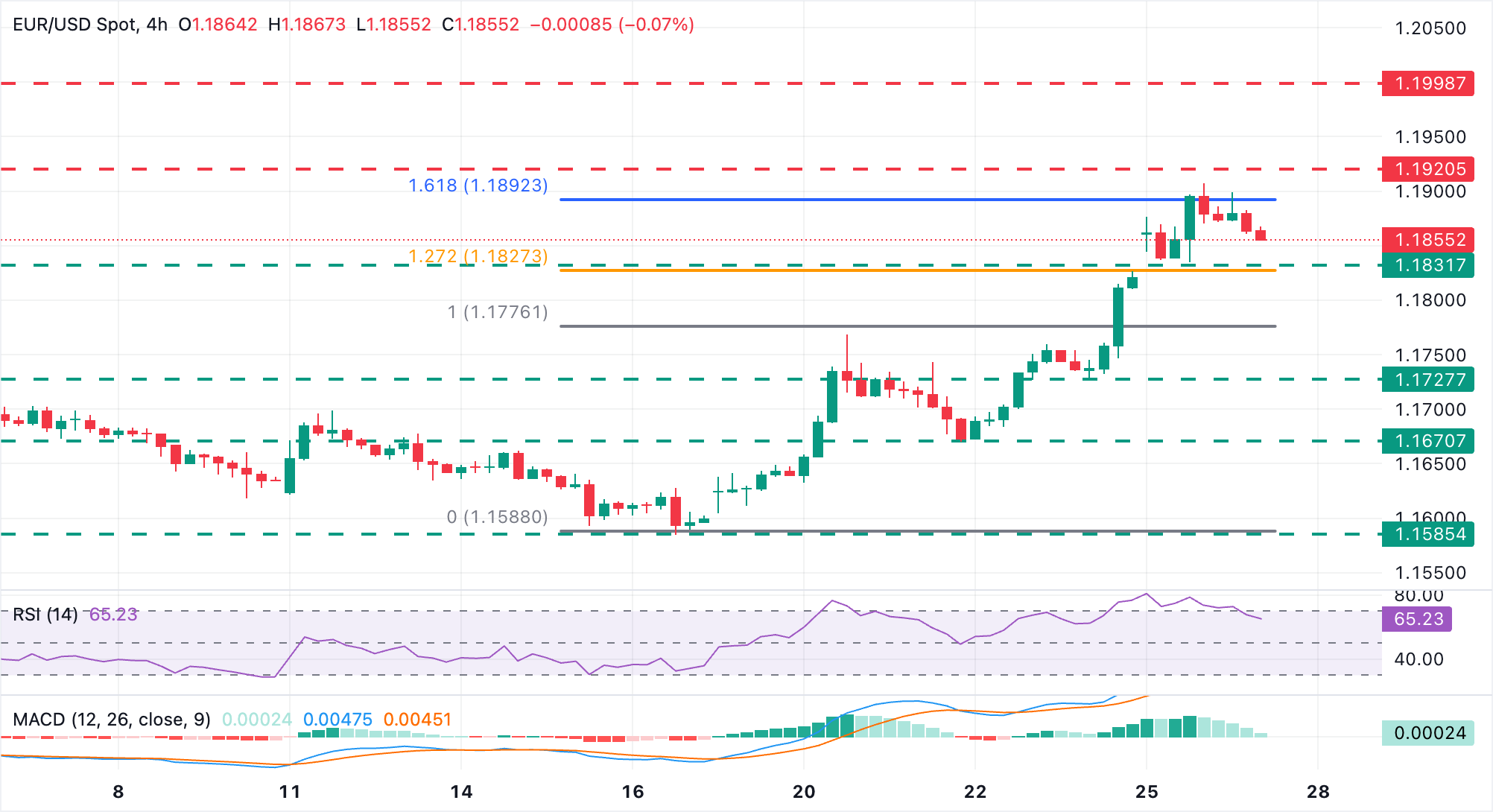
EUR/USD is going through a mild correction, although it remains within Monday's trading range. Technical indicators show a softer bullish momentum on the 4-hour chart. The Moving Average Convergence Divergence (MACD) histogram remains positive but has contracted from recent highs, and the Relative Strength Index (RSI) remains above 60, levels consistent with a bullish trend, after pulling back from overbought territory.
The pair has dropped to the mid-range of the 1.1800s, but remains above Monday's low around 1.1830, which is the prime support, ahead of Friday's low near 1.1725.
To the upside, the area between Monday's high, at 1.1907, and the September peak of 1.1918 is likely to offer significant resistance. Further up, the 1.2000 psychological level emerges as a potential target.
(The technical analysis of this story was written with the help of an AI tool.)
Euro FAQs
The Euro is the currency for the 20 European Union countries that belong to the Eurozone. It is the second most heavily traded currency in the world behind the US Dollar. In 2022, it accounted for 31% of all foreign exchange transactions, with an average daily turnover of over $2.2 trillion a day. EUR/USD is the most heavily traded currency pair in the world, accounting for an estimated 30% off all transactions, followed by EUR/JPY (4%), EUR/GBP (3%) and EUR/AUD (2%).
The European Central Bank (ECB) in Frankfurt, Germany, is the reserve bank for the Eurozone. The ECB sets interest rates and manages monetary policy. The ECB’s primary mandate is to maintain price stability, which means either controlling inflation or stimulating growth. Its primary tool is the raising or lowering of interest rates. Relatively high interest rates – or the expectation of higher rates – will usually benefit the Euro and vice versa. The ECB Governing Council makes monetary policy decisions at meetings held eight times a year. Decisions are made by heads of the Eurozone national banks and six permanent members, including the President of the ECB, Christine Lagarde.
Eurozone inflation data, measured by the Harmonized Index of Consumer Prices (HICP), is an important econometric for the Euro. If inflation rises more than expected, especially if above the ECB’s 2% target, it obliges the ECB to raise interest rates to bring it back under control. Relatively high interest rates compared to its counterparts will usually benefit the Euro, as it makes the region more attractive as a place for global investors to park their money.
Data releases gauge the health of the economy and can impact on the Euro. Indicators such as GDP, Manufacturing and Services PMIs, employment, and consumer sentiment surveys can all influence the direction of the single currency. A strong economy is good for the Euro. Not only does it attract more foreign investment but it may encourage the ECB to put up interest rates, which will directly strengthen the Euro. Otherwise, if economic data is weak, the Euro is likely to fall. Economic data for the four largest economies in the euro area (Germany, France, Italy and Spain) are especially significant, as they account for 75% of the Eurozone’s economy.
Another significant data release for the Euro is the Trade Balance. This indicator measures the difference between what a country earns from its exports and what it spends on imports over a given period. If a country produces highly sought after exports then its currency will gain in value purely from the extra demand created from foreign buyers seeking to purchase these goods. Therefore, a positive net Trade Balance strengthens a currency and vice versa for a negative balance.
추천 기사


