




USD/INR refreshes four-week high amid consistent FIIs selling in Indian equity market
- The Indian Rupee declines at open as FIIs continue to dump their stake in the Indian stock market.
- The RBI is expected to continue reducing interest rates in the near term.
- Fed’s Bostic stresses the need for a restrictive interest rate policy to contain inflation risks.
The Indian Rupee (INR) revisits the four-week low against the US Dollar (USD) in the opening session on Friday. The USD/INR pair rises to near 90.70 as the Indian Rupee underperforms amid the continuous outflow of foreign funds from the Indian stock market.
On Wednesday, Foreign Institutional Investors (FIIs) offloaded their stake worth Rs. 4,781.24 crore, according to data from NSE. The selling pressure from FIIs continues in the Indian equity market amid the absence of a trade deal announcement between the United States (US) and India. So far in January, FIIs have remained net sellers in nine out of ten trading days, and have pared their stake worth Rs. 21,706.27 crore.
This week, trade talks took place between India’s External Affairs Minister Subrahmanyam Jaishankar and US Secretary of State Marco Rubio, which were called “good” by both through their social media posts, but the sentiment of overseas investors towards the Indian stock market remains weak amid the absence of a breakthrough in trade discussions.
Economists at HSBC have also pointed out that weak capital inflows into the Indian stock market are a major problem for the Indian Rupee.
On the economic front, India’s retail and wholesale inflation data for December have shown growth in price pressures, but this is unlikely to deter the Reserve Bank of India (RBI) from delivering more interest rate cuts in the near term. Though the retail Consumer Price Index (CPI) has grown at a faster pace of 1.33% Year-on-Year (YoY), it is still lower than the RBI’s tolerance band of 2%-6%.
Daily Digest Market Movers: US Dollar trades broadly firm as Fed officials support restrictive policy stance
- The Indian Rupee trades lower against the US Dollar, even as the latter edges down ahead of an extended weekend in the US. At the time of writing, the US Dollar Index (DXY), which tracks the Greenback’s value against six major currencies, ticks lower to near 99.28. However, the DXY is still close to its six-week high of 99.50 posted the previous day.
- On Thursday, the US Dollar gained sharply after hawkish remarks from Federal Reserve (Fed) officials. Kansas Fed Bank President Jeffrey Schmid and Atlanta Fed Bank President Raphael Bostic stressed the need to maintain a restrictive stance on interest rates, citing upside inflation risks.
- “We need to stay restrictive because inflation is too high," Bostic said on Thursday, adding, “I expect inflation pressures will continue through 2026 as many businesses are still incorporating tariffs into prices.”
- According to the CME FedWatch tool, the Fed is certain to hold interest rates steady in the current range of 3.50%-3.75% in the January policy meeting.
- Going forward, the major trigger for the Silver price will be the announcement of the new Fed Chairman by the White House. US President Trump said in December that he would announce the successor to Fed Chair Jerome Powell sometime in January.
- The comments from Trump in his latest interviews show that White House Economic Adviser Kevin Hassett, former Fed Chair Kevin Warsh, and current Fed Governors Christopher Waller and Michelle Bowman are major contenders to replace Jerome Powell.
Technical Analysis: USD/INR jumps to near 90.70
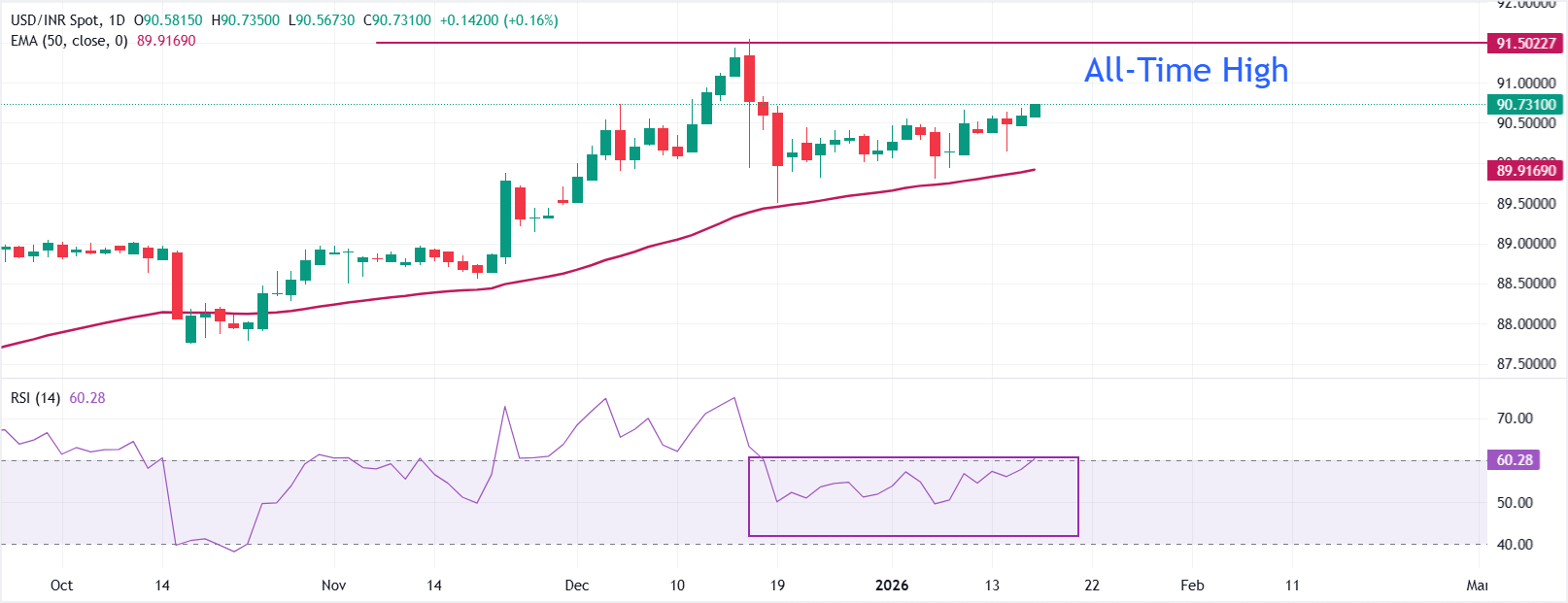
USD/INR rises to near 90.70. The 50-day Exponential Moving Average (EMA) is rising and continues to underpin the advance. Price action holds above this dynamic gauge, keeping pullbacks contained.
The 14-day Relative Strength Index (RSI) at 58.76, above its midline, confirms steady bullish momentum. Initial support sits at the 50-EMA at 89.9134.
As long as the pair holds above the average, topside extension remains favored, while a close beneath it would soften the tone and expose a deeper retracement. Momentum would improve if RSI extends toward the 60s, whereas a drop back to 50 would cap upside and shift the bias toward consolidation.
(The technical analysis of this story was written with the help of an AI tool.)
Indian Rupee FAQs
The Indian Rupee (INR) is one of the most sensitive currencies to external factors. The price of Crude Oil (the country is highly dependent on imported Oil), the value of the US Dollar – most trade is conducted in USD – and the level of foreign investment, are all influential. Direct intervention by the Reserve Bank of India (RBI) in FX markets to keep the exchange rate stable, as well as the level of interest rates set by the RBI, are further major influencing factors on the Rupee.
The Reserve Bank of India (RBI) actively intervenes in forex markets to maintain a stable exchange rate, to help facilitate trade. In addition, the RBI tries to maintain the inflation rate at its 4% target by adjusting interest rates. Higher interest rates usually strengthen the Rupee. This is due to the role of the ‘carry trade’ in which investors borrow in countries with lower interest rates so as to place their money in countries’ offering relatively higher interest rates and profit from the difference.
Macroeconomic factors that influence the value of the Rupee include inflation, interest rates, the economic growth rate (GDP), the balance of trade, and inflows from foreign investment. A higher growth rate can lead to more overseas investment, pushing up demand for the Rupee. A less negative balance of trade will eventually lead to a stronger Rupee. Higher interest rates, especially real rates (interest rates less inflation) are also positive for the Rupee. A risk-on environment can lead to greater inflows of Foreign Direct and Indirect Investment (FDI and FII), which also benefit the Rupee.
Higher inflation, particularly, if it is comparatively higher than India’s peers, is generally negative for the currency as it reflects devaluation through oversupply. Inflation also increases the cost of exports, leading to more Rupees being sold to purchase foreign imports, which is Rupee-negative. At the same time, higher inflation usually leads to the Reserve Bank of India (RBI) raising interest rates and this can be positive for the Rupee, due to increased demand from international investors. The opposite effect is true of lower inflation.
추천 기사


