

USD/INR ticks up on pent-up US Dollars' demand by Indian importers
- The Indian Rupee edges down against the US Dollar as Indian importers pick up the USD/INR pair’s dip.
- So far in December, FIIs have offloaded their stake worth Rs. 24,148.33 crore.
- The Fed is expected to deliver at least 50 bps reduction in interest rates in 2026.
The Indian Rupee (INR) opens mildly lower against the US Dollar (USD) at the start of the last week of 2025. The USD/INR pair ticks up to near 90.35 amid strong demand for US Dollars by Indian importers in both onshore and offshore markets, following the sell-off that came in the middle of December due to the Reserve Bank of India’s (RBI) intervention.
The RBI sold US Dollars heavily in both spot and Non-Deliverable Forward (NDF) markets to cushion the Indian Rupee after it slid to its record lows around 91.55. While investors capitalized on the dip in the USD/INR pair as an opportunity to add US Dollars at bargain levels.
There has been a pent-up demand for the US Dollar among Indian importers amid the absence of a trade deal announcement between the United States (US) and India. So far this year, the Indian currency has depreciated over 6% against the US Dollar, the worst performer among its Asian peers, despite the US Dollar Index (DXY), which tracks the Greenback’s value against six major currencies, declining almost 9.5%.
Foreign Institutional Investors (FIIs) have also offloaded their significant stake in the Indian equity market this year, while expensive valuations of Indian stocks against Chinese and Taiwan markets have been another key factor behind the relentless selling. In the December 01-26 period, FIIs have sold shares worth Rs. 24,148.33 crore.
This week, investors will focus on the Federal Fiscal Deficit data for November, which will be published on Wednesday.
Daily Digest Market Movers: US Dollar trades subduedly amid firm Fed dovish bets
- The Indian Rupee ticks lower against the US Dollar, even as the DXY trades subduedly near 98.00 as of writing. The DXY is broadly under pressure, trading close to its 12-week low of 97.75, amid expectations that the Federal Reserve (Fed) will cut interest rates by at least 50 basis points (bps) in 2026.
- The odds of the Fed reducing interest rates at least 50 bps in 2026 are 73.3%, according to the CME FedWatch tool. The expected size of reduction in interest rates by the Fed is larger than what the Fed’s dot plot showed in the monetary policy announced this month.
- The Fed’s dot plot showed that policymakers collectively see the Federal Funds Rate heading to 3.4% by the end of 2026, indicating that there won’t be more than one interest rate cut.
- Fed dovish expectations are contributed by weak job market conditions and the latest evidence that the tariff effect was one-off on inflationary pressures. The latest Consumer Price Index (CPI) data showed that the headline inflation decelerated to 2.7% Year-on-year (YoY) in November.
- For more cues on the monetary policy outlook, investors will focus on the Federal Open Market Committee (FOMC) minutes of the December meeting, which will be published on Wednesday.
- In 2026, the major trigger for the US Dollar will be the selection of the Fed’s new chairman, an event that would boost dovish expectations, given US President Donald Trump’s support for lower interest rates despite domestic markets rising. "I want my new Fed Chairman to lower Interest Rates if the Market is doing well," Trump said last week.
Technical Analysis: USD/INR holds above 20-day EMA
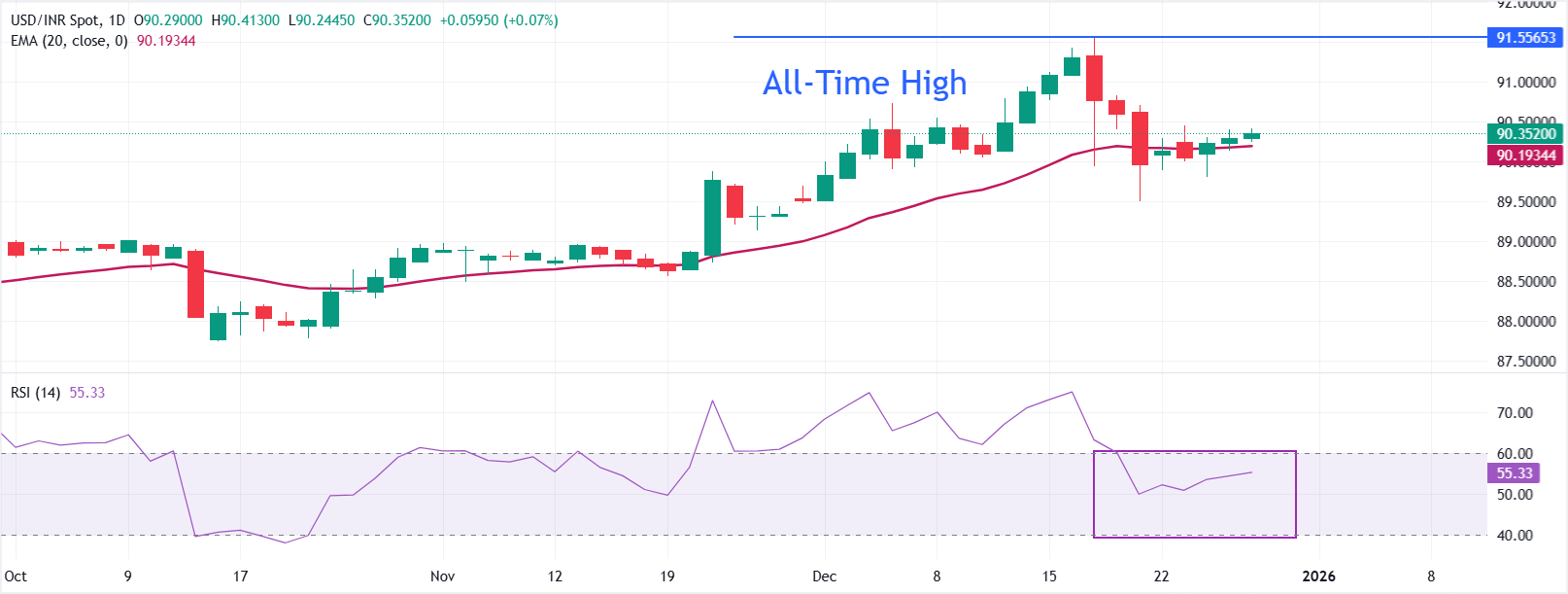
In the daily chart, USD/INR trades at 90.3515. The pair holds above a rising 20-day Exponential Moving Average (EMA) at 90.1934, keeping a short-term bullish bias intact. The slope of the average remains positive, reflecting persistent upward pressure.
The 14-day Relative Strength Index (RSI) at 55 (neutral) confirms steady momentum without overbought strain.
Focus stays on whether price can maintain traction above the 20-day EMA at 90.1934, where pullbacks could be absorbed. A close below this dynamic support would dampen momentum and open room for a deeper retracement towards the December low around 89.50. While a continued strength above the 20-day EMA would favor trend extension towards the all-time high of 91.50
(The technical analysis of this story was written with the help of an AI tool.)
Indian Rupee FAQs
The Indian Rupee (INR) is one of the most sensitive currencies to external factors. The price of Crude Oil (the country is highly dependent on imported Oil), the value of the US Dollar – most trade is conducted in USD – and the level of foreign investment, are all influential. Direct intervention by the Reserve Bank of India (RBI) in FX markets to keep the exchange rate stable, as well as the level of interest rates set by the RBI, are further major influencing factors on the Rupee.
The Reserve Bank of India (RBI) actively intervenes in forex markets to maintain a stable exchange rate, to help facilitate trade. In addition, the RBI tries to maintain the inflation rate at its 4% target by adjusting interest rates. Higher interest rates usually strengthen the Rupee. This is due to the role of the ‘carry trade’ in which investors borrow in countries with lower interest rates so as to place their money in countries’ offering relatively higher interest rates and profit from the difference.
Macroeconomic factors that influence the value of the Rupee include inflation, interest rates, the economic growth rate (GDP), the balance of trade, and inflows from foreign investment. A higher growth rate can lead to more overseas investment, pushing up demand for the Rupee. A less negative balance of trade will eventually lead to a stronger Rupee. Higher interest rates, especially real rates (interest rates less inflation) are also positive for the Rupee. A risk-on environment can lead to greater inflows of Foreign Direct and Indirect Investment (FDI and FII), which also benefit the Rupee.
Higher inflation, particularly, if it is comparatively higher than India’s peers, is generally negative for the currency as it reflects devaluation through oversupply. Inflation also increases the cost of exports, leading to more Rupees being sold to purchase foreign imports, which is Rupee-negative. At the same time, higher inflation usually leads to the Reserve Bank of India (RBI) raising interest rates and this can be positive for the Rupee, due to increased demand from international investors. The opposite effect is true of lower inflation.
추천 기사


