


USD/INR ticks down as FIIs selling momentum cools down, outlook remains firm
- The Indian Rupee ticks up at open against the US Dollar; however, its outlook remains uncertain.
- The amount of stake dumped by FIIs in the Indian stock market remained lower in the last two trading days.
- Investors expect the Fed to cut interest rates by 25 bps on Wednesday.
The Indian Rupee (INR) trades mildly higher against the US Dollar (USD) at open on Tuesday. The USD/INR pair ticks down to near 90.30, but remains close to its all-time high of 90.70, amid a slowdown in the pace of foreign outflow from the Indian stock market.
Over the last two trading days, overseas investors have pared their stake by an average worth of Rs. 547.25 crore, which is lower than the average selling of Rs. 2,491.18 crore seen in the first four trading days this month.
Foreign Institutional Investors (FIIs) have relentlessly sold their stake in the Indian equity market in the second half of the year due to a delay in the announcement of a United States (US)-India trade deal. This has led to the widening of India’s fiscal deficit and strong demand for US Dollars in the non-deliverable forward (NDF) market.
However, the outlook for the Indian Rupee remains uncertain as top negotiators from India and the US have not provided any hint on the timeframe in which they can reach a consensus.
On the domestic front, investors await the retail Consumer Price Index (CPI) data for November, which will be released on Friday. According to a December 4-8 Reuters poll, India’s retail inflation is expected to have grown at an annualized pace of 0.7%, faster than 0.25% in October.
In the Reserve Bank of India’s (RBI) monetary policy, announced on Friday, Governor Sanjay Malhotra revised inflation projections for the current year lower to 2.0% from 2.6% anticipated earlier.
Daily digest market movers: Investors await US JOLTS Job Openings data, Fed’s policy
- The Indian Rupee broadly underperforms the US Dollar, even as the latter trades cautiously ahead of the monetary policy announcement by the Federal Reserve (Fed) on Wednesday.
- At the press time, the US Dollar Index (DXY), which tracks the Greenback’s value against six major currencies, trades subduedly near 99.00.
- Investors are confident that the Fed will cut interest rates by 25 basis points (bps) to 3.50%-3.75% in the December policy meeting amid weakening job market conditions.
- In late November, New York Fed Bank President John Williams also warned of slower economic growth and weak labour demand, while supporting the need for more interest rate cuts.
- "Economic growth has slowed, and the labor market gradually cooled," Williams said, adding that there is room for a further adjustment in the near term.”
- With traders remaining confident that the Fed will cut interest rates on Wednesday, the major driver for the US Dollar will be the central bank’s guidance on the monetary policy outlook. Federal Open Market Committee (FOMC) members are expected to support holding interest rates steady in early 2026 as inflationary pressures have remained well above the 2% target for months.
- In Tuesday’s session, investors will focus on the US JOLTS Job Openings data, which will be published at 15:00 GMT. US employers are expected to have posted 7.2 million fresh jobs in October.
Technical Analysis: USD/INR trades mildly lower around 90.35
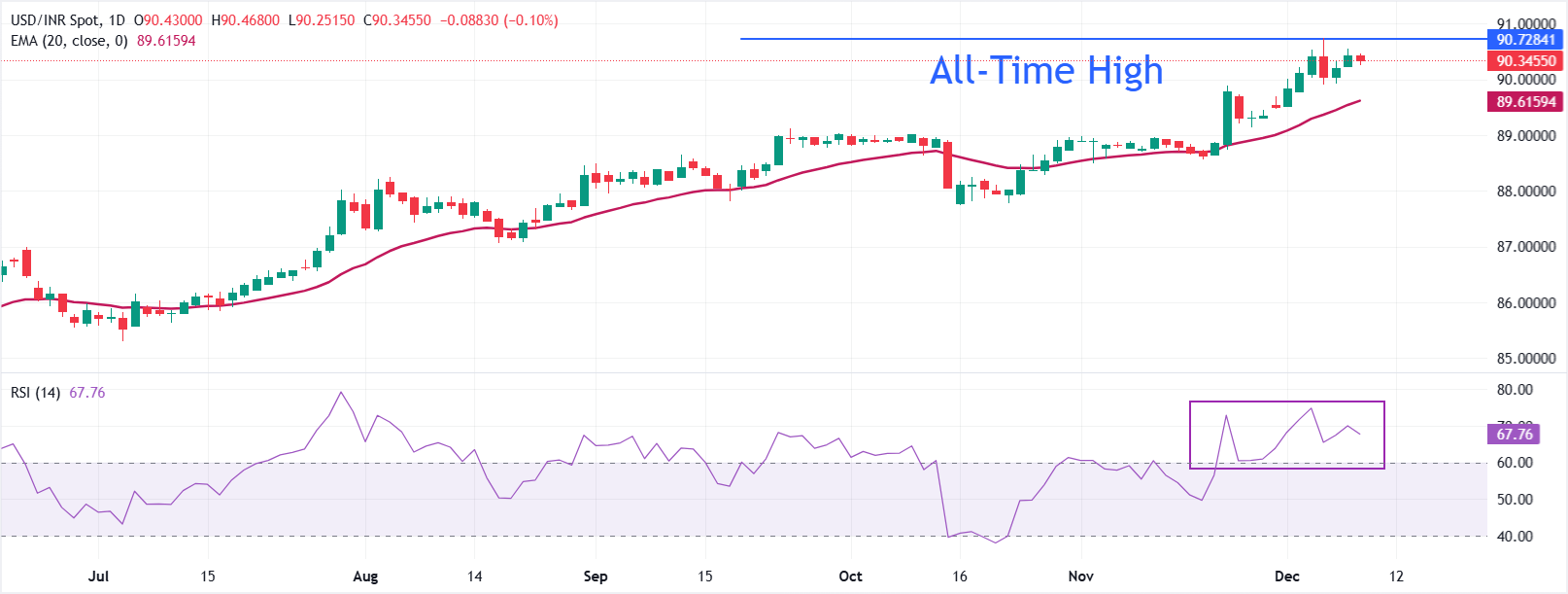
USD/INR trades at 90.3455 as of writing. The 20-day EMA at 89.6159 rises, and the pair holds above it, keeping the bullish bias intact. RSI at 67.76 (bullish) has eased from overbought, indicating firm momentum that is no longer stretched.
Staying above the 20-day EMA would keep the path of least resistance to the upside, while a close below it would tilt risks toward a pullback. A push in RSI back above 70 would flag overbought conditions and could prompt consolidation. Initial support is at the 20-day EMA near 89.6159 as the uptrend remains supported by an improving moving-average slope.
(The technical analysis of this story was written with the help of an AI tool)
Indian Rupee FAQs
The Indian Rupee (INR) is one of the most sensitive currencies to external factors. The price of Crude Oil (the country is highly dependent on imported Oil), the value of the US Dollar – most trade is conducted in USD – and the level of foreign investment, are all influential. Direct intervention by the Reserve Bank of India (RBI) in FX markets to keep the exchange rate stable, as well as the level of interest rates set by the RBI, are further major influencing factors on the Rupee.
The Reserve Bank of India (RBI) actively intervenes in forex markets to maintain a stable exchange rate, to help facilitate trade. In addition, the RBI tries to maintain the inflation rate at its 4% target by adjusting interest rates. Higher interest rates usually strengthen the Rupee. This is due to the role of the ‘carry trade’ in which investors borrow in countries with lower interest rates so as to place their money in countries’ offering relatively higher interest rates and profit from the difference.
Macroeconomic factors that influence the value of the Rupee include inflation, interest rates, the economic growth rate (GDP), the balance of trade, and inflows from foreign investment. A higher growth rate can lead to more overseas investment, pushing up demand for the Rupee. A less negative balance of trade will eventually lead to a stronger Rupee. Higher interest rates, especially real rates (interest rates less inflation) are also positive for the Rupee. A risk-on environment can lead to greater inflows of Foreign Direct and Indirect Investment (FDI and FII), which also benefit the Rupee.
Higher inflation, particularly, if it is comparatively higher than India’s peers, is generally negative for the currency as it reflects devaluation through oversupply. Inflation also increases the cost of exports, leading to more Rupees being sold to purchase foreign imports, which is Rupee-negative. At the same time, higher inflation usually leads to the Reserve Bank of India (RBI) raising interest rates and this can be positive for the Rupee, due to increased demand from international investors. The opposite effect is true of lower inflation.
추천 기사


