


What Amazon's Unconventional Path to Profitability Meant for Its Shareholders
Key Points
During the 20th century, most companies tried to become profitable as quickly as possible.
Amazon broke that model, sacrificing short-term profitability for a steeper revenue growth curve.
When Amazon finally flipped the switch and started making money, the results were impressive.
- 10 stocks we like better than Amazon ›
In the long run, the value of a company relies on its ability to make money. However, there are different pathways to profitability for young businesses. Historically, many businesses concentrated on becoming profitable as quickly as possible, even if it meant choosing not to make certain investments that would result in faster growth. This more disciplined approach to capital allocation ensured that shareholders got a short-term reward for their investment, but sometimes at the cost of giving up long-term opportunities.
Amazon (NASDAQ: AMZN) was one of the first companies to change that long-held paradigm. Rather than emphasizing short-term profits, the e-commerce giant instead didn't hesitate to spend money toward the long-term goal of maximizing market share. And as you'll see in this second article in my three-part series on Amazon for the Voyager Portfolio, the resulting shift transformed the way that countless companies pitch their value propositions to shareholders.
Will AI create the world's first trillionaire? Our team just released a report on the one little-known company, called an "Indispensable Monopoly" providing the critical technology Nvidia and Intel both need. Continue »
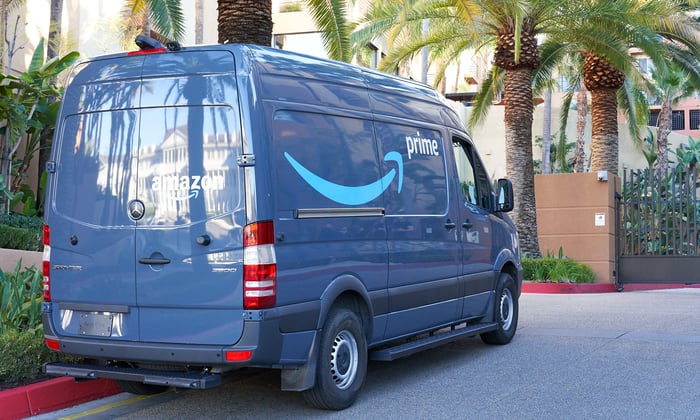
Image source: Amazon.
Amazon's capital allocation strategy: deferred gratification
Like just about every other company, Amazon started out with losses as it ramped up its operations. It took plenty of capital to build e-commerce infrastructure for the first time, and making a name for itself amid the competitive chaos of the early internet era was important. Then, when the tech bust happened in the early 2000s, just about every company found itself dealing with financial challenges. Amazon was no different.
But what confounded many investors during the boom times that followed for Amazon was how little it pursued profit. It's not that Amazon failed to make money; the company posted net losses only twice in the period from 2003 to 2021. However, profit growth was clearly not a priority.
Take this example: in 2004, Amazon made $588 million in net income on sales of $6.92 billion. By 2015, Amazon's sales had eclipsed the $100 billion mark, more than 14 times revenue from 11 years earlier. Yet net income was nearly identical at $596 million.
What was behind that disparity? Consider:
- Research and development expenses in 2004 amounted to just over $250 million. Just over a decade later, Amazon spent $12.5 billion on R&D. Put another way, Amazon's 2015 R&D spending alone was almost double what the company produced in total revenue in 2004.
- Overhead costs also rose sharply, at a pace faster than overall sales. In 2015, selling, general, and administrative expenses totaled $7 billion, up from $286 million in 2004.
The result of this relative stagnation in profits was that as Amazon's stock soared, its earnings multiples soared with it. Value investors believed that Amazon's ascent was unsustainable. But what they didn't fully realize was that Amazon's decision to defer its profitability was a conscious choice -- and one that it could reverse at a strategically appropriate moment.
Turning on the profit pump
Amazon's ability to control its profit destiny became apparent in the late 2010s. The three-year period from 2015 to 2018 was a strong one for Amazon, as revenue more than doubled. However, the most noticeable change was that the e-commerce pioneer started pursuing higher margins from parts of its business. Profit soared from just under $600 million to $10.1 billion during that span.
Since then, Amazon has looked much more like its 20th-century counterparts. Sales have continued to climb, but margins have risen substantially. In 2025, Amazon made $77.7 billion. Suddenly, Amazon's earnings multiple of less than 30 has started to look more attractive even to growth investors with more of a value bent.
The next chapter for Amazon
Amazon's path has inspired a generation of start-ups to emphasize initial sales growth over profits. But eventually, investors want to see proof that a business can make money. And for Amazon, shareholders want to see more profits. How it intends to find them is the subject of the third and final article on Amazon for the Voyager Portfolio.
Should you buy stock in Amazon right now?
Before you buy stock in Amazon, consider this:
The Motley Fool Stock Advisor analyst team just identified what they believe are the 10 best stocks for investors to buy now… and Amazon wasn’t one of them. The 10 stocks that made the cut could produce monster returns in the coming years.
Consider when Netflix made this list on December 17, 2004... if you invested $1,000 at the time of our recommendation, you’d have $456,188!* Or when Nvidia made this list on April 15, 2005... if you invested $1,000 at the time of our recommendation, you’d have $1,133,413!*
Now, it’s worth noting Stock Advisor’s total average return is 916% — a market-crushing outperformance compared to 194% for the S&P 500. Don't miss the latest top 10 list, available with Stock Advisor, and join an investing community built by individual investors for individual investors.
See the 10 stocks »
*Stock Advisor returns as of February 27, 2026.
Dan Caplinger has positions in Amazon. The Motley Fool has positions in and recommends Amazon. The Motley Fool has a disclosure policy.
Recommended Articles


