


Forget Altimmune: This Proven Obesity‑Drug Giant Is the Better Weight‑Loss Play
Key Points
Altimmune and Novo Nordisk have encountered some headwinds in recent years.
Both could rebound, but one of them looks far more likely to do so.
- 10 stocks we like better than Novo Nordisk ›
The weight-loss drug market has experienced incredible momentum over the past few years, and according to analyst projections, it hasn't peaked yet -- far from it. Among the many drugmakers looking to join this market is Altimmune (NASDAQ: ALT), a smaller biotech whose shares could skyrocket from their current levels if its leading program is successful. While the upside potential of a company like Altimmune is attractive, it's important to highlight that there is plenty of risk, too.
A safer -- and arguably better -- way to cash in on the anti-obesity drug market is to invest in a proven leader like Novo Nordisk (NYSE: NVO). Let's find out more.
Will AI create the world's first trillionaire? Our team just released a report on the one little-known company, called an "Indispensable Monopoly" providing the critical technology Nvidia and Intel both need. Continue »
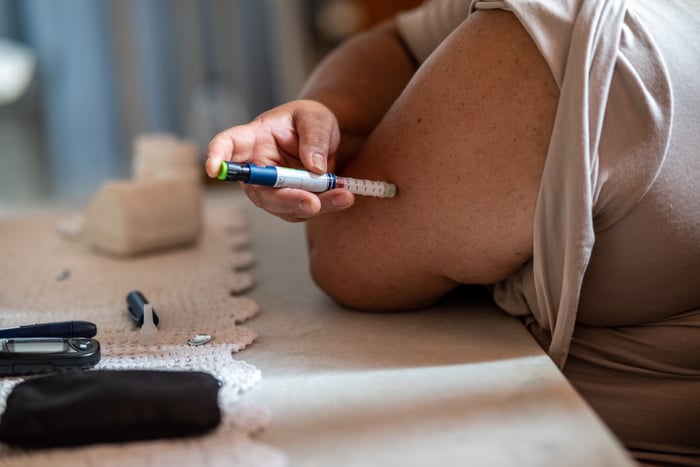
Image source: Getty Images.
Both have faced challenges
Altimmune and Novo Nordisk have both encountered headwinds in recent years. Let's start with the former.
The smaller biotech's leading candidate is called pemvidutide. It's a dual GLP-1/glucagon receptor agonist -- that is, it mimics the action of both of those gut hormones, which help control satiety and blood sugar levels. In 2023, Altimmune shared data from a phase 2 clinical trial of pemvidutide for weight loss. Although it showed reasonably strong efficacy, it also had high rates of patient discontinuation due to adverse reactions.
Altimmune is also developing pemvidutide as a medicine for metabolic dysfunction-associated steatohepatitis (MASH) -- another area with a high unmet need -- and alcohol use disorder. Last year, the biotech reported phase 2 study results for the medicine in MASH. Here, too, the data was mixed. Pemvidutide hit its main primary endpoint of MASH resolution without worsening of fibrosis (liver scarring). But the other endpoint of improvement in fibrosis was not statistically significant in those who took the medicine compared to those who took a placebo. Altimmune's shares plunged as a result.
Now, onto Novo Nordisk. The Denmark-based pharmaceutical giant has lost ground in the weight-loss market to its biggest competitor, Eli Lilly, over the past couple of years. It has had to reduce its guidance several times and now predicts its revenue will move in the wrong direction this year. Novo Nordisk has also faced clinical setbacks for otherwise promising candidates, all while lowering the prices of its medicines due to government-led efforts. These challenges have sunk the stock.
One of these stocks has better prospects
Altimmune could recover. Despite mixed mid-stage data in MASH, pemvidutide has received Breakthrough Therapy designation from the U.S. Food and Drug Administration (FDA). This designation is granted to help speed up the development and approval of medicines that target areas with high unmet needs, and for which there is at least some promising evidence of efficacy. If there were already dozens of approved products to treat MASH, pemvidutide's path to approval would be much harder, given the mixed phase 2 data.
But that's not the case at all; the therapy still has a shot, hence the designation. However, Altimmune's leading candidate still has to ace phase 3 studies and overcome regulatory hurdles. If it fails to do so, its stock price will sink even more. Altimmune is a pre-commercial biotech company with a thin pipeline, which means its fate is largely tied to its leading candidate. Investors could be left owning worthless shares in several years if pemvidutide doesn't pan out.
Novo Nordisk, even with its challenges, seems to have a much more attractive outlook. The company's Wegovy earned approval for treating MASH last year. This year, Novo Nordisk launched an oral version of its famous anti-obesity drug, making it the first oral GLP-1 approved for weight loss.
It has also submitted regulatory applications for CagriSema, a next-gen anti-obesity and diabetes medicine, which could hit the market later this year or in early 2027.
Finally, Novo Nordisk has a deep pipeline, with several programs in diabetes and weight loss across phase 2 and phase 3 studies. One of them, amycretin, is being developed in both oral and subcutaneous formulations.
Investors should look at 2026 as a transition year for Novo Nordisk. The company's sales may decline this year, but as newer approvals and recent label expansions start meaningfully impacting its financial results, its revenue will begin to climb again. And the company's fate isn't tied to the results of clinical trials for a single medicine that hasn't yet earned approval. That's why Novo Nordisk is a much better pick for investors looking to capitalize on the market for weight loss drugs.
Should you buy stock in Novo Nordisk right now?
Before you buy stock in Novo Nordisk, consider this:
The Motley Fool Stock Advisor analyst team just identified what they believe are the 10 best stocks for investors to buy now… and Novo Nordisk wasn’t one of them. The 10 stocks that made the cut could produce monster returns in the coming years.
Consider when Netflix made this list on December 17, 2004... if you invested $1,000 at the time of our recommendation, you’d have $445,995!* Or when Nvidia made this list on April 15, 2005... if you invested $1,000 at the time of our recommendation, you’d have $1,198,823!*
Now, it’s worth noting Stock Advisor’s total average return is 927% — a market-crushing outperformance compared to 194% for the S&P 500. Don't miss the latest top 10 list, available with Stock Advisor, and join an investing community built by individual investors for individual investors.
See the 10 stocks »
*Stock Advisor returns as of February 26, 2026.
Prosper Junior Bakiny has positions in Eli Lilly and Novo Nordisk. The Motley Fool recommends Novo Nordisk. The Motley Fool has a disclosure policy.
Recommended Articles


