


Is Sandisk Stock Still a Buy After its 1,750% Surge?
Key Points
Sandisk has become popular among AI-focused investors, thanks to its role in the memory-storage market.
Wall Street is calling for strong revenue and profit growth for Sandisk, thanks to rising AI infrastructure spending.
Despite its massive rally, Sandisk stock is still modestly valued relative to other leading AI chip stocks.
- 10 stocks we like better than Sandisk ›
It's no secret that demand for artificial intelligence (AI) has inspired something of a renaissance for the semiconductor industry. Thanks to surging demand for AI chips over the last few years, companies such as Nvidia, Broadcom, and Taiwan Semiconductor Manufacturing have experienced pronounced upswings in their stock prices -- with each now handily a member of the exclusive trillion-dollar club.
As AI hyperscalers like Microsoft, Alphabet, Amazon, Meta Platforms, and OpenAI double down on their infrastructure investments, more capital is beginning to flow beyond graphics processing units (GPUs) and custom silicon -- namely, demand for high-bandwidth memory (HBM) solutions is on the rise.
Will AI create the world's first trillionaire? Our team just released a report on the one little-known company, called an "Indispensable Monopoly" providing the critical technology Nvidia and Intel both need. Continue »
Since Sandisk (NASDAQ: SNDK) was spun off from Western Digital about a year ago, shares of the memory storage specialist have rocketed 1,750%, as of the closing bell on Feb. 23. After such a meteoric rise, is Sandisk still a no-brainer buy or have growth investors missed their chance?
Why is Sandisk stock up so much?
Throughout the AI revolution, investors have been bombarded with headlines about breakthroughs from generative AI. Indeed, large language models (LLMs) from OpenAI, Anthropic, Grok, and more are increasingly becoming embedded in enterprise workflows.
While LLMs have proven to carry a value-add in answering search queries or software coding, these use cases are fairly generic. AI is far more than a productivity enhancer -- its applications span well into extremely sophisticated environments in robotics, autonomous systems, life sciences, and more.
As big tech leads the charge in developing these next-generation services, AI workloads are beginning to scale at unprecedented rates. From a tech-stock perspective, this means that AI budgets are no longer solely concerned with data center buildouts and GPU procurement. Now, hyperscalers are scrambling to complement their GPU clusters with HBM chips.
Sandisk is a beneficiary of these dynamics as the company has been able to parlay its memory solutions in consumer electronics to suffice enterprise workloads.

Image source: Getty Images.
Is it too late to buy Sandisk stock?
It's one thing to understand the importance of the HBM market relative to the broader AI opportunity. However, smart investors are digging into Sandisk's growth outlook to help justify the company's generous share-price gains over the last year.
While the memory chip market is susceptible to cyclical trends, Wall Street appears generally bullish on Sandisk's prospects as AI infrastructure budgets accelerate. For this fiscal year, consensus estimates peg Sandisk's revenue at $15.5 billion, while earnings per share (EPS) are expected to be $39.76. Heading into next year, sales are forecast to grow 65% to $25.5 billion, while EPS doubles to $81.
Against this backdrop, Sandisk's business appears to have lots of upside opportunity. But what about the actual stock -- has it run too far?
Where could Sandisk stock be headed?
If you assess a company's investment prospects purely based on the movements of its stock price, odds are you'll miss out on numerous opportunities. While Sandisk's surge might imply you've missed the boat, looking at percentage gains (or losses) in a share price reveals very little about a company's underlying valuation profile.
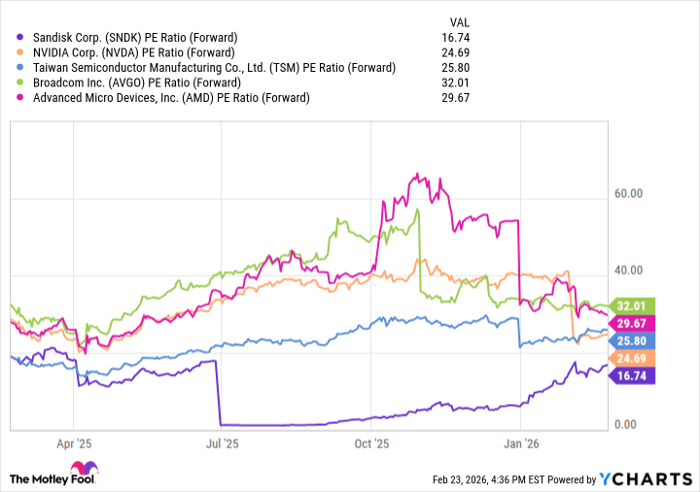
SNDK Price-to-Earnings Ratio (Forward) data by YCharts.
As the trends in the chart above illustrate, Sandisk is valued at a steep discount, relative to other leading AI chip stocks, based on forward price-to-earnings multiples (P/E).
Don't misinterpret the analysis above. Nvidia, Advanced Micro Devices, Broadcom, and Taiwan Semi are all vastly different companies than Sandisk, and each plays a unique role along the AI chip value chain. Moreover, these companies are more diversified than Sandisk, making them more insulated to cyclical headwinds and less susceptible to changes in hyperscaler budget allocations.
Nevertheless, the bigger takeaway is that Sandisk's valuation, relative to its growth profile, seems muted -- especially given the ranges other leading AI chip stocks have reached in their own respective P/Es.
Reaching a forward earnings multiple of 20 is completely realistic and appropriate, given Sandisk's role in the ever-important HBM market. Should the company trade in that range, which is still a considerable discount to adjacent AI chip stocks, shares of Sandisk could climb to roughly $800 -- implying 20% upside from current levels.
Although I can't predict Sandisk's future price target down to the decimal, I feel confident that significant valuation expansion is on the horizon as the AI infrastructure boom kicks into gear. Given Wall Street's bullish outlook and the company's modest valuation profile, Sandisk stock appears well-positioned to continue rallying.
Should you buy stock in Sandisk right now?
Before you buy stock in Sandisk, consider this:
The Motley Fool Stock Advisor analyst team just identified what they believe are the 10 best stocks for investors to buy now… and Sandisk wasn’t one of them. The 10 stocks that made the cut could produce monster returns in the coming years.
Consider when Netflix made this list on December 17, 2004... if you invested $1,000 at the time of our recommendation, you’d have $445,995!* Or when Nvidia made this list on April 15, 2005... if you invested $1,000 at the time of our recommendation, you’d have $1,198,823!*
Now, it’s worth noting Stock Advisor’s total average return is 927% — a market-crushing outperformance compared to 194% for the S&P 500. Don't miss the latest top 10 list, available with Stock Advisor, and join an investing community built by individual investors for individual investors.
See the 10 stocks »
*Stock Advisor returns as of February 26, 2026.
Adam Spatacco has positions in Alphabet, Amazon, Meta Platforms, Microsoft, and Nvidia. The Motley Fool has positions in and recommends Advanced Micro Devices, Alphabet, Amazon, Meta Platforms, Microsoft, Nvidia, Taiwan Semiconductor Manufacturing, and Western Digital. The Motley Fool recommends Broadcom. The Motley Fool has a disclosure policy.
Recommended Articles


