


Prediction: This Artificial Intelligence (AI) Stock Will Be Worth More Than SoundHound AI in 2026
Key Points
SoundHound AI stock pulled back substantially in 2025, and more downside may be possible in 2026 due to its rich valuation.
Another company capitalized on the growing demand for edge AI hardware, reporting impressive growth in revenue and earnings.
This company's sales multiple is significantly lower than SoundHound AI's.
- 10 stocks we like better than Ambarella ›
SoundHound AI (NASDAQ: SOUN) has been a popular artificial intelligence (AI) stock, and that's not just because the company has AI in its name. It provides voice AI solutions to customers, which can be deployed in various industries such as customer relationship management, automotive, hospitality, finance, and others.
SoundHound's offerings have turned out to be a big hit among customers, leading to remarkable growth in its revenue in the past couple of years. That's the reason the stock shot up phenomenally last year. However, SoundHound AI's expensive valuation has caught up with the stock. It is down 42% this year but still trades at an expensive 32 times sales.
Where to invest $1,000 right now? Our analyst team just revealed what they believe are the 10 best stocks to buy right now, when you join Stock Advisor. See the stocks »
It won't be surprising to see SoundHound's valuation weighing on the stock in 2026 as well. That could pave the way for Ambarella (NASDAQ: AMBA) to overtake SoundHound's market cap. Let's look at why that's likely to be the case next year.

Image source: Getty Images
Ambarella is taking advantage of a fast-growing AI niche
Ambarella designs chips that are deployed in devices at the edge that process data locally instead of sending it to a data center. Its computer vision processors are capable of processing AI workloads in edge devices such as security cameras, industrial robots, vehicles, and drones. Ambarella made the switch to AI-capable computer vision chips in 2021. These chips process images and videos to extract data, which can be processed instantly to help the edge devices make real-time decisions.
The decision to pivot toward manufacturing edge AI chips has turned out to be a tailwind for the company. It used to get just 10% of its revenue from edge AI processors in fiscal 2021, with the rest coming from video processing chips that were deployed by the likes of GoPro. The growing popularity of AI in the past three years has justified Ambarella's switch to making AI-focused processors.
It is on track to end the ongoing fiscal year 2026 with $390 million in revenue (calculated by adding its nine-month revenue of $290 million to the fiscal fourth-quarter forecast of $100 million). That would be an improvement of 37% over the prior year, when 70% of Ambarella's revenue came from edge AI processors. The company estimates that its AI-capable processors will account for 80% of revenue in the current fiscal year.
More importantly, Ambarella's AI-focused chips are leading to margin improvements because of higher average selling prices (ASPs). The company reported a 20% year-over-year increase in its ASP in the previous quarter. Ambarella expects its ASP to head higher in the future once its latest generation of computer vision processors and new products become a bigger part of its product mix.
The robust top-line gains and the growth in Ambarella's margins are the reasons the company's earnings popped by 145% year over year to $0.27 per share in the previous quarter. For the full year, Ambarella is expected to deliver $0.59 per share in earnings as compared to a loss of $0.16 per share in fiscal 2025.
Here's why it could be worth more than SoundHound next year
Ambarella operates in a market that's expected to grow at a brisk pace. According to one estimate, the edge AI hardware market could clock $59 billion in revenue in 2030, compared to $26 billion last year. That's why it won't be surprising to see Ambarella sustain solid growth levels in the long run.
Consensus estimates, however, are expecting a slowdown in Ambarella's growth in the next fiscal year before an improvement the following year.
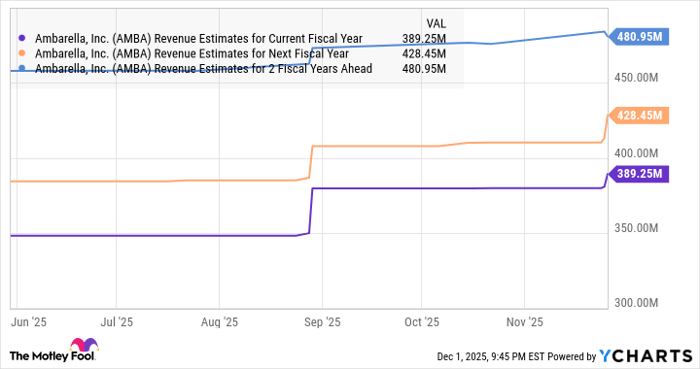
Data by YCharts.
However, the fast-growing nature of the edge AI market and the fact that Ambarella is expecting its serviceable addressable market (SAM) to increase at an annual rate of 18% for the next five years suggest that it can do better. As such, it won't be surprising to see the company sustain a much stronger level of growth next year.
Assuming Ambarella manages to increase its revenue by even 20% in the next fiscal year (which will begin in January 2026), its top line could jump to $468 million from its fiscal 2026 estimate of $390 million. The stock is currently trading at less than 5 times sales, a discount to the U.S. technology sector's average sales multiple of 8.4. Assuming the market rewards it with a richer multiple on account of its healthy growth, and it trades in line with the sector average after a year, its market cap could jump to $3.9 billion, a 30% increase from current levels.
SoundHound, meanwhile, has a market cap of $4.8 billion. Its 2026 revenue is expected to land at $233 million, as per consensus estimates. Even if the stock were to trade at 16 times sales after a year (which is half of its current sales multiple), its market cap may drop to $3.7 billion. So, there is a strong possibility of Ambarella stock overtaking SoundHound in the coming year because of the latter's expensive valuation.
Should you invest $1,000 in Ambarella right now?
Before you buy stock in Ambarella, consider this:
The Motley Fool Stock Advisor analyst team just identified what they believe are the 10 best stocks for investors to buy now… and Ambarella wasn’t one of them. The 10 stocks that made the cut could produce monster returns in the coming years.
Consider when Netflix made this list on December 17, 2004... if you invested $1,000 at the time of our recommendation, you’d have $560,649!* Or when Nvidia made this list on April 15, 2005... if you invested $1,000 at the time of our recommendation, you’d have $1,100,862!*
Now, it’s worth noting Stock Advisor’s total average return is 998% — a market-crushing outperformance compared to 194% for the S&P 500. Don’t miss out on the latest top 10 list, available when you join Stock Advisor.
See the 10 stocks »
*Stock Advisor returns as of December 1, 2025
Harsh Chauhan has no position in any of the stocks mentioned. The Motley Fool has no position in any of the stocks mentioned. The Motley Fool has a disclosure policy.
Recommended Articles


