

Bitcoin Price Flashes Downside Break: Will Bears Take Over?

Source Newsbtc

Bitcoin price failed to clear the $60,650 resistance. BTC is now correcting gains and might decline toward the $57,500 support zone.

  • Bitcoin is correcting gains and trading well below the $60,000 level.
  • The price is trading below $58,800 and the 100 hourly Simple moving average.
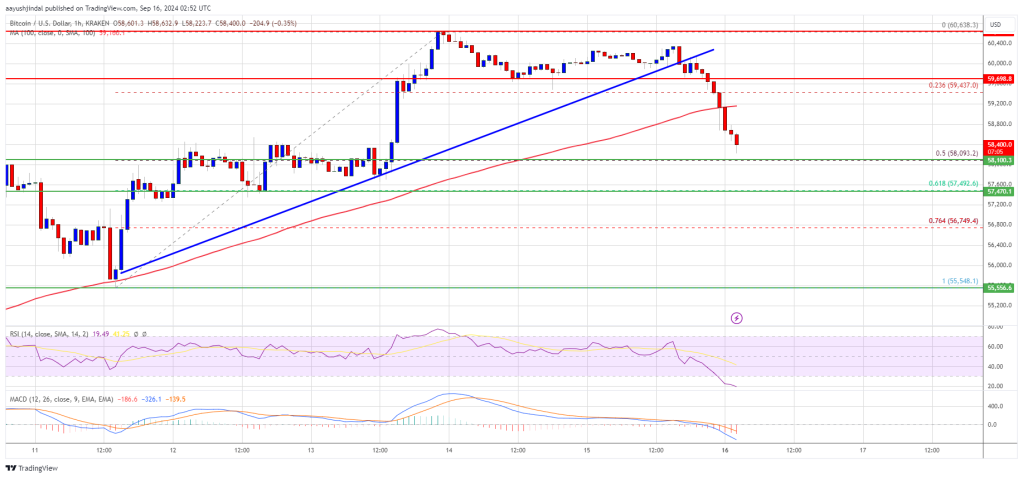
  • There was a break below a key bullish trend line with support at $60,000 on the hourly chart of the BTC/USD pair (data feed from Kraken).
  • The pair could climb again if it stays above the $57,500 support zone.

Bitcoin Price Starts Downside Correction

Bitcoin price started a decent increase after it broke the $58,500 resistance zone. BTC was able to climb above the $59,500 resistance. The pair even cleared the $60,000 resistance zone.

However, the bears seem to be active near the $60,650 resistance zone. A high was formed at $60,638 and the price is now correcting gains. There was a drop below the $59,500 level. The price even dipped below the 23.6% Fib retracement level of the upward move from the $55,548 swing low to the $60,638 high.

There was also a break below a key bullish trend line with support at $60,000 on the hourly chart of the BTC/USD pair. Bitcoin is now trading below $58,800 and the 100 hourly Simple moving average.
Bitcoin Price

On the upside, the price could face resistance near the $59,200 level. The first key resistance is near the $60,000 level. A clear move above the $60,000 resistance might start a steady increase in the coming sessions. The next key resistance could be $60,650. A close above the $60,650 resistance might spark more upsides. In the stated case, the price could rise and test the $62,000 resistance.

More Downsides In BTC?

If Bitcoin fails to rise above the $59,200 resistance zone, it could continue to move down. Immediate support on the downside is near the $58,000 level or the 50% Fib retracement level of the upward move from the $55,548 swing low to the $60,638 high.

The first major support is $57,500. The next support is now near the $56,750 zone. Any more losses might send the price toward the $55,550 support in the near term.

Technical indicators:

Hourly MACD – The MACD is now gaining pace in the bearish zone.

Hourly RSI (Relative Strength Index) – The RSI for BTC/USD is now below the 50 level.

Major Support Levels – $58,000, followed by $57,500.

Major Resistance Levels – $59,200, and $60,000.

Disclaimer: For information purposes only. Past performance is not indicative of future results.
placeholder
Fed hike odds near 90% into Wednesday's decision — how to trade the dollar, gold and the S&P 500A 0.3% monthly core CPI print has lifted the market-implied probability of a 25bp Fed hike on 16 September to roughly 86.5% ~ 90%, which would be the first increase since July 2023. Here is the decision timeline, the pricing versus the forecasts, both scenarios, and the key levels for the dollar, gold and the S&P 500.
Author  Suzie
Sep 14, Mon
A 0.3% monthly core CPI print has lifted the market-implied probability of a 25bp Fed hike on 16 September to roughly 86.5% ~ 90%, which would be the first increase since July 2023. Here is the decision timeline, the pricing versus the forecasts, both scenarios, and the key levels for the dollar, gold and the S&P 500.
placeholder
Bitcoin falls below $75,000 as the CLARITY Act fails in the Senate — what the vote means for cryptoThe US Senate blocked the Digital Asset Market CLARITY Act in a 49-50 procedural vote, sending Bitcoin briefly below $75,000 — its biggest one-day drop since June. Ethereum fell more than 8%, Coinbase slid 10% and $75 billion of crypto market value evaporated. Here is what the vote was, why it failed, and the levels that matter now.
Author  Suzie
Sep 16, Wed
The US Senate blocked the Digital Asset Market CLARITY Act in a 49-50 procedural vote, sending Bitcoin briefly below $75,000 — its biggest one-day drop since June. Ethereum fell more than 8%, Coinbase slid 10% and $75 billion of crypto market value evaporated. Here is what the vote was, why it failed, and the levels that matter now.
placeholder
Dollar index tops 100 for the first time since July as the Fed's hawkish dot plot sinks inThe U.S. dollar index broke back above 100 for the first time since 31 July after the Fed delivered its first rate hike since 2023, with the dot plot showing 16 of 18 officials expect at least one more increase this year. Here are the levels that matter for DXY, the currencies feeling it most, and what to watch next.
Author  Irene Q.
Sep 17, Thu
The U.S. dollar index broke back above 100 for the first time since 31 July after the Fed delivered its first rate hike since 2023, with the dot plot showing 16 of 18 officials expect at least one more increase this year. Here are the levels that matter for DXY, the currencies feeling it most, and what to watch next.
placeholder
Gold rebounds to near $4,350 on weaker US Dollar, falling oil pricesGold price (XAU/USD) rises to near $4,345 during the early Asian session on Friday. The precious metal rebounds from a six-week low amid falling oil prices and a weaker US Dollar (USD). Traders continue to assess the latest Federal Reserve (Fed) rate hike and policy cues.
Author  FXStreet
Yesterday 01: 32
Gold price (XAU/USD) rises to near $4,345 during the early Asian session on Friday. The precious metal rebounds from a six-week low amid falling oil prices and a weaker US Dollar (USD). Traders continue to assess the latest Federal Reserve (Fed) rate hike and policy cues.
placeholder
US to delay new "overcapacity" tariffs on China — what the pause means for trade, inflation and the dollarWashington is expected to hold off announcing new tariffs over Chinese "overcapacity" until after the 24 September summit, according to Bloomberg. The postponed plan would have added 7.5% to Chinese goods, taking second-term US tariffs to around 20%. Here is what is on the table, and what a deal versus no deal would mean for the yuan, Hong Kong equities and the dollar.
Author  Mitrade
Yesterday 07: 43
Washington is expected to hold off announcing new tariffs over Chinese "overcapacity" until after the 24 September summit, according to Bloomberg. The postponed plan would have added 7.5% to Chinese goods, taking second-term US tariffs to around 20%. Here is what is on the table, and what a deal versus no deal would mean for the yuan, Hong Kong equities and the dollar.
goTop
quote