


Tilray Just Posted Record Quarterly Revenue of $257 Million. So Why Did Its Cannabis Sales Shrink?
Key Points
Tilray reported record quarterly revenue of $257.1 million.
Cannabis revenue declined 13% despite strong international growth.
Beverage revenue surged 82%, driving Tilray's overall growth.
- Motley Fool Issues Rare "Total Conviction" Buy Alert ›
Tilray Brands (NASDAQ: TLRY) reported record first-quarter fiscal 2027 revenue of $257.1 million, up 23% from $209.5 million a year earlier. Gross profit also reached a Q1 record of $77.5 million, increasing 35%, while gross margin improved from 27% to 30%.
Those are encouraging numbers for a company that has spent years expanding beyond cannabis. But there's a catch. Despite reporting record overall revenue, Tilray's cannabis business struggled. Net cannabis revenue declined 13% year over year, from $64.5 million to $56.1 million.
Missed Nvidia in 2009? This Rare Signal Is Flashing Again. In 2009, a "Double Down" signal flashed for a little-known chipmaker called Nvidia. For the first time in years, that same "Total Conviction" signal is flashing for a company 1/100th the size of Nvidia. Continue »
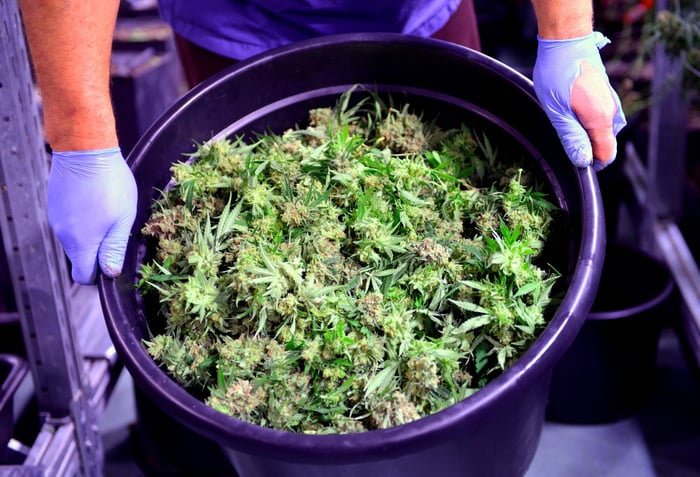
Image source: Getty Images.
Canada's cannabis market remains a problem
Most of the weakness came from Canada. Adult-use cannabis revenue declined 16% to $53.6 million, while medical cannabis revenue fell 23% to $4.7 million. Wholesale cannabis revenue also dropped sharply, from $4.2 million to less than $700,000.
International cannabis sales provided some relief, increasing 21% to $16.2 million. However, that growth wasn't enough to offset the decline in Canadian sales. After deducting $19.1 million in cannabis excise taxes, Tilray reported total net cannabis revenue of $56.1 million.
Beverages are driving Tilray's growth
Tilray's beverage business generated $101.5 million in quarterly revenue, an 82% increase from $55.7 million a year earlier. Much of that increase reflected the acquisition of BrewDog, which expanded Tilray's beverage operations. Beverage gross margin also improved from 38% to 41%.
Beverages now account for approximately 39% of Tilray's total revenue. Cannabis contributes just 22%, down from 31% a year earlier. So it's clear that Tilray is increasingly becoming a diversified beverage, pharmaceutical distribution, and cannabis company rather than a business primarily dependent on marijuana sales. Pharmaceutical distribution revenue increased 14% to $84.3 million, while wellness revenue remained relatively unchanged at $15.3 million.
Record revenue hasn't translated into profitability
Despite higher revenue and gross profit, Tilray reported a quarterly net loss of approximately $40 million. Adjusted EBITDA declined from $10.2 million to $9.2 million. Free cash flow was negative $27.4 million, compared with negative $10.6 million a year earlier.
That said, the balance sheet did improve. Tilray ended the quarter with approximately $221 million in cash, restricted cash, and marketable securities and reduced outstanding debt by $42 million during the fiscal year. Management also reaffirmed its fiscal 2027 adjusted EBITDA guidance of $68 million to $75 million.
Is Tilray stock worth buying?
Tilray's diversification strategy is generating substantial revenue growth, particularly in beverages and pharmaceutical distribution. Higher gross margins also suggest the company is making progress improving its product mix. But cannabis sales are still declining, adjusted EBITDA slipped, and free cash flow remains negative.
If you're expecting Tilray to capitalize on expanding global marijuana markets, international cannabis growth offers some encouragement. However, the company's latest results show that its strongest growth is currently coming from businesses outside the cannabis sector. So until Tilray demonstrates sustained profitability and stabilizes its core cannabis operations, record revenue alone isn't enough to establish a convincing bullish case.
Should you buy stock in Tilray Brands right now?
Before you buy stock in Tilray Brands, consider this:
The Motley Fool Stock Advisor analyst team just identified what they believe are the 10 best stocks for investors to buy now… and Tilray Brands wasn’t one of them. The 10 stocks that made the cut could produce monster returns in the coming years.
Consider when Netflix made this list on December 17, 2004... if you invested $1,000 at the time of our recommendation, you’d have $334,793!* Or when Nvidia made this list on April 15, 2005... if you invested $1,000 at the time of our recommendation, you’d have $1,257,420!*
Now, it’s worth noting Stock Advisor’s total average return is 874% — a market-crushing outperformance compared to 209% for the S&P 500. Don't miss the latest top 10 list, available with Stock Advisor, and join an investing community built by individual investors for individual investors.
See the 10 stocks »
*Stock Advisor returns as of November 1, 2026.
Jeff Siegel has no position in any of the stocks mentioned. The Motley Fool recommends Tilray Brands. The Motley Fool has a disclosure policy.
Recommended Articles


