


Target Trades at a Fraction of Walmart's Valuation. Is the Discount Deserved?
Key Points
Target trades at a P/E of just 15, compared to 43 for Walmart.
Target's comparable sales growth has started accelerating, while Walmart's is slowing.
Walmart deserves a higher multiple than Target because of its defensive positioning, but the gap is wider than it should be.
- Motley Fool Issues Rare "Total Conviction" Buy Alert ›
Target (NYSE: TGT) and Walmart (NASDAQ: WMT) are two of the biggest retailers in the country.
As the only national, brick-and-mortar, multi-category chains where anyone can shop, the two are also close competitors, even if they have both carved out different brand identities. Over the last few years, Walmart has won that competition hands down, as the chart below shows.
Missed Nvidia in 2009? This Rare Signal Is Flashing Again. In 2009, a "Double Down" signal flashed for a little-known chipmaker called Nvidia. For the first time in years, that same "Total Conviction" signal is flashing for a company 1/100th the size of Nvidia. Continue »
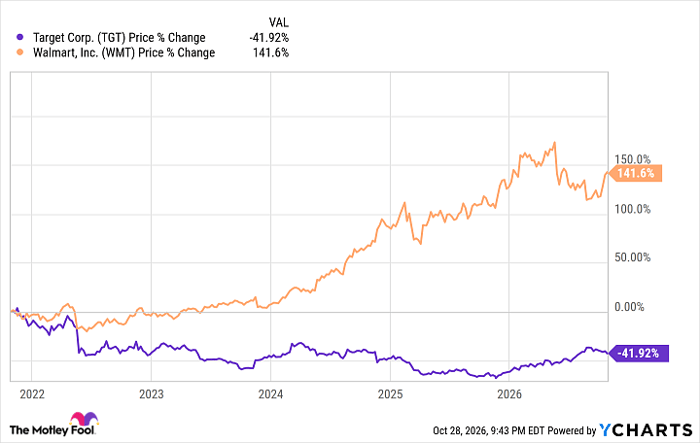
TGT data by YCharts
As you can see from the chart above, Target and Walmart have gone in diametrically opposite directions, though the trend started to reverse earlier this year as Target showed some signs of life, and Walmart's comparable sales growth slowed.
While Walmart was trouncing Target, its earnings multiple got significantly higher, and at the same time, Target's fell. Foolish investors know that past performance isn't a guarantee of future returns. So is it time for a changing of the guard in big-box retail? Let's take a closer look.

Image source: Target.
Target vs. Walmart
It's understandable that Target would catch the eye of value investors at a price-to-earnings ratio of 15 and a dividend yield of 3.1%.
Additionally, under the guidance of new CEO Michael Fiddelke, the company seems to be emerging from a series of problems that challenged the retailer for years, including theft, getting dragged into culture war issues, and weak spending on discretionary items, and a slowdown coming out of a strong performance after the pandemic.
Walmart, on the other hand, now trades at a P/E ratio of 43, which reflects a consistent record of growth with comparable sales of 2% or better for every quarter for the last six years. Its investment in a network of grocery pickup stations has paid off, and it's built up its e-commerce business to a point where it's a real challenger to Amazon. That includes a Prime-like membership program, Walmart+, and it's growing its digital advertising business fast.
Which is the better buy?
Walmart deserves to have a higher earnings multiple than Target because the two are different kinds of stocks.
Walmart is one of the top, defensive, recession-proof stocks on the market, as it earns more than half of its revenue from groceries, a category people need regardless of the state of the economy.
Target, on the other hand, gets most of its revenue from discretionary goods, making it more sensitive to economic factors like inflation, which explains in part why the stock has struggled.
Still, I think the gap in valuation is too steep, especially as Target's comparable sales growth is accelerating while Walmart's is fading.
Target is the better buy of the two, though if Walmart's valuation slipped closer to the market average, it would be an attractive buy as well.
Should you buy stock in Walmart right now?
Before you buy stock in Walmart, consider this:
The Motley Fool Stock Advisor analyst team just identified what they believe are the 10 best stocks for investors to buy now… and Walmart wasn’t one of them. The 10 stocks that made the cut could produce monster returns in the coming years.
Consider when Netflix made this list on December 17, 2004... if you invested $1,000 at the time of our recommendation, you’d have $334,308!* Or when Nvidia made this list on April 15, 2005... if you invested $1,000 at the time of our recommendation, you’d have $1,323,413!*
Now, it’s worth noting Stock Advisor’s total average return is 897% — a market-crushing outperformance compared to 213% for the S&P 500. Don't miss the latest top 10 list, available with Stock Advisor, and join an investing community built by individual investors for individual investors.
See the 10 stocks »
*Stock Advisor returns as of October 29, 2026.
Jeremy Bowman has positions in Amazon and Target. The Motley Fool has positions in and recommends Amazon, Target, and Walmart. The Motley Fool has a disclosure policy.
Recommended Articles


