




Dow Closes Higher, Reversing Over 1,100-Point Intraday Drop; Chip Stocks Pare Early Losses, Anthropic Reverses to Rise 1%
TradingKey - On Wednesday, November 25, Eastern Time, U.S. stocks experienced sharp volatility. Artificial intelligence (AI)-related stocks faced morning sell-offs, sending the Dow down more than 1,100 points at one point before it erased all losses and turned higher. The Nasdaq and the S&P 500 also narrowed their losses significantly, though they remained in negative territory. Meanwhile, well-known investor Michael Burry drew market attention after disclosing a reduction in his short positions.
At the close, the Dow Jones Industrial Average rose 0.33% to 50,182.95; the Nasdaq Composite Index fell 0.62% to 23,585.80; and the S&P 500 Index fell 0.25% to 7,182.78.
Tech Stock Performance
Anthropic (ANT) reversed earlier losses to gain 1.08% to $82.79, with an intraday swing of up to 14.73%. Reportedly, ARK Invest increased its holdings in Anthropic by over 750,000 shares. In addition, Arete Research initiated coverage on Anthropic with a "Buy" rating and a price target of $300.
The performance of large-cap tech stocks today is shown in the chart below:
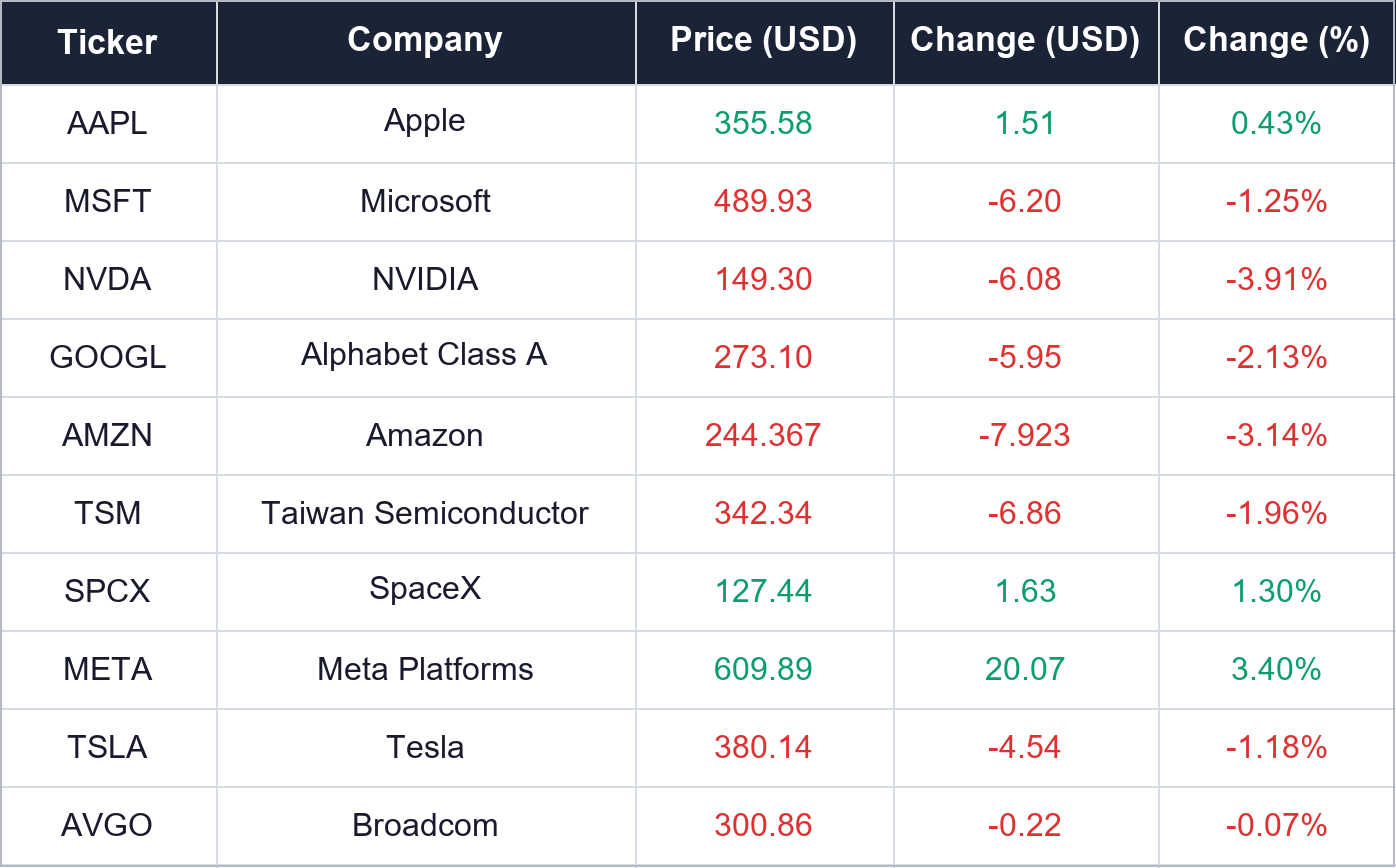
The Philadelphia Semiconductor Index fell 0.65% to 8,774.86 points. Among the 30 constituent stocks, 11 rose and 19 fell.
Company News
S&P Places Nvidia's AA Rating on CreditWatch Negative, Eyeing Board Independence and Succession Planning
S&P Global Ratings placed Nvidia's issuer credit rating and senior unsecured debt rating—both currently AA—on CreditWatch with negative implications. S&P believes Jensen Huang's return to lead the company after a brief departure highlights Nvidia's reliance on its co-founder and brings board independence and management succession planning under scrutiny. S&P has revised its assessment of Nvidia's management and governance from "positive" to "neutral." If subsequent investigations show persistent governance deficiencies, S&P could downgrade the ratings by one notch to AA- within the next 90 days. A larger downgrade could occur if further disclosures indicate that Nvidia's reputation or future business prospects have been impaired.
SpaceX Approved to Deploy Up to 1 Million Satellites for Orbital Data Centers
The U.S. Federal Communications Commission (FCC) has conditionally approved SpaceX (SPCX) to deploy up to 1 million satellites to build an orbital data center network called Starmind, providing computing power for AI workloads. This marks the first U.S. approval for such an orbital data center constellation. Under the authorization, SpaceX must begin deployment no later than November 2033 and deploy 100,000 satellites by November 2035.
Under the plan initially submitted by SpaceX, the satellites are intended to be deployed in orbits roughly 500 to 2,000 kilometers above Earth and communicate with each other via laser links. SpaceX stated that orbital data centers can be powered by solar energy and use radiative cooling to reduce reliance on terrestrial cooling systems and water resources. Organizations such as the American Astronomical Society had urged the FCC to deny the application, raising concerns that massive deployment would exacerbate orbital congestion and collision risks, as well as disrupt astronomical observations.
SpaceX Cuts Prices for Small Blackwell Clusters; Anthropic Reportedly Plans Not to Renew Some H200 Compute Capacity
Semiconductor research firm SemiAnalysis reported that SpaceX has slashed rental prices for small-scale Nvidia Blackwell clusters from around $15 to $15.50 per GPU hour to $10 to $12, a reduction of roughly 20% to 35%, bringing them largely in line with volume pricing offered to major customers such as Anthropic and Google. Just weeks ago, GPU rental rates tracked by the firm were still climbing. This price reduction signals that the premium smaller customers previously paid to secure tight computing capacity is narrowing.
SemiAnalysis also noted that Anthropic may not renew its lease for a batch of SpaceX's H200 compute capacity. Since SpaceX's compute leasing consists primarily of short-term contracts, and the company plans to roll out more compute capacity powered by Nvidia's next-generation chips next year, the price cuts help boost utilization rates for existing GPUs before new capacity comes online.
Industry & Macro News
U.S. October Core PCE Rose to 3.3% YoY, Hitting a Near Three-Year High
The U.S. core Personal Consumption Expenditures (PCE) price index rose 3.3% year-over-year in October, exceeding market expectations of 3.2% and September's 3.1%, marking the highest level since November 2023. Core PCE increased 0.3% month-over-month, unchanged from the previous month and in line with expectations. Meanwhile, the headline PCE price index rose from 3.6% to 3.8% year-over-year, the highest since May this year, and climbed 0.3% month-over-month, with both readings meeting market expectations.
Fed Beige Book: Eight Districts Report Economic Growth, Firms Remain Cautious on Hiring
The Federal Reserve's latest Beige Book showed that among the 12 Fed districts, eight reported slight to modest economic growth, while four were essentially flat. Consumer spending changed little, but households were more price-sensitive and cut back on some discretionary spending. Auto sales slowed somewhat, and housing affordability pressures also dampened residential real estate activity. Overall employment increased slightly, with most businesses maintaining current headcount and hiring primarily to fill vacancies. Wages and benefits rose moderately, accelerating from the prior period. Overall prices rose moderately, as expenses related to energy, transportation, healthcare, insurance, and tariffs continued to push up business costs, though competition and consumer price sensitivity limited companies' ability to pass along costs. Most districts expected economic activity to maintain slight to modest growth going forward.
Recommended Articles


