




SpaceX Stock Price Forecast: Merger Agreement With Tesla as Soon as Year-End, Shares Poised to Rebound to $132
TradingKey - SpaceX (SPCX) and Tesla (TSLA) have each formed special committees, with two SpaceX directors and three Tesla directors responsible for negotiating a potential all-stock merger. The combined group could be valued at $3.5 trillion, potentially setting a global M&A record. Both sides are currently negotiating business valuations, the exchange ratio, and corporate governance structures, with an agreement possible as early as the end of this year, though significant disagreements remain on key terms.
For SpaceX shareholders, $3.5 trillion is the potential valuation of the combined group, and how much existing shareholders will capture depends on the exchange ratio negotiated by the two sides. This makes the valuation of SpaceX's AI business a key entry point for understanding the deal. Morgan Stanley maintains an "Overweight" rating and a $300 price target on SpaceX, with the enterprise AI business accounting for $170 per share—or approximately 57% of the price target—which already factors in a 50% execution risk discount. Among the remaining valuation, the connectivity business contributes $111, X and Grok contribute $11, and the space business contributes $8.
What Morgan Stanley values is whether SpaceX can simultaneously benefit from the growth in demand for computing power and communications. Taking factory robots as an example, an individual device needs to run models locally to execute movements and operations in a timely manner, while multi-device coordination requires a stable communications network. The bank believes that as autonomous devices expand their deployment, both SpaceX's AI and connectivity businesses have growth opportunities. It expects SpaceX's earnings per share to rise from $0.58 in 2026 to $3.95 in 2027, and further to $9.91 in 2028.
The merger could also alter the timing of index funds buying SpaceX. JPMorgan pointed out that under standard S&P 500 inclusion criteria, newly listed companies must typically trade for at least 12 months, and GAAP net income from continuing operations must be positive both for the most recent quarter and cumulatively over the last four quarters. While SpaceX does not currently meet standard requirements, Tesla is already an index constituent. If the merger is completed, the S&P Dow Jones Indices committee may look to past M&A cases and waive certain requirements, depending on the transaction structure and the committee's decision.
JPMorgan estimates that if the merger accelerates SpaceX's index inclusion, buying by relevant passive funds could equal about 10% of its free float, and the buying could emerge earlier than the previously expected September 2027.
From a technical perspective, weighed down by the pullback in tech stocks, SpaceX gapped lower and broke below its previous low of around $120 from early November, hitting an intraday low of $112.93 to form a lower low. The stock subsequently rebounded to $120.12, hugging the 0.786 Fibonacci retracement level ($120.15).
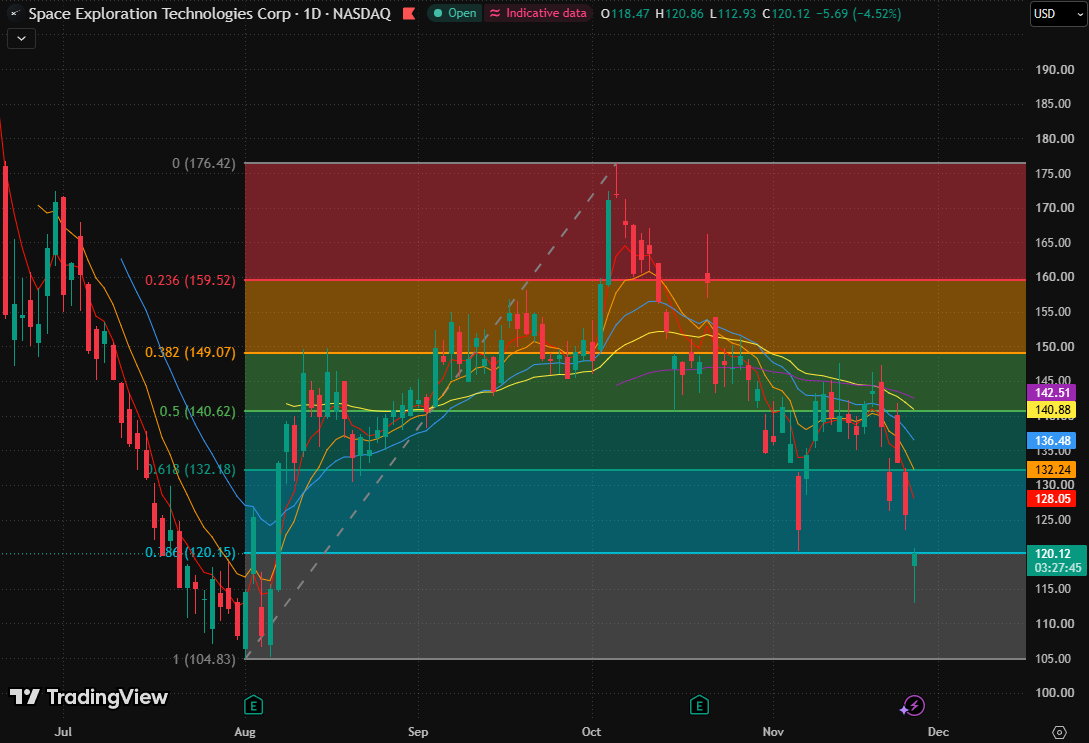
SpaceX stock chart, Source: TradingView
In terms of moving averages, the stock remains below all exponential moving averages, which maintain a complete bearish alignment, and the intraday rebound has yet to overcome resistance from the nearest moving average.
On the upside, if the daily chart reclaims $120.15 and holds on a subsequent retest, a new round of rebound could be initiated. Overhead resistance lies at the 5-day exponential moving average ($128.05). More significant resistance is concentrated near $132, where the 0.618 Fibonacci retracement level is adjacent to the 10-day exponential moving average.
The biggest risk is that the stock fails to reclaim its previous low near $120 and subsequently breaks below this intraday low again. In that case, the decline following the breach of the previous low will extend further, testing historical support near $104.83 below.
Recommended Articles


