




Archer Aviation and Joby Aviation: Speculative Plays With Upside Potential and Downside Risk
Key Points
eVTOL stocks have declined due to certification issues and concerns over cash burn.
Defense contracts and autonomous tech offer some risk mitigation.
- 10 stocks we like better than Joby Aviation ›
Investing in Joby Aviation (NYSE: JOBY) and Archer Aviation (NYSE: ACHR) right now is a speculative bet on the two leading U.S. electric vertical takeoff and landing (eVTOL) companies. The two stocks have slumped in 2026, down 58% and 40%, respectively, at the time of writing. Do those declines reflect a worsening outlook for the companies, and how could investing in them now work out for investors?
Why eVTOL stocks have declined this year
The falling stock prices reflect a combination of certification delays, concerns over funding with interest rates rising, delays in launching services in the Middle East (Joby in Dubai, and Archer in Abu Dhabi) potential future dilution if both need cash, and anecdotal evidence that suggests the early, easy, revenue and cash flow from airport shuttle services might not be as early, easy, or as a large as previously expected.
Missed AI’s "Act 1"? Act 2 Could Be 15x Bigger. Most investors think they missed the AI boat because they didn't buy Nvidia in 2005. But according to our analysts, we’re only at the end of "Act 1"—the R&D phase. "Act 2" is the global rollout. Continue »
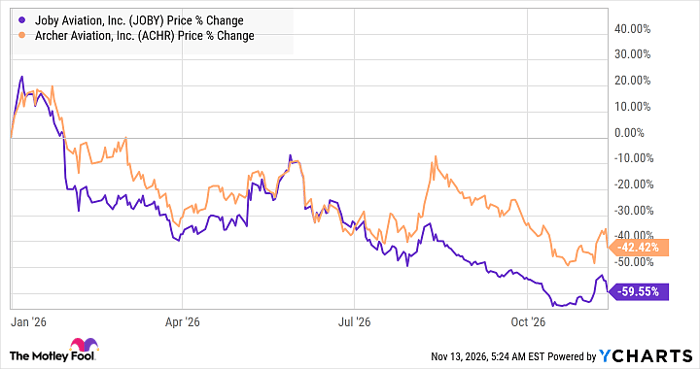
JOBY data by YCharts
Most of these issues are likely to push back earnings and cash flow for the companies, with Federal Aviation Administration (FAA) type certification the most important milestone by far. Until either company achieves it for its eVTOL vehicles, revenue from original equipment sales to third parties (Archer's core business model) and transportation services (Joby's core business model) will be delayed, exacerbating cash burn and funding concerns.
Moreover, comments from United Airlines (a key partner of Archer Aviation) management highlighting challenges around air traffic control in flying eVTOL craft into congested airports raise concerns over both Archer and Joby Aviation, which has investment from and partners with Delta Air Lines.
As such, any financial projections for 2030 need to be put in the context of the moving timelines for certification and launch of commercial services, not least the airport shuttle services that investors were hoping would bridge the gap between cash burn and widespread eVTOL sales or commercial transportation services.
Image source: Joby Aviation.
Good news for eVTOL stocks in 2026
Still, it hasn't all been negative for Archer and Joby in 2026, and the two pieces of good news are setting up the companies for long-term profit growth.
First, both companies have actively pivoted toward the defense industry to generate revenue while they work through delays in establishing commercial services. Revenue from the Pentagon helps derisk both stocks by providing reliable income.
Second, both companies have made significant progress in their programs to develop autonomous eVTOL aircraft. While they will both initially deploy piloted eVTOL vehicles, it's clear that the path to making eVTOL craft cost-effective enough for wide-scale deployment is to move toward autonomous aircraft.
In that sense, both companies were derisked when Archer agreed to buy Wisk Aero, a Boeing company focused solely on autonomous eVTOL aircraft. The acquisition enhanced Archer's prospects and also removed a potential competitor to both Archer and Joby.
In addition, both companies are collaborating with Nvidia in developing autonomous technology.

Image source: Getty Images.
Where will both stocks be in 2030?
If Wall Street analysts' expectations are met, and both companies start generating earnings, then I expect investors will waste no time in pricing in a long-term stream of income from both, pushing their stock prices up. Moreover, the advent of autonomous eVTOL aircraft could encourage a step change in margin expectations.
If it pans out as planned, then Joby and Archer stocks are likely to be substantially higher in 2030. However, getting there requires progress on key milestones, and there's no guarantee either will see that progress.
The most important milestone is FAA certification in 2027, but also keep an eye out for their defense revenue and autonomous eVTOL aircraft development, because they were bright spots for the company in a challenging year. All told, both are speculative stocks that offer investors plenty of upside potential, alongside the downside risk of certification delays.
Should you buy stock in Joby Aviation right now?
Before you buy stock in Joby Aviation, consider this:
The Motley Fool Stock Advisor analyst team just identified what they believe are the 10 best stocks for investors to buy now… and Joby Aviation wasn’t one of them. The 10 stocks that made the cut could produce monster returns in the coming years.
Consider when Netflix made this list on December 17, 2004... if you invested $1,000 at the time of our recommendation, you’d have $335,171!* Or when Nvidia made this list on April 15, 2005... if you invested $1,000 at the time of our recommendation, you’d have $1,000,640!*
Now, it’s worth noting Stock Advisor’s total average return is 823% — a market-crushing outperformance compared to 208% for the S&P 500. Don't miss the latest top 10 list, available with Stock Advisor, and join an investing community built by individual investors for individual investors.
See the 10 stocks »
*Stock Advisor returns as of November 15, 2026.
Lee Samaha has no position in any of the stocks mentioned. The Motley Fool has positions in and recommends Boeing and Nvidia. The Motley Fool recommends Delta Air Lines. The Motley Fool has a disclosure policy.
Recommended Articles


