




SCHD vs. VYM: Which Dividend ETF Deserves a Spot in Your Income Portfolio?
Key Points
Dividend stocks can vary widely in terms of yield, dividend growth, and the underlying company’s fundamentals.
The intended design of exchange-traded funds with a dividend focus can also make each investment option distinctly different from one another.
A potential shift in this bull market’s complexion should be prompting income investors to rethink how they want to be positioned for the foreseeable future.
- 10 stocks we like better than Schwab U.S. Dividend Equity ETF ›
Contrary to a common assumption, not all dividend funds are the same. Most of the most popular ones are noticeably different than one another, while some of them are surprisingly downright distinct. Ignoring these differences could prevent income investors from meeting their true goals.
With that as the backdrop, any income seekers mulling either the Vanguard High Dividend Yield ETF (NYSEMKT: VYM) or the Schwab U.S. Dividend Equity ETF (NYSEMKT: SCHD) -- two of the market's most popular and biggest (as measured by total assets) ETFs -- right now will want to keep reading. Here's a closer look at each and the key ways they differ. One or the other will most definitely be a better fit for your portfolio.
Missed AI’s "Act 1"? Act 2 Could Be 15x Bigger. Most investors think they missed the AI boat because they didn't buy Nvidia in 2005. But according to our analysts, we’re only at the end of "Act 1"—the R&D phase. "Act 2" is the global rollout. Continue »
Vanguard High Dividend Yield ETF
As the name suggests, the Vanguard High Dividend Yield ETF's primary purpose is to offer investors higher yields than they might get with the average dividend stock. Based on the FTSE® High Dividend Yield Index, its top holdings right now include familiar names like Broadcom, JPMorgan Chase, ExxonMobil, and pharmaceutical company Johnson & Johnson ... names known for being solid dividend payers.
Except that the way its underlying index is created and updated doesn't exactly allow VYM to achieve its goal of offering higher yields. Mostly thanks to strong gains in its largest positions, this exchange-traded fund's trailing dividend yield has been pared back to a respectable but modest 2.35%.
Image source: Getty Images.
It's not anybody's fault, to be clear. The London Stock Exchange Group (LSEG), which manages the FTSE® High Dividend Yield Index, doesn't control the price performance of the tickers that qualify for inclusion in the index; its rules for removing stocks that become disqualified from the index must also be adhered to.
This bullish performance is a sign of just how quickly the market is changing at this time and how quickly some stocks -- technology and energy stocks in particular -- have made gains of late. It happens.
Nevertheless, this underlying action has exposed an arguable flaw in this ETF's philosophy. Although the conditions that caused its yield to dwindle have been welcomed by shareholders who were already in place before the sizable run-up, there's reason for prospective newcomers to balk.
Schwab U.S. Dividend Equity ETF
For a handful of reasons, the Schwab U.S. Dividend Equity ETF hasn't experienced the same problem of overheated performance that has led to lower past and projected dividend yields.
Chief among these reasons is the fact that the Dow Jones U.S. Dividend 100™ Index that SCHD is meant to mirror just doesn't hold the stocks that investors are clamoring for at this time. Its biggest positions right now are Texas Instruments, Qualcomm, Procter & Gamble, and beverage powerhouse Coca-Cola.
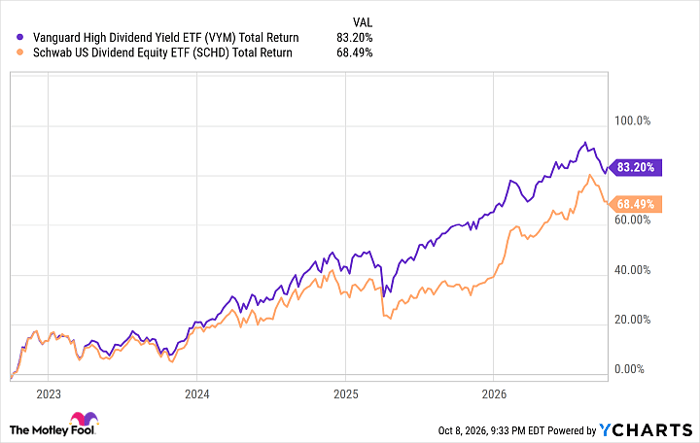
Thanks to these stocks' modest performance, this ETF's dividend yield remains just above 3%. While not thrilling for patient owners who were secretly hoping for more capital gains from their income-oriented investment, the slow-moving nature of this fund's underlying index has certainly kept its yield attractive to newcomers.
VYM Total Return Level data by YCharts
There's something else worth knowing here, though; something quietly bullish (particularly right now). That is, the Dow Jones U.S. Dividend 100™ Index is maintained as an equal-weight index, meaning each position's relative size is regularly updated so that no constituent makes up more or less of the index's value than another holding.
Between that and the fact that LSEG prioritizes a combination of higher yields along with fundamentals like strong free cash flow and return on equity, it's not surprising SCHD has underperformed for a while now. Investors have been wildly interested in the artificial intelligence names that don't offer much by those measures, at the expense of stocks that do.
Just bear in mind that everything market-related is cyclical. The names that aren't exactly in favor now will fall back into favor again sooner or later.
And the winner is...
There are no absolute right or wrong choices when it comes to picking stocks or funds. There are cases where either of these ETFs meets a specific need.
On balance, though, most income-seeking investors are arguably better served by Schwab's U.S. Dividend Equity ETF, and not just because it boasts the higher yield right now (although that certainly doesn't hurt the argument).
See, VYM is also highly exposed to the healthcare, financial, technology, and industrial sectors at this time, making it a bit more vulnerable to AI-led weakness. While SCHD's also got more healthcare exposure than anything else right now, significant stakes in consumer staples and energy stocks arguably leave it a little better protected from economic weakness and uncertainty.
Although both funds could struggle under the weight of sweeping selling pressure, Schwab's U.S. Dividend Equity ETF is more value-oriented and also more defensive. That could prove important here in the latter stages of the bull market, even if only modestly so. After all, the nickels and dimes still add up over time.
Should you buy stock in Schwab U.S. Dividend Equity ETF right now?
Before you buy stock in Schwab U.S. Dividend Equity ETF, consider this:
The Motley Fool Stock Advisor analyst team just identified what they believe are the 10 best stocks for investors to buy now… and Schwab U.S. Dividend Equity ETF wasn’t one of them. The 10 stocks that made the cut could produce monster returns in the coming years.
Consider when Netflix made this list on December 17, 2004... if you invested $1,000 at the time of our recommendation, you’d have $379,123!* Or when Nvidia made this list on April 15, 2005... if you invested $1,000 at the time of our recommendation, you’d have $1,408,822!*
Now, it’s worth noting Stock Advisor’s total average return is 950% — a market-crushing outperformance compared to 215% for the S&P 500. Don't miss the latest top 10 list, available with Stock Advisor, and join an investing community built by individual investors for individual investors.
See the 10 stocks »
*Stock Advisor returns as of October 12, 2026.
JPMorgan Chase is an advertising partner of Motley Fool Money. James Brumley has positions in Coca-Cola and Procter & Gamble. The Motley Fool has positions in and recommends Broadcom, JPMorgan Chase, Qualcomm, Texas Instruments, and Vanguard High Dividend Yield ETF. The Motley Fool recommends Johnson & Johnson and London Stock Exchange Group Plc. The Motley Fool has a disclosure policy.
Recommended Articles


