




Not Alphabet. Not Amazon. Microsoft Trades at Big Tech's Cheapest Valuation.
Key Points
Apple's AI investments have been relatively small.
Alphabet and Amazon are spending every dollar they can find to build AI infrastructure.
Microsoft is taking a more measured approach to its data center build-out.
- 10 stocks we like better than Microsoft ›
When big tech is mentioned, most of the time, the discussion is centered around four stocks: Apple (NASDAQ: AAPL), Alphabet (NASDAQ: GOOG) (NASDAQ: GOOGL), Microsoft (NASDAQ: MSFT), and Amazon (NASDAQ: AMZN). These four are the stalwarts that always seem to stick around, but that aren't so influenced by AI computing that they can be considered purely AI stocks, as a company like Nvidia may be.
These four stocks have gained reputations for being pricey, mainly due to their popularity and success. However, which is the cheapest? It's obviously not Apple, as it has a reputation (that it has earned) for being a very expensive stock. As of now, Microsoft is the cheapest stock of this cohort, and there's an interesting reason for that.
Missed AI’s "Act 1"? Act 2 Could Be 15x Bigger. Most investors think they missed the AI boat because they didn't buy Nvidia in 2005. But according to our analysts, we’re only at the end of "Act 1"—the R&D phase. "Act 2" is the global rollout. Continue »

Image source: Getty Images.
Microsoft has had a lackluster 2026
First, let's look at how relatively cheap Microsoft is. There are many ways to value stocks, but the most common way to value big tech players is by their price-to-earnings ratios. However, that isn't as useful a metric for Amazon and Alphabet right now because they have recently been enjoying huge gains on their investments in other companies. Even if they don't sell those shares and lock in those gains, they still have to report the price increases as profits. As a result, their earnings per share (EPS) metrics are out of whack.
To factor those non-business-related gains out of the calculation, investors can look at a line item a bit further up the financial statement: operating earnings.
From a price-to-operating-earnings standpoint, Microsoft is notably cheaper than Amazon or Alphabet. Apple is meaningfully more expensive than all three.
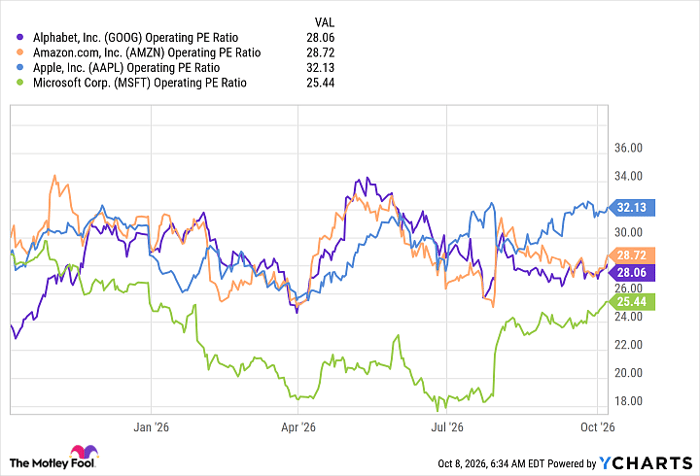
GOOG Operating PE Ratio data by YCharts.
Why does Microsoft trade at a discount to its peers? It all has to do with how each company is approaching AI.
The market has mixed opinions on AI
Apple really hasn't done much with AI compared to its peers. That could wind up looking like a genius strategy in retrospect, or it could prove a costly mistake. Apple has made a habit of arriving late to the party when new technologies are being developed, but when it finally does show up, it frequently brings a nearly perfect product.
AI technology may not have reached the point where Apple wants to deploy it on a widespread basis, which could be why it's being patient. Regardless, Apple's lack of AI participation, and in particular its decision not to build a massive fleet of AI data centers, has made its stock a haven for those who are wary of the AI bubble, so it has become quite popular from that perspective.
On the flip side, Alphabet and Amazon have gone all-in. They are spending every penny they can get their hands on to build more AI data centers for their cloud computing units. They see huge demand for cloud computing and are spending heavily to capture it. As a result, these two stocks have become attractive picks for investors who are bullish about AI.
Left in the middle is Microsoft. Microsoft, too, is spending heavily on AI, but not to quite the same degree as Amazon or Alphabet. Microsoft has budgeted for around $175 billion in capital expenditures this year, while Alphabet's and Amazon's capex bills will each top $200 billion. The market views Microsoft as not being all-in on AI, so it's not as bullish on its prospects. Furthermore, Microsoft's flagship AI product, Copilot, consistently lags the competition in AI proficiency scores. If it invests billions into an inferior product that fails, it will be an investment bust as well.
So, Microsoft's cheaper valuation stems from it not being as committed to AI as its peers. The market wants to see an all-in or all-out approach, and with Microsoft taking a more middle-ground approach, it's not as popular an investment.
Should you buy stock in Microsoft right now?
Before you buy stock in Microsoft, consider this:
The Motley Fool Stock Advisor analyst team just identified what they believe are the 10 best stocks for investors to buy now… and Microsoft wasn’t one of them. The 10 stocks that made the cut could produce monster returns in the coming years.
Consider when Netflix made this list on December 17, 2004... if you invested $1,000 at the time of our recommendation, you’d have $379,123!* Or when Nvidia made this list on April 15, 2005... if you invested $1,000 at the time of our recommendation, you’d have $1,408,822!*
Now, it’s worth noting Stock Advisor’s total average return is 950% — a market-crushing outperformance compared to 215% for the S&P 500. Don't miss the latest top 10 list, available with Stock Advisor, and join an investing community built by individual investors for individual investors.
See the 10 stocks »
*Stock Advisor returns as of October 11, 2026.
Keithen Drury has positions in Alphabet, Amazon, Microsoft, and Nvidia. The Motley Fool has positions in and recommends Alphabet, Amazon, Apple, Microsoft, and Nvidia. The Motley Fool has a disclosure policy.
Recommended Articles


