




Berkshire's Cash Pile Fell From $400 Billion to $365.5 Billion as Greg Abel Became a Net Buyer for the First Time in 3 Years. What Does That Signal for Investors?
Key Points
Berkshire has been stockpiling cash over the last few years.
New CEO Greg Abel has made several changes to the portfolio in 2026.
Despite the recent activity, Berkshire's buying has still been relatively modest.
- 10 stocks we like better than Alphabet ›
After 14 consecutive quarters as a net seller of equities, Berkshire Hathaway's (NYSE: BRKA) (NYSE: BRKB) cash reserves dropped from nearly $400 billion at the end of the first quarter to roughly $365 billion by June 30, marking a clear strategic pivot under new CEO Greg Abel.
During the second quarter, the investment conglomerate purchased about $23.5 billion in stocks while selling only $3.7 billion -- producing net buying activity of nearly $20 billion. These moves, combined with Berkshire's recent share repurchases and selective acquisitions, signal that the company's leadership finally sees some attractive opportunities after years of patience and cash accumulation.
Missed Nvidia in 2009? This Rare Signal Is Flashing Again. In 2009, a "Double Down" signal flashed for a little-known chipmaker called Nvidia. For the first time in years, that same "Total Conviction" signal is flashing for a company 1/100th the size of Nvidia. Continue »
Image source: The Motley Fool.
Breaking down Berkshire's portfolio
Earlier this year, Abel oversaw a significant cleanup of Berkshire's portfolio, trimming or exiting several smaller positions to concentrate capital in higher-conviction holdings. According to Berkshire's 13F filings, sales included substantial reductions in Bank of America, Capital One, Kroger, DaVita, Ally Financial, and Nucor, as well as complete exits from Constellation Brands and Amazon.
On the acquisition front, Berkshire closed its $9.7 billion purchase of Occidental Petroleum's chemicals business in January and completed the $6.8 billion all-cash acquisition of homebuilder Taylor Morrison last month.
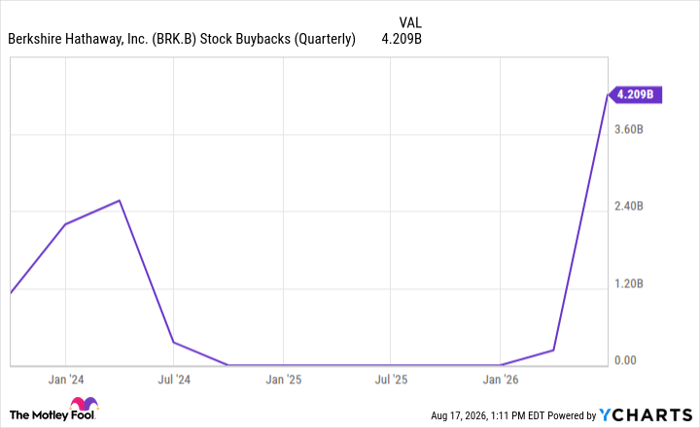
Share buybacks are also ramping up, totaling more than $4 billion during the second quarter alone. Taken together, these actions reduced Berkshire's cash pile while reallocating capital into both wholly owned businesses and public companies.
BRK.B Stock Buybacks (Quarterly) data by YCharts
Alphabet emerges as a magnificent holding
The new commitment that stands out in Berkshire's portfolio is Alphabet (NASDAQ: GOOGL) (NASDAQ: GOOG). Berkshire first established a position in the internet giant during the third quarter of 2025 and has steadily increased its exposure in 2026.
During the second quarter, Berkshire dramatically expanded its stake in Alphabet. A pivotal piece was executing a $10 billion private placement in June, split evenly between Alphabet's Class A and Class C share classes. The company made additional open-market purchases to further enlarge the position. What began as a modest foothold has swiftly become a core holding in the portfolio, reflecting conviction in Alphabet's long-term competitive advantages and growth trajectory.
How to interpret Abel's measured signal
Berkshire's reduction in cash and return to net equity buying do not signal a broad market bottom or an abrupt change in the company's investment philosophy. Remember, Berkshire still holds more than $360 billion in liquidity -- preserving its fortress balance sheet.
The recent buying activity suggests Abel and his leadership team have identified a specific value that outweighs the safety of short-term Treasuries. Alphabet's elevation to core status, alongside incremental acquisitions and stock buybacks, underscores a long-standing preference for durable competitive moats and reasonable valuations.
Ultimately, Berkshire's cash deployment indicates that Abel is prepared to put capital to work when the right opportunities emerge, while remaining characteristically disciplined about price and long-term appreciation.
Should you buy stock in Alphabet right now?
Before you buy stock in Alphabet, consider this:
The Motley Fool Stock Advisor analyst team just identified what they believe are the 10 best stocks for investors to buy now… and Alphabet wasn’t one of them. The 10 stocks that made the cut could produce monster returns in the coming years.
Consider when Netflix made this list on December 17, 2004... if you invested $1,000 at the time of our recommendation, you’d have $419,408!* Or when Nvidia made this list on April 15, 2005... if you invested $1,000 at the time of our recommendation, you’d have $1,348,694!*
Now, it’s worth noting Stock Advisor’s total average return is 966% — a market-crushing outperformance compared to 213% for the S&P 500. Don't miss the latest top 10 list, available with Stock Advisor, and join an investing community built by individual investors for individual investors.
See the 10 stocks »
*Stock Advisor returns as of August 19, 2026.
Bank of America is an advertising partner of Motley Fool Money. Ally is an advertising partner of Motley Fool Money. Adam Spatacco has positions in Alphabet and Amazon. The Motley Fool has positions in and recommends Alphabet, Amazon, and Berkshire Hathaway. The Motley Fool recommends Capital One Financial, Constellation Brands, Kroger, and Occidental Petroleum. The Motley Fool has a disclosure policy.
Recommended Articles


