




Nvidia Is on Track to Beat the S&P 500 for the 4th Straight Year. Should Its $500 Billion AI Infrastructure Financing Plan Give Investors Pause?
Key Points
Nvidia is using third-party capital to fund an AI infrastructure investable asset class.
The more customers that join Nvidia’s ecosystem, the greater the demand for its hardware and software.
Nvidia’s compute is transferable across customers, providing flexibility as clients' needs shift.
- 10 stocks we like better than Nvidia ›
Since the start of 2023, Nvidia (NASDAQ: NVDA) has given its shareholders a staggering 1,440% total return compared to a 113.2% total return for the S&P 500 (SNPINDEX: ^GSPC). As of market close on Aug. 14, Nvidia was the best-performing "Magnificent Seven" stock year to date and the only one outperforming the Nasdaq-100 -- putting the chipmaker on track to beat the S&P 500 for the fourth straight year.
Here's what investors need to know about Nvidia's latest collaboration with major financial institutions, the risks involved, and why the deals could help Nvidia remain a long-term compounder for years to come.
Missed Nvidia in 2009? This Rare Signal Is Flashing Again. In 2009, a "Double Down" signal flashed for a little-known chipmaker called Nvidia. For the first time in years, that same "Total Conviction" signal is flashing for a company 1/100th the size of Nvidia. Continue »
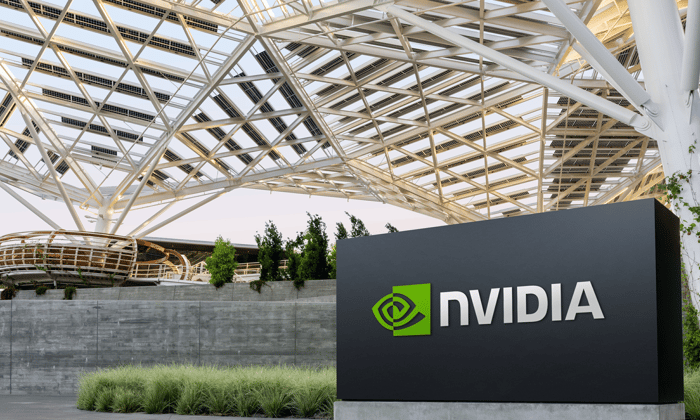
Image source: Nvidia.
Underwriting AI infrastructure
Nvidia is now so massive that it takes considerable earnings growth to move the needle -- specifically from its data center segment, which made up 92% of revenue in the first quarter of its fiscal 2027. It is heavily reliant on a handful of customers -- such as hyperscalers and the leading developers of artificial intelligence (AI) models -- to drive its earnings growth. That concentration is a double-edged sword. It is benefiting Nvidia right now because its key customers' AI capital expenditures continue to climb. But its results could take a significant hit even if one or two of those customers pull back on spending.
To broaden its customer base, Nvidia signed memorandums of understanding with BlackRock, Blackstone, KKR, Apollo Global Management, Brookfield, and Goldman Sachs to pull together $500 billion in long-term capital to fund the build-out of AI infrastructure. In an Aug. 10 interview on CNBC, Nvidia founder and CEO Jensen Huang estimated that each gigawatt (GW) of AI compute will cost between $50 billion and $60 billion, meaning the consortium is supporting the build-out of 10 GW of AI compute on the high end.
It remains to be seen whether the memorandums of understanding will translate into real deals and how the money will be raised. But in the CNBC interview, the group of financial partners signaled ample demand in both public and private markets.
The securitization of AI computing
At first glance, $500 billion in AI capital investment appears to be a massive win for Nvidia. The GPU leader won't bear the credit risk of the investment; the financial institutions will. The plan is to securitize AI infrastructure assets, much like how pools of mortgage loans are securitized into mortgage-backed securities. Since the assets all fall under Nvidia's ecosystem, the company's track record and brand power reinforce the credibility of the loans.
The deal essentially places AI infrastructure in the same category as other critical assets, such as electrical transmission lines, bridges, and roads. Financial institutions will raise the capital to turn Nvidia's compute and full-stack AI infrastructure into an investable asset class, owned by public and private investors. Then, that compute can be sold to AI labs, AI start-ups, AI clouds, and other enterprises that need compute.
Of course, selling that compute means little if the customers' cash flows dry up. But Nvidia is confident in the profitability pathway for its existing and potential customers. Jensen Huang said the following in the Aug. 10 interview with CNBC:
I believe within months you're going to realize that these companies are extremely profitable. These are the fastest-growing technology companies in history, and the tokens they're generating are incredibly profitable.
Tokens are basic units of text and data that AI models process. Nvidia prides itself on producing hardware that processes tokens as quickly and cost-effectively as possible. Huang stressed that every company and industry will be impacted by the digitalization of intelligence through AI and that the system architecture of the AI compute deal is flexible. Meaning that if one customer needed to scale back their commitments, it would be easy for a new customer to step in -- regardless of the model -- and use that compute in a similar vein as electricity on the grid that can be used interchangeably.
The fungibility of Nvidia's AI compute is arguably the strongest competitive advantage of the deal.
"There will always be a customer for that computing platform," said Huang during the Aug. 10 CNBC interview. "And the reason for that is because, as you know, Nvidia's architecture is fairly universally adopted. It runs every AI model."
Nvidia has plenty of room to run
Some investors may view the $500 billion AI financing news as a red flag because it resembles the kind of financial engineering that transformed a housing slowdown into a nationwide financial crisis in 2008. If public and private investors own securities tied to Nvidia AI infrastructure and demand for that infrastructure craters, those securities would lose value -- amplifying the impact of an AI slowdown.
There are plenty of unanswered questions around the structure of the financing deal. But I think the idea is absolutely brilliant for Nvidia.
If you've tuned in to Nvidia's major conferences (like GTC) or its recent earnings calls, you may have noticed an ongoing theme: Nvidia wants to expand beyond one-time hardware sales.
Nvidia is evolving into a product and service ecosystem rather than just a chip business. Its latest Vera Rubin rack-scale high-performance computing platform features GPUs, central processing units, and associated networking and interconnects. Its CUDA software stack is co-designed to work with Vera Rubin. The $500 billion deal helps solidify Nvidia as the most commonly used ecosystem for AI compute customers, which will depend on it to process tokens in the age of AI infrastructure. Token demand will increase in lockstep with the use of generative AI, AI agents, and physical AI (like self-driving cars and robotics) -- in turn benefiting Nvidia through an inferencing-as-a-service revenue stream.
The biggest risk to Nvidia's investment case is how it would endure a slowdown in spending on data center computing. And the best way to address that risk is for Nvidia to get more and more customers involved in its ecosystem, so they depend on its services and upgrade to its latest hardware when the cycle calls for it. It's basically the enterprise-scale version of what Apple does with its consumer electronics products and associated services -- like iCloud, Apple TV, and Apple Music.
Trading now at just 34.5 times earnings and 25.1 times forward earnings, Nvidia remains one of the best AI stocks for long-term investors to buy as the company continues to diversify its revenue streams beyond hyperscale hardware spending.
Should you buy stock in Nvidia right now?
Before you buy stock in Nvidia, consider this:
The Motley Fool Stock Advisor analyst team just identified what they believe are the 10 best stocks for investors to buy now… and Nvidia wasn’t one of them. The 10 stocks that made the cut could produce monster returns in the coming years.
Consider when Netflix made this list on December 17, 2004... if you invested $1,000 at the time of our recommendation, you’d have $409,970!* Or when Nvidia made this list on April 15, 2005... if you invested $1,000 at the time of our recommendation, you’d have $1,381,040!*
Now, it’s worth noting Stock Advisor’s total average return is 969% — a market-crushing outperformance compared to 215% for the S&P 500. Don't miss the latest top 10 list, available with Stock Advisor, and join an investing community built by individual investors for individual investors.
See the 10 stocks »
*Stock Advisor returns as of August 18, 2026.
Daniel Foelber has positions in Apollo Global Management, Blackstone, and Nvidia and has the following options: short August 2026 $240 calls on Nvidia. The Motley Fool has positions in and recommends Apple, BlackRock, Blackstone, Brookfield Corporation, Goldman Sachs Group, KKR, and Nvidia. The Motley Fool has a disclosure policy.
Recommended Articles


