




Applied Materials Beat Q3: Advanced Packaging +70%, HBM Momentum, $555 Caps Recovery Into Jackson Hole
TradingKey - On August 14, Applied Materials (AMAT) released an impressive third fiscal quarter report. An immediate, fundamental question was raised: why did the stock drop 5% when the numbers were undeniably positive? Total revenue of $9.115 billion exceeded the expectation and set a record for the company’s strongest sequential revenue growth. Growth in adjusted EPS was 41% year over year at $3.50. The company’s gross margin also improved and stood at 50.4%. The expectations for the growth of advanced packaging were more optimistic, shifting from over 50% to over 70% growth for the calendar year of 2026.
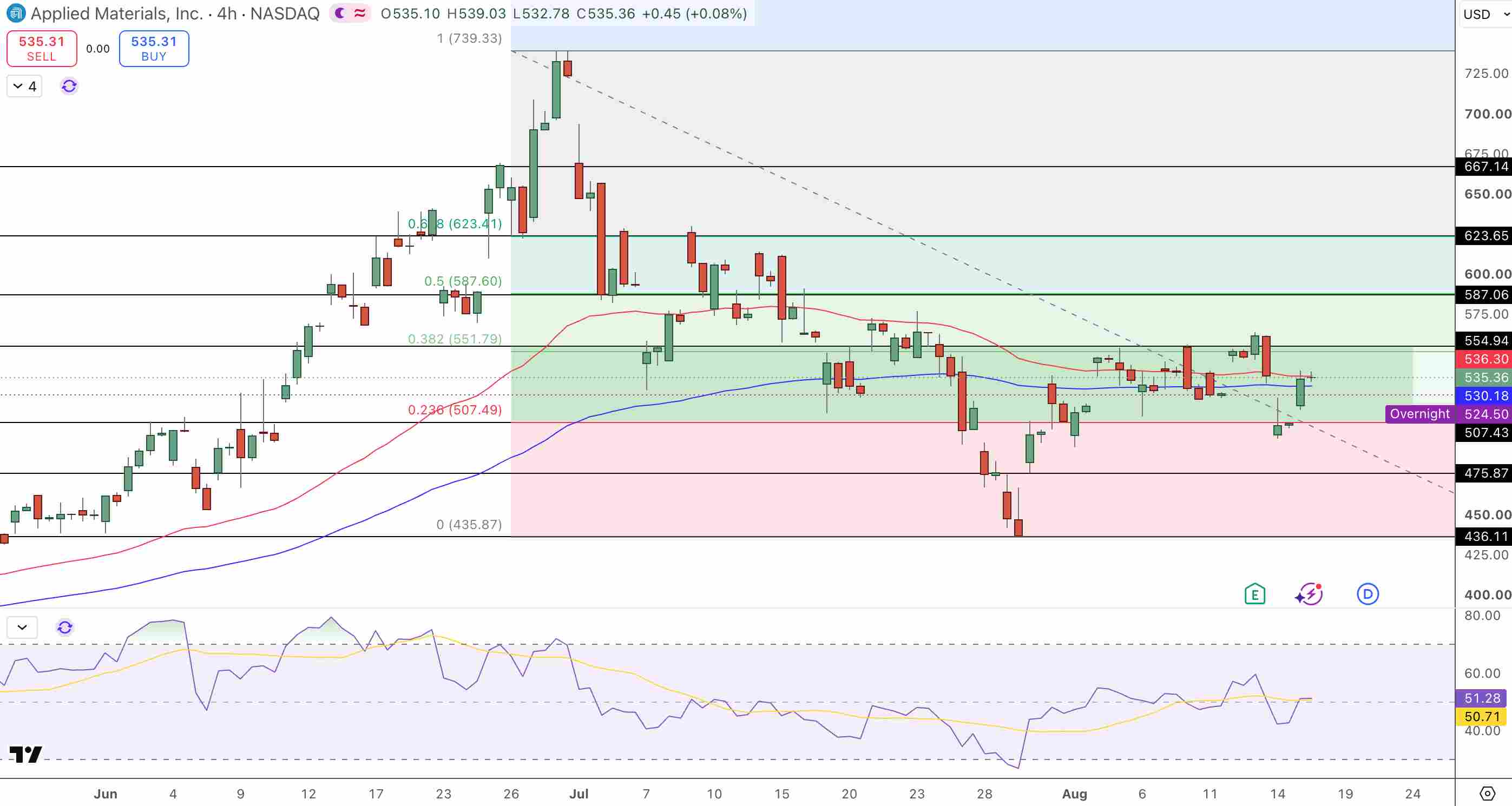
Management set a rough target of $10.25 billion with a range of $500 million for Q4 revenue, which is well over the consensus estimate of $9.54 billion. This caused AMAT to sell off even harder, and caused investors to suspect that Applied was compared to even more positive earnings by Lam Research, KLA and ASML, and that investors may have over speculated the near future positive margin expansion. The drop took AMAT down to around $535 where it consolidated between support of $507 and resistance of $555.
For the rest of August, the focus will be on Jackson Hole (August 21-22). This will decide whether the consolidation moves upward to $587-623 or reverses back into the support and resistance range. The question remains the same for investors, was the selling on August 14 simply resetting expectations and creating an actual buying opportunity, or has the bullishness surrounding the AI equipment cycle already reflected in Applied Materials?
Q3 Delivered Record Revenue: 25% YoY Growth with Strongest Sequential Increase Ever
Applied Materials reported an increase of 25% to $9.115 billion attributable to revenue for the fiscal Q3 that closed on December 31, 2026. This, in turn, encouraged Applied Materials to post its best revenue growth in history. Adjusted GAAP EPS was $3.50, an increase of 41% year over year. GAAP EPS was $3.17, a 43% increase year over year, while GAAP net income was $2.54 billion, an increase of 43% year over year.
Adjusted operating margin expanded to 34.0% from 33.7%, GAAP gross margin improved to 50.3% from 48.8%, and adjusted gross margin was 50.4%. Cash from operations was a record $3.04 billion, and adjusted free cash flow was $2.33 billion, an increase of 14% year over year.
The best part of the report is the Earnings Quality. Especially given the difficult comparable in Q3 last year.
Advanced Packaging Outlook Raised to +70%: The Most Important Signal in the Report
Reuters informs us that management has raised its outlook on the advanced packaging business to more than 70% growth this year, from the prior outlook for growth in the range of over 50%. This positive surprise contains the strongest high-level fundamental signal in the report.
Why? AI chips integrate multiple components through advanced packaging. Packaging is crucial and will significantly impact system performance. Hybrid bonding, chiplets, and higher-layer HBM stacking are adopted by more and more customers. Applied sees that as a market opportunity.
To address this market opportunity, Applied recently released some new platforms. First, Producer Avila 2 is for manufacturing even thinner DRAM dies for higher-stack (12-, 16-, and more) HBM. Next, Nokota, VMax 2 is for more advanced copper plating for 3D stacking. Lastly, the Quad CMP and eBeam inspection systems are for more advanced packaging. Broadcom also joined the EPIC Center with an advanced packaging focus. This brings Applied even closer to chip designers through the packaging supply chain and more integrated packaging solutions for AI.
HBM Is Becoming Critical: DRAM Rose to 26% of Semiconductor Systems Revenue
AI-related activities at Applied continue to engage higher levels of memory. In Q3, DRAM accounted for 26% of revenue from Semiconductor Systems, compared to 22% in the previous year. Logic, foundry, and microelectronic products accounted for 67%, and Flash accounted for 7%.
The increase in DRAM exposure was attributable to the strong demand for high-bandwidth memory (HBM). Along with AI accelerators, HBM requires a vertically stacked memory architecture composed of several DRAM dies that are connected through via-fill (thru-silicon) and bonded with high precision. Each additional layer of HBM requires more manufacturing steps that Applied is capable of pricing.
The key assumption is that AI both complicates and increases the demand for semiconductors. More layers of HBM, as well as increased complexity of memory transistors, hybrid bonding, and advanced packaging, create even more manufacturing steps.
Semiconductor Systems Division Generating Extraordinary Operating Leverage
The Semiconductor Systems division grew revenue 27% to $7.04 billion from $5.56 billion in the previous year. Gross margin improved to 55.3%, and operating margin grew even more significantly to 37.7% from 33.0%. Operating income also improved to $2.67 billion.
Applied Global Services also improved significantly. Revenue increased to $1.78 billion from $1.46 billion with an improvement in operating margin of 30.1% from 27.3%. Services provide an additional level of stability.
After equipment is placed in a fab, Applied charges various services for the equipment at a fab through maintenance contracts and the sale of software and productivity-enhancing additions and upgrades to the equipment. AI boosts the importance of time-on and yield in semiconductor fabrication because the fabrication process is expensive and complicated.
Q4 Guidance Signals Continued Momentum: $10.25B ±$500M Revenue, $4.02 EPS
Of the numbers reported for Q4, the outlook is the strongest. Applied previously set a revenue target for FY 2022 between $10.25 billion and $500 million, which was better than the $9.54 billion estimate consensus prior to the earnings report. The target for adjusted EPS is $4.02 and $0.20. Approximating these numbers, the 12.5% sequential growth from Q3 to Q4 is significant as the reported revenue levels approach $9 billion.
Management said anecdotal evidence for demand increased for the period. Challenged customers of the company who have limited space in a cleanroom, the section of the lab where the most sensitive work occurs, are deploying methods to overcome this constraint and are placing more frequent tool demands.
More importantly, Applied's significant customers are now giving them demand forecasts for the next eight quarters, giving substantial visibility to 2027, and even beyond for some significant capital expenditures, to the end of the current decade. The reason is structural: there is still a large imbalance in demand and supply for sophisticated AI chips.
AMAT Technical Setup: $507 Support Holds, $555 Resistance Is The Breakout Target
On the 4-hour chart, AMAT made a recovery and is currently sideways between $535 and $555. The recovery level has moved AMAT up and above the $507.49 level, adding weight to the 23.6% Fibonacci retracement level. The market has $530-$535 along with $554.94 as the key levels to watch until the market resolves this consolidation.
Applied Materials Price Chart - Source: Tradingview
Neutral momentum is supported by a recovery level moving the market back toward $555, along with the $555 horizontal resistance level and the 38.2% Fibonacci retracement level. This level may act as a solid resistance and reverse the recovery. A break below the combination of Fibonacci levels and horizontal support, $507.49, has potential to extend the selling toward the $475.87 level.
The main levels for AMAT leading up to the Jackson Hole conference are centered on the $555 level and the 38.2% Fibonacci retracement level. This level may provide a breakout opportunity and extended selling into the $587.06 level. A break below $507.49 may provide the potential to sell toward the $475.87 support level.
Why Did AMAT Sell Off 5% on Record Earnings?
APLD fell by 5% on August 14 despite a positive earnings report and upward revision to its guidance. APLD's peers, ASML, Lam, and KLA, also released positive results. According to some analysts, guidance for Applied's adjusted gross margin of 50.4% in Q4, while still higher than last year, represents a flat sequential margin. This, along with an expected significant increase in revenue, has prompted some of Applied's clients to expect margin expansion.
Bottom Line
Applied Materials Q3 Sales = $9.12B (record, +25% YoY, record sequential), +$3.50 EPS (+41%), 50.4% margin, $2.33B. Adjusted FCF. Advanced Packaging guidance for 2026 at +70%. HBM/DRAM Account for ~26% of SemiSys Revenue. Q4 guide = $10.25B +/- $500M. Continued acceleration. 8 quarters of customer visibility into 2027.
Technical: AMAT $535 retesting support $507, resistance $555. RSI = 51. Potential breakout to $587-$623. Selloff on August 14 most likely expectations reset, not a negative event. Jackson Hole (August 21-22) will determine if the capex narrative holds.
For Investors: The sell off on August 14th appears to be an adjustment of expectations vs a decline in fundamentals. The primary question is whether or not Applied can hit $10.25B in revenue for Q4 while keeping gross margin at 50%. That likely will determine if the goal of $2.5B in revenue growth for 2027 can be achieved. The most recent data points to this interpretation being correct. Spending on AI infrastructure continues to move upstream to the semiconductor manufacturing budget.
Recommended Articles


