




Fed Chair Kevin Warsh Has Inherited His Predecessor's Trump Problem, and There's No Easy Fix
Key Points
Kevin Warsh officially succeeded Jerome Powell as Fed chair on May 22.
The new Fed chair finds himself in a no-win scenario with interest rates.
The evolution of Trumpflation makes it likelier that Warsh will draw the ire of President Donald Trump and/or Wall Street over the next year.
- 10 stocks we like better than S&P 500 Index ›
Nearly three months ago, on May 22, Kevin Warsh, President Donald Trump's handpicked successor to Jerome Powell, was sworn in as the new Fed chair. Although the Dow Jones Industrial Average (DJINDICES: ^DJI), S&P 500 (SNPINDEX: ^GSPC), and Nasdaq Composite (NASDAQINDEX: ^IXIC) have rallied to new highs since Warsh took the reins, things are anything but picture-perfect for the new head of the Fed.
In the year leading up to Powell's departure as Fed chair, he faced constant criticism from President Trump over the Federal Open Market Committee's (FOMC) unwillingness to slash interest rates. While the criticisms directed at Warsh haven't been nearly as sharp in his early tenure, it's become increasingly evident that the new Fed chair has inherited his predecessor's Trump problem.
Missed Nvidia in 2009? This Rare Signal Is Flashing Again. In 2009, a "Double Down" signal flashed for a little-known chipmaker called Nvidia. For the first time in years, that same "Total Conviction" signal is flashing for a company 1/100th the size of Nvidia. Continue »

President Trump has been critical of the FOMC's handling of interest rates. Image source: Official White House Photo by Daniel Torok.
Kevin Warsh finds himself in a no-win scenario
Although it's perfectly normal for investors to be on edge as a new Fed chair takes the reins, Warsh is quickly discovering that there's no way to appease all parties on Wall Street.
On the one hand, above-average inflation would seem to merit a reaction. Trailing 12-month (TTM) headline inflation clocked in at 3.4% in July, marking the 65th consecutive month that the U.S. inflation rate has been above the Federal Reserve's long-term target of 2%.
65.
-- Charlie Bilello (@charliebilello) August 12, 2026
As in 65 consecutive months with US inflation above the Fed's 2% target.
The Fed has lost all credibility when it comes to fighting inflation. pic.twitter.com/WErvde2rue
But the second-priciest stock market in history is unlikely to be happy with a rate hike. Higher lending costs could slow the artificial intelligence data center build-out and contract historically high valuation multiples.
At the other end of the spectrum, President Trump has opined that interest rates should be cut to 1% or lower. If the FOMC raises interest rates, it and Warsh will almost certainly draw the public ire of the president. Yet if Warsh and the FOMC don't take action amid a significant jump in TTM inflation, they may be viewed as capitulating to Trump's demands and lose credibility with Wall Street and investors.
No matter what Fed Chair Warsh and the FOMC do, it won't appease everyone.
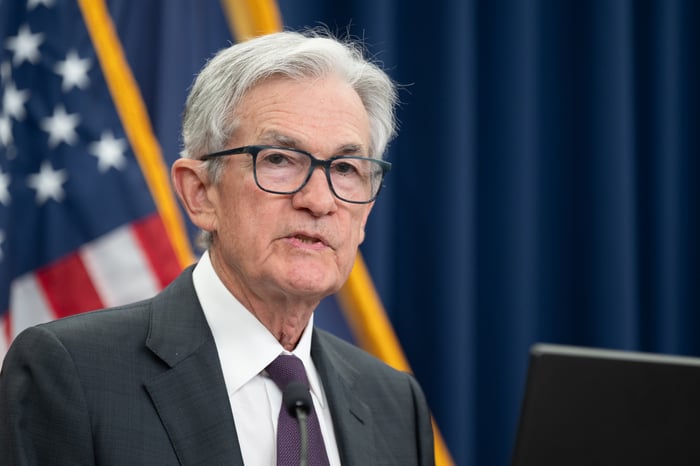
Former Fed Chair Jerome Powell was no stranger to criticism from President Trump. Image source: Official Federal Reserve Photo.
The new Fed chair also inherited the evolution of Trumpflation
Additionally, Warsh inherited the evolution of Trumpflation from his predecessor.
During Powell's tenure, he frequently cited Trump's tariffs as a catalyst for elevated prices in the goods sector. Recently, the Trump administration implemented sweeping global tariffs, ranging from 10% to 12.5%, on more than 80 countries.
There's also the Iran war, which began during the final months of Powell's second term as Fed chair. But while Powell primarily dealt with the effects of a historic energy supply shock caused by the closure of the Strait of Hormuz, Warsh is overseeing the evolution of Trumpflation.
BREAKING: US June PCE inflation, the Fed's preferred inflation metric, falls to 3.7%, in-line with expectations.
-- The Kobeissi Letter (@KobeissiLetter) July 30, 2026
Core PCE inflation fell to 3.3%, the second highest reading since October 2024.
US inflation continues to run at nearly double the Fed's 2% target.
Specifically, the Iran war is no longer just an energy story. The impacts of this war on transportation costs, supply chains, and other factors have extended to the broader economy. It's considerably more challenging for FOMC policymakers to combat entrenched inflation than it is to tackle short-lived energy supply problems.
With "price stability" the clear top priority of America's foremost financial institution, it feels inevitable that Fed Chair Kevin Warsh will draw the ire of Wall Street and President Trump at some point over the next year.
Should you buy stock in S&P 500 Index right now?
Before you buy stock in S&P 500 Index, consider this:
The Motley Fool Stock Advisor analyst team just identified what they believe are the 10 best stocks for investors to buy now… and S&P 500 Index wasn’t one of them. The 10 stocks that made the cut could produce monster returns in the coming years.
Consider when Netflix made this list on December 17, 2004... if you invested $1,000 at the time of our recommendation, you’d have $421,511!* Or when Nvidia made this list on April 15, 2005... if you invested $1,000 at the time of our recommendation, you’d have $1,381,960!*
Now, it’s worth noting Stock Advisor’s total average return is 981% — a market-crushing outperformance compared to 216% for the S&P 500. Don't miss the latest top 10 list, available with Stock Advisor, and join an investing community built by individual investors for individual investors.
See the 10 stocks »
*Stock Advisor returns as of August 18, 2026.
Sean Williams has no position in any of the stocks mentioned. The Motley Fool has no position in any of the stocks mentioned. The Motley Fool has a disclosure policy.
Recommended Articles


