




Nvidia Partners With Six Wall Street Giants to Raise $500 Billion, Reigniting 'Circular Financing' Concerns?
TradingKey - Nvidia (NVDA) is trying to open a new financing channel for AI infrastructure.
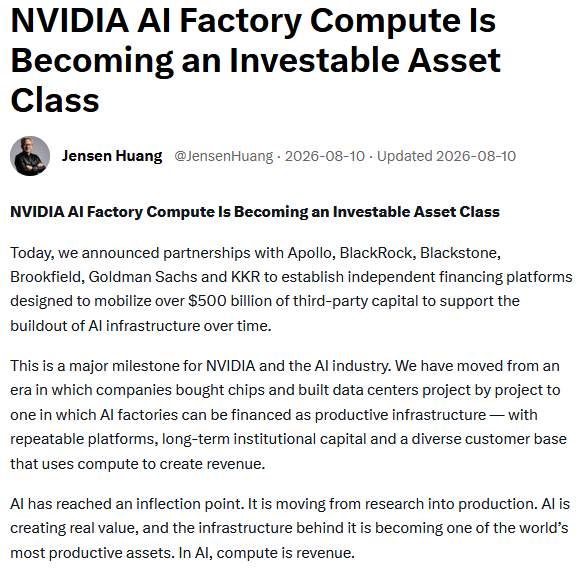
On August 10, local time, Nvidia announced the signing of a memorandum of understanding with Apollo Global Management, Blackstone, BlackRock, Brookfield Asset Management, Goldman Sachs, and KKR. The parties plan to establish dedicated financing platforms to mobilize over $500 billion in third-party capital as projects progress to support AI infrastructure development.
This initiative does not involve Nvidia directly providing $500 billion in funds. Instead, it seeks to leverage the capital and underwriting capabilities of six major asset management and financial institutions to provide financing for Nvidia's customers to build data centers, procure GPUs, and expand computing capacity.
Nvidia Chief Executive Officer Jensen Huang stated that these funds will come entirely from third-party capital, and the related platforms will provide long-term financial support for AI infrastructure projects on competitive financing terms.
Source: X
Currently, the specific scale, timeline, and deal structures of the financing are still being finalized. According to people familiar with the matter, some transactions may utilize asset-backed debt financing based on computing capacity, including private debt and bonds issued by special purpose entities. Individual deal sizes could reach billions of dollars, with the raised funds subsequently used to construct data centers and procure compute capacity, generating revenue by leasing compute capacity to customers such as AI enterprises and cloud service providers.
Why Nvidia Is Pushing for $500 Billion in Financing
Over the past few years, AI infrastructure investment has expanded rapidly, with major tech companies continuously increasing capital expenditures on data centers, GPUs, power, and networking facilities. Morgan Stanley previously estimated that related spending by hyperscale data center operators could reach trillions of dollars between 2026 and 2028.
Such massive capital requirements have exceeded what can be met solely through corporate operating cash flow. In addition to issuing equity and corporate bonds, tech companies have also begun using private credit, asset securitization, and project finance more frequently to raise funds.
Nvidia aims to play a more active role in this process.
In the past, Nvidia generated revenue primarily by selling GPUs and related systems, whereas this financing initiative extends further downstream in the industry chain. By bringing in banks, private capital, and long-term institutional funds, Nvidia hopes to help customers address the funding needed to purchase GPUs and build data centers, thereby accelerating the pace of computing infrastructure construction.
Jensen Huang has called this model a new stage in AI infrastructure financing. He believes that AI computing equipment should not be viewed merely as fast-depreciating electronics, but can instead become productive assets akin to power, telecommunications, and transportation infrastructure.
"We started by making chips, and today we are helping build a new type of infrastructure," Huang said, adding that AI factories can generate revenue by continuously providing computing power, thus establishing the foundation to become long-term investment assets.
Why Jensen Huang Thinks GPUs Can Become 'Investment-Grade Assets'
At the core of Nvidia's plan is changing how financial institutions traditionally view the value of GPUs.
In the past, GPUs were generally seen as iterating rapidly, with the market value of older products potentially declining quickly as newer generations of chips were launched. Consequently, it was difficult for financial institutions to provide long-term financing for GPUs in the same way they evaluate real estate, toll roads, or other long-term infrastructure.
Jensen Huang, however, believes that AI computing power is undergoing a shift.
He pointed out that an AI factory does not consist solely of GPUs, but is rather a complete platform that includes accelerated computing, networking, system software, AI frameworks, and a developer ecosystem.
Given Nvidia's broad customer base, when a specific customer's needs change, the corresponding computing capacity can theoretically be redirected to other enterprises, cloud service providers, or even operators in different regions.
This means that when financial institutions evaluate these assets, they can focus on their capacity to generate future cash flows rather than just the residual value of the chips themselves.
Huang also cited the A100 as an example, which was launched in 2020 and is still used today for AI training, inference, fine-tuning, and high-performance computing. He argued that as CUDA software continually improves the performance and efficiency of older hardware, the economic lifespan of certain AI computing equipment could be significantly longer than that of traditional electronics.
Nvidia also points to prices in the GPU rental market as evidence supporting this logic; Huang cited market data showing that rental prices for high-end GPUs like the H100 have continued to rise in recent years, while the newer Blackwell series commands a distinct premium in the cloud market.
From Nvidia's perspective, if GPUs can generate rental income continuously over a prolonged period, such computing assets qualify for long-term debt financing.
Nvidia 'Circular Financing' Doubts Persist
However, the $500 billion financing plan has also sparked market debate regarding circular funding within the AI supply chain.
Over recent months, Nvidia has signed large-scale investment and partnership agreements with multiple AI companies, while some of these AI firms have used the raised capital to purchase Nvidia chips. This interconnected model between capital, chips, and computing power has raised concerns among some investors that demand within the AI supply chain may be somewhat circular.
Nvidia's direct collaboration with major financial institutions to build a financing platform has brought this issue back into the market spotlight.
Following the news, Nvidia closed down about 2.8% on Monday, wiping out over $70 billion in market value in a single day.
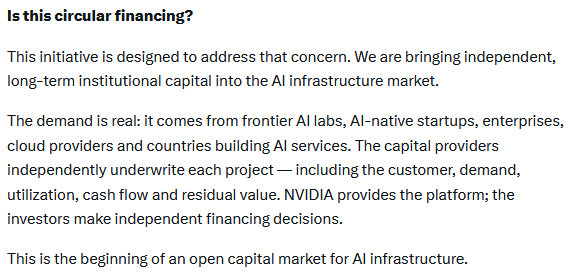
However, Jensen Huang explicitly denied that this model implies artificially manufacturing AI demand. He emphasized that every project on the financing platform will be independently evaluated by financial institutions, considering factors such as customer qualifications, actual computing power demand, utilization rates, cash flow, and residual asset value.
Source: X
In other words, Nvidia provides a computing platform and ecosystem, rather than deciding for financial institutions which projects should receive financing.
Jensen Huang also revealed that in certain projects, Nvidia may provide residual value support of up to about 25%, but such arrangements will be evaluated on a project-by-project basis. He emphasized that this mechanism does not replace the financial institutions' own due diligence.
Recommended Articles


